
Electric Vehicle Market Overview
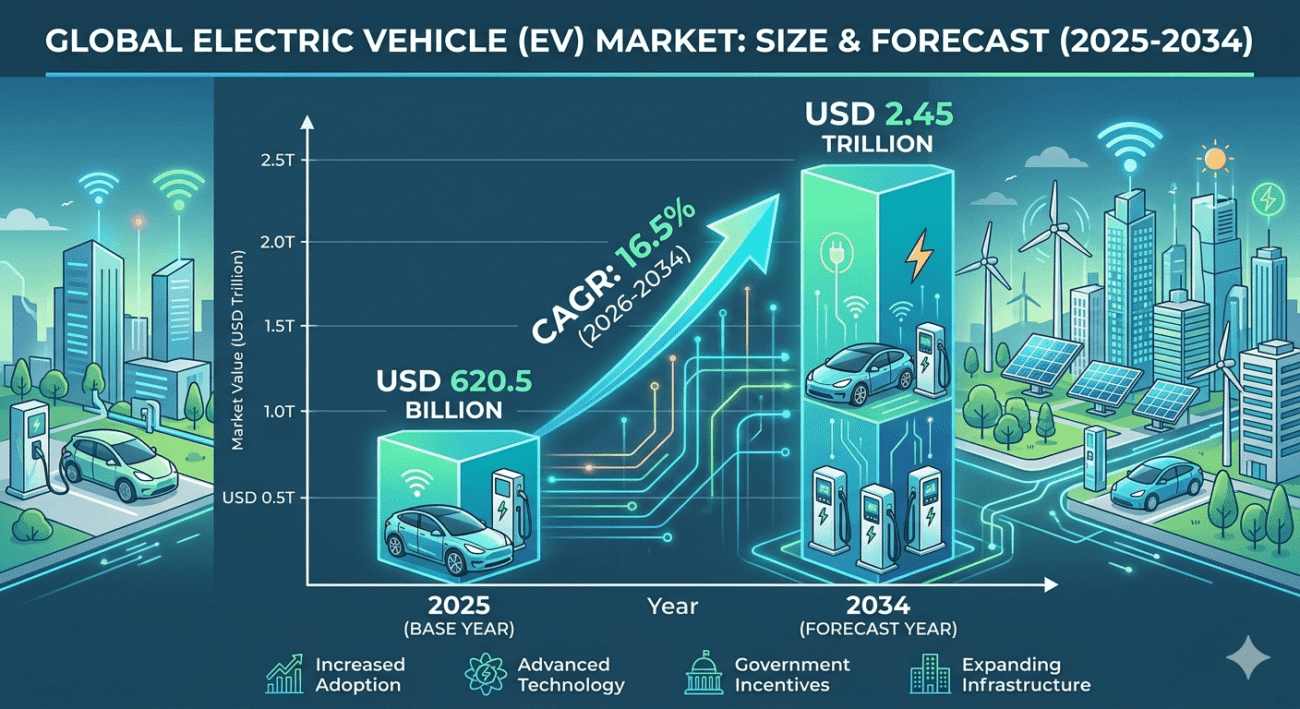
The global Electric Vehicle Market was valued at approximately USD 620.5 billion in 2025 and is projected to reach nearly USD 2.45 trillion by 2034, expanding at a Compound Annual Growth Rate (CAGR) of 16.5% during the forecast period from 2026 to 2034.
The global Electric Vehicle (EV) Market has witnessed remarkable growth in recent years due to increasing environmental concerns, rising fuel prices, and supportive government policies promoting clean transportation solutions. Electric vehicles are powered either fully or partially by electricity and are considered an environmentally friendly alternative to traditional internal combustion engine (ICE) vehicles. The market includes battery electric vehicles (BEVs), plug-in hybrid electric vehicles (PHEVs), and hybrid electric vehicles (HEVs), covering passenger cars, commercial vehicles, buses, and two-wheelers.
The growing awareness regarding climate change and carbon emissions has significantly accelerated the adoption of electric vehicles worldwide. Governments across developed and emerging economies are implementing stringent emission regulations and introducing subsidies, tax incentives, and financial support programs to encourage EV adoption. These initiatives are helping consumers and businesses transition toward sustainable transportation solutions.
Technological advancements in battery technology have played a major role in the expansion of the electric vehicle market. Lithium-ion batteries have become more efficient, offering improved energy density, longer driving ranges, and reduced charging times. Continuous investments in research and development are further enhancing battery performance while reducing production costs. As battery prices decline, electric vehicles are becoming more affordable and accessible to a broader consumer base.
The automotive industry is undergoing a major transformation as leading manufacturers increasingly invest in electric mobility solutions. Automotive companies are launching new electric vehicle models with advanced features such as connected car technologies, autonomous driving systems, smart infotainment, and advanced driver assistance systems (ADAS). The competition among manufacturers is driving innovation and improving vehicle performance, safety, and efficiency.
The rise of charging infrastructure development is also supporting market growth. Public and private organizations are investing heavily in charging networks to address range anxiety and improve charging accessibility. Fast-charging stations, ultra-fast charging technologies, and home charging solutions are becoming more widely available, encouraging consumers to adopt electric vehicles with greater confidence.
Consumer demand for fuel-efficient and low-maintenance vehicles is further boosting the EV market. Electric vehicles have fewer moving parts compared to traditional vehicles, resulting in lower maintenance costs and improved operational efficiency. Additionally, rising gasoline and diesel prices are encouraging consumers to shift toward electric mobility as a cost-effective transportation alternative.
The passenger electric vehicle segment currently dominates the market due to growing consumer preference for eco-friendly personal transportation. However, electric commercial vehicles and electric buses are also witnessing substantial growth because of increasing government investments in sustainable public transportation systems and zero-emission logistics operations.
Asia-Pacific represents the largest regional market for electric vehicles, led by countries such as China, Japan, and South Korea. China dominates global EV production and sales due to strong government support, extensive charging infrastructure, and large-scale battery manufacturing capabilities. Europe and North America are also major markets driven by environmental regulations and increasing consumer awareness regarding sustainable mobility.
The electric vehicle market is highly competitive, with established automotive manufacturers, technology companies, and emerging EV startups competing through innovation and strategic partnerships. Companies are focusing on expanding production capacity, improving battery technologies, and strengthening charging infrastructure networks to maintain competitive advantages in the rapidly evolving market landscape.
Despite strong growth prospects, the market faces challenges such as high initial vehicle costs, limited charging infrastructure in some regions, and raw material supply concerns. However, continuous technological advancements, supportive government initiatives, and increasing environmental awareness are expected to drive substantial market growth during the forecast period.
Key Electric Vehicle Market Trends
The electric vehicle market is experiencing several transformative trends that are reshaping the global automotive industry. One of the most prominent trends is the rapid growth of battery electric vehicles (BEVs). Consumers and businesses are increasingly adopting fully electric vehicles due to their zero-emission capabilities, lower operating costs, and government incentives. Automotive manufacturers are expanding their electric vehicle portfolios to meet rising consumer demand and strengthen their market presence.
The advancement of battery technology is another major trend influencing the electric vehicle market. Manufacturers are investing heavily in next-generation battery technologies such as solid-state batteries, which offer higher energy density, faster charging times, and improved safety compared to traditional lithium-ion batteries. Battery recycling and second-life battery applications are also gaining importance as the industry focuses on sustainability and resource optimization.
Charging infrastructure expansion is becoming a critical trend supporting EV adoption. Governments and private companies are rapidly increasing investments in public charging stations, fast chargers, and ultra-fast charging networks. The availability of widespread charging infrastructure is helping reduce range anxiety among consumers and improving the convenience of electric vehicle ownership.
Connected and smart vehicle technologies are increasingly integrated into electric vehicles. Modern EVs are equipped with advanced connectivity features, over-the-air software updates, AI-based navigation systems, remote diagnostics, and smartphone integration. These technologies enhance user experience, improve vehicle performance, and enable predictive maintenance capabilities.
Autonomous driving technology is also emerging as an important trend in the EV market. Several automotive companies are developing self-driving electric vehicles equipped with sensors, cameras, radar systems, and artificial intelligence. Autonomous EVs have the potential to improve road safety, optimize traffic management, and reduce transportation costs in the future.
The growing popularity of electric commercial vehicles is another significant market trend. Logistics companies, delivery service providers, and public transportation agencies are increasingly adopting electric vans, trucks, and buses to reduce operational costs and comply with environmental regulations. E-commerce growth is further accelerating demand for electric delivery vehicles used in last-mile transportation operations.
Government regulations and sustainability goals are strongly influencing market trends. Many countries have announced plans to phase out internal combustion engine vehicles and promote electric mobility through incentives, emission standards, and infrastructure investments. Carbon neutrality goals and climate change mitigation strategies are accelerating the transition toward sustainable transportation systems.
The rise of vehicle-to-grid (V2G) technology is creating new opportunities within the electric vehicle market. V2G systems allow electric vehicles to store energy and supply electricity back to the grid during peak demand periods. This technology can improve grid stability, optimize energy management, and support renewable energy integration.
Battery leasing and subscription-based EV ownership models are becoming increasingly popular. These flexible ownership options help reduce the high upfront cost of electric vehicles and make EV adoption more accessible to consumers. Mobility-as-a-service (MaaS) platforms and electric vehicle sharing services are also gaining traction in urban transportation systems.
Another key trend is the increasing use of renewable energy in EV charging infrastructure. Solar-powered charging stations and renewable energy integration are helping reduce the environmental impact of electric vehicle charging operations. As sustainability becomes a central focus, renewable-powered charging networks are expected to expand significantly in the coming years.
Strategic collaborations between automotive manufacturers, battery producers, technology companies, and charging infrastructure providers are also shaping the market. These partnerships aim to accelerate innovation, improve battery supply chains, and enhance charging network availability. The combination of technological advancement and sustainability initiatives continues to drive major changes across the electric vehicle market.
Key Electric Vehicle Market Key Restraints
Despite the strong growth potential of the electric vehicle market, several restraints continue to limit widespread adoption and market expansion. One of the most significant challenges is the high initial cost of electric vehicles compared to conventional gasoline and diesel-powered vehicles. Although battery prices have gradually declined, EVs still require expensive battery systems, advanced electronics, and specialized manufacturing processes, making them less affordable for price-sensitive consumers.
Limited charging infrastructure remains a major obstacle in many regions. While developed countries are rapidly expanding charging networks, several developing economies still lack sufficient public charging stations and fast-charging facilities. Consumers often face concerns related to charging accessibility, particularly in rural and remote areas where charging infrastructure is limited.
Range anxiety is another key restraint affecting consumer confidence in electric vehicles. Many consumers worry about the limited driving range of EVs and the possibility of running out of battery power during long-distance travel. Although battery technologies are improving, concerns regarding driving range and charging availability continue to influence purchasing decisions.
Long charging times compared to traditional fuel refueling also present challenges for EV adoption. Even with fast-charging technologies, charging an electric vehicle typically takes longer than refueling a conventional vehicle with gasoline or diesel. This issue can reduce convenience for consumers and commercial fleet operators requiring continuous vehicle operation.
The supply chain dependency on critical raw materials such as lithium, cobalt, nickel, and rare earth elements poses another significant market restraint. These materials are essential for battery manufacturing, and supply shortages or price fluctuations can increase battery production costs. Geopolitical tensions and mining-related environmental concerns may further impact raw material availability.
Battery degradation and replacement costs remain concerns for many electric vehicle owners. Over time, EV batteries lose their energy storage capacity, reducing vehicle performance and driving range. Replacing battery packs can be expensive, creating long-term ownership concerns for consumers and businesses.
The lack of standardization in charging systems and connectors can also create operational challenges. Different automotive manufacturers and charging network providers often use varying charging technologies and connector standards, making compatibility difficult in some cases. This fragmentation may limit charging convenience and slow market adoption.
Electric vehicle production requires substantial investments in manufacturing infrastructure, battery plants, and research and development activities. Automotive companies transitioning from internal combustion engine production to EV manufacturing face high capital expenditure requirements. Smaller manufacturers may struggle to compete with larger companies possessing stronger financial resources and established supply chains.
Grid capacity and electricity demand concerns are becoming increasingly important as EV adoption rises. Large-scale charging of electric vehicles can place significant pressure on electricity grids, particularly during peak demand periods. Inadequate grid infrastructure may limit the ability of some regions to support widespread EV adoption without major infrastructure upgrades.
Consumer awareness and perception challenges also affect market growth. Some consumers remain uncertain about EV reliability, battery lifespan, resale value, and maintenance requirements. Misconceptions regarding electric vehicle performance and charging convenience can slow adoption rates in certain markets.
Economic uncertainty and inflationary pressures may further impact electric vehicle demand. Rising interest rates, reduced consumer spending, and economic slowdowns can affect vehicle purchasing decisions. In addition, government incentives and subsidies play a major role in EV affordability, and changes in policy support may influence future market growth.
Lastly, environmental concerns related to battery production and disposal continue to generate debate. Battery manufacturing processes require significant energy consumption and mining activities, which may create environmental and social challenges. Proper battery recycling and sustainable raw material sourcing will remain critical issues for the long-term development of the electric vehicle market.
Electric Vehicle Market Key Opportunities
The global Electric Vehicle Market is witnessing tremendous growth opportunities due to increasing environmental awareness, rapid technological advancements, and strong government support for sustainable transportation solutions. One of the most significant opportunities in the market is the rising global transition toward clean energy and low-emission transportation systems. Governments worldwide are implementing strict emission regulations and carbon neutrality goals, encouraging the adoption of electric vehicles across passenger and commercial transportation sectors.
The expansion of charging infrastructure presents a major opportunity for the electric vehicle industry. Public and private investments in fast-charging stations, ultra-fast charging networks, and smart charging technologies are increasing rapidly. As charging accessibility improves, consumer confidence in electric vehicles is expected to grow significantly. The development of wireless charging systems and battery swapping technologies also offers new growth possibilities for the market.
The growing demand for electric commercial vehicles is creating substantial opportunities for manufacturers and logistics providers. E-commerce companies and transportation firms are increasingly adopting electric delivery vans, trucks, and buses to reduce operational costs and comply with environmental regulations. Last-mile delivery operations in urban areas are particularly driving demand for compact electric commercial vehicles.
Battery technology innovation is another major opportunity shaping the electric vehicle market. Advances in solid-state batteries, lithium iron phosphate (LFP) batteries, and fast-charging battery systems are improving vehicle range, charging speed, and overall performance. As battery manufacturing becomes more efficient and scalable, production costs are expected to decline further, making electric vehicles more affordable for consumers.
The increasing integration of renewable energy with electric vehicle charging infrastructure is opening new opportunities in the market. Solar-powered charging stations and renewable electricity integration support sustainable mobility goals while reducing dependency on fossil fuels. Vehicle-to-grid (V2G) technology is also emerging as a promising opportunity, allowing EVs to store and return electricity to power grids during peak demand periods.
Autonomous and connected electric vehicles represent another high-growth opportunity within the market. Automotive manufacturers and technology companies are investing heavily in artificial intelligence, autonomous driving systems, and connected mobility solutions. Self-driving electric vehicles have the potential to improve transportation efficiency, reduce accidents, and optimize urban mobility systems.
The growth of electric two-wheelers and micro-mobility solutions is creating strong opportunities in densely populated urban regions. Electric scooters, e-bikes, and compact electric mobility vehicles are becoming increasingly popular for short-distance travel due to their low operating costs and environmental benefits. This trend is especially strong in Asia-Pacific countries where urban congestion and fuel costs are major concerns.
Government subsidies and financial incentives continue to create favorable market conditions for EV adoption. Tax rebates, purchase incentives, reduced registration fees, and infrastructure development grants are encouraging consumers and businesses to transition toward electric mobility. Several governments are also introducing policies to phase out internal combustion engine vehicles over the coming decades, creating long-term growth opportunities for EV manufacturers.
The development of battery recycling and second-life battery applications is another emerging opportunity. As electric vehicle adoption increases, the demand for sustainable battery disposal and recycling solutions is growing rapidly. Companies specializing in battery recycling technologies can benefit from recovering valuable raw materials such as lithium, cobalt, and nickel, reducing environmental impact and supply chain dependency.
Emerging economies present significant untapped potential for electric vehicle adoption. Countries across Asia-Pacific, Latin America, and Africa are investing in urban transportation modernization, renewable energy integration, and smart mobility infrastructure. Rising disposable incomes, increasing urbanization, and supportive government initiatives are expected to drive strong EV demand in these regions during the forecast period.
Electric Vehicle Market Key Drivers
The electric vehicle market is primarily driven by increasing environmental concerns and global efforts to reduce greenhouse gas emissions. Climate change awareness has encouraged governments, businesses, and consumers to adopt cleaner transportation alternatives. Electric vehicles produce lower emissions compared to conventional internal combustion engine vehicles, making them an important component of global sustainability strategies.
Government regulations and supportive policies are among the strongest drivers of the electric vehicle market. Many countries have introduced strict emission standards, fuel efficiency regulations, and carbon reduction targets to promote electric mobility. Financial incentives such as subsidies, tax credits, reduced import duties, and registration fee exemptions are encouraging consumers to purchase electric vehicles.
Rising fuel prices are significantly contributing to the growth of the EV market. Increasing gasoline and diesel costs are motivating consumers and fleet operators to seek cost-effective transportation alternatives. Electric vehicles offer lower operating and maintenance costs, making them financially attractive over the long term.
Advancements in battery technology are playing a major role in driving market expansion. Improvements in lithium-ion batteries have increased driving ranges, reduced charging times, and enhanced vehicle performance. Continuous research and development in battery chemistry and manufacturing efficiency are lowering battery costs, making electric vehicles more affordable and accessible.
The expansion of charging infrastructure is another critical driver supporting EV adoption. Governments and private companies are investing heavily in public charging stations, residential charging solutions, and ultra-fast charging networks. Improved charging accessibility helps reduce range anxiety and increases consumer confidence in electric mobility.
Consumer preference for environmentally friendly transportation solutions is also accelerating market growth. Many consumers are becoming more conscious of their carbon footprint and are choosing electric vehicles to support sustainable living practices. The growing popularity of eco-friendly products is influencing automotive purchasing decisions globally.
The increasing adoption of electric commercial vehicles is driving additional market growth. Logistics companies, public transportation agencies, and delivery service providers are transitioning toward electric fleets to reduce fuel costs and meet environmental compliance requirements. The rapid expansion of e-commerce and urban delivery services is further increasing demand for electric delivery vehicles.
Technological advancements in connected mobility and smart transportation systems are enhancing the appeal of electric vehicles. Modern EVs are equipped with advanced driver assistance systems (ADAS), AI-powered navigation, remote diagnostics, over-the-air software updates, and connected infotainment systems. These technologies improve driving experience, safety, and operational efficiency.
Automotive manufacturers are making substantial investments in electric mobility, which is further driving market expansion. Leading automotive companies are launching new EV models across multiple vehicle categories, including passenger cars, SUVs, buses, trucks, and two-wheelers. Increased competition among manufacturers is accelerating innovation and improving product availability.
The rise of renewable energy integration is also supporting electric vehicle market growth. The use of solar and wind energy for EV charging reduces dependence on fossil fuels and supports sustainable transportation systems. Governments are increasingly promoting renewable-powered charging infrastructure to create environmentally friendly mobility ecosystems.
Urbanization and smart city development projects are contributing significantly to EV adoption. Growing urban populations are increasing the need for clean public transportation systems and efficient urban mobility solutions. Electric buses, shared mobility services, and compact electric vehicles are becoming important components of modern smart city transportation networks.
Electric Vehicle Market Segment Insights
The electric vehicle market is segmented based on vehicle type, propulsion type, battery type, charging infrastructure, and end-user applications. Each segment contributes uniquely to market growth and reflects evolving consumer preferences, technological advancements, and regulatory developments.
Based on vehicle type, the market is segmented into passenger cars, commercial vehicles, buses, two-wheelers, and others. Passenger electric vehicles currently dominate the market due to increasing consumer demand for sustainable personal transportation. Rising environmental awareness, government incentives, and growing model availability are driving strong adoption in this segment.
Electric commercial vehicles are emerging as one of the fastest-growing segments. Logistics providers, delivery companies, and fleet operators are increasingly adopting electric vans and trucks to reduce operating costs and comply with emission regulations. The rapid expansion of e-commerce and urban delivery services is significantly supporting this segment’s growth.
Electric buses represent another important segment in the market. Governments worldwide are investing in electric public transportation systems to reduce urban air pollution and improve sustainability. Electric buses offer lower maintenance costs and reduced emissions compared to diesel-powered buses, making them an attractive option for public transportation agencies.
Electric two-wheelers are gaining substantial popularity, particularly in Asia-Pacific countries. E-bikes and electric scooters are widely used for urban commuting because of their affordability, fuel efficiency, and convenience. Rising fuel prices and traffic congestion are further encouraging adoption of electric two-wheelers.
By propulsion type, the market is categorized into battery electric vehicles (BEVs), plug-in hybrid electric vehicles (PHEVs), and hybrid electric vehicles (HEVs). Battery electric vehicles account for the largest market share due to their zero-emission operation and growing government support. Improvements in charging infrastructure and battery technology are driving BEV adoption globally.
Plug-in hybrid electric vehicles combine electric propulsion with internal combustion engines, providing extended driving range and reduced fuel consumption. These vehicles are particularly attractive in regions where charging infrastructure is still developing. Hybrid electric vehicles also continue to witness steady demand because they offer improved fuel efficiency without complete dependence on charging infrastructure.
Based on battery type, the market includes lithium-ion batteries, nickel-metal hydride batteries, solid-state batteries, and others. Lithium-ion batteries dominate the market due to their high energy density, lightweight design, and long operational life. However, solid-state batteries are expected to gain significant attention in the future because of their enhanced safety and faster charging capabilities.
The charging infrastructure segment includes home charging, public charging, and fast-charging stations. Public charging infrastructure is expanding rapidly as governments and private companies invest in widespread charging networks. Fast-charging stations are becoming increasingly important for supporting long-distance travel and commercial fleet operations.
From an end-user perspective, individual consumers, fleet operators, government transportation agencies, and corporate organizations represent key market participants. Individual consumers account for a large share of passenger EV sales, while fleet operators and public transportation agencies are driving growth in electric commercial vehicles and buses.
Electric Vehicle Market, Regional Analysis
The global electric vehicle market demonstrates strong regional growth patterns influenced by government policies, infrastructure development, technological innovation, and consumer awareness. Major regions analyzed in the market include Asia-Pacific, North America, Europe, Latin America, and the Middle East & Africa.
Asia-Pacific dominates the global electric vehicle market due to strong government support, extensive battery manufacturing capabilities, and rapid urbanization. China represents the largest EV market globally, accounting for a significant share of electric vehicle production and sales. The Chinese government has implemented substantial subsidies, charging infrastructure investments, and strict emission regulations to promote electric mobility.
Japan and South Korea also contribute significantly to regional market growth through advanced battery technologies and strong automotive manufacturing industries. Leading automotive and battery manufacturers in these countries continue investing heavily in research and development for next-generation electric vehicles.
India is emerging as a rapidly growing electric vehicle market because of increasing fuel prices, urban pollution concerns, and government initiatives promoting electric mobility. Policies supporting electric two-wheelers, public transportation electrification, and domestic battery manufacturing are driving market expansion in the country.
Europe holds a substantial share of the global EV market due to stringent environmental regulations and strong sustainability goals. Countries such as Germany, Norway, France, the United Kingdom, and the Netherlands are leading EV adoption in the region. European governments provide financial incentives, tax benefits, and charging infrastructure support to encourage electric vehicle purchases.
The European automotive industry is rapidly transitioning toward electric mobility as manufacturers invest heavily in EV production facilities and battery plants. The region is also witnessing strong growth in electric buses and commercial vehicles as part of broader carbon neutrality initiatives.
North America represents another important market for electric vehicles, led primarily by the United States and Canada. Rising consumer awareness regarding sustainability, expanding charging infrastructure, and government support programs are contributing to regional market growth. The presence of leading EV manufacturers and technology companies further strengthens the North American market.
The United States is experiencing increasing adoption of electric passenger vehicles, electric trucks, and autonomous EV technologies. Federal and state-level incentives are encouraging consumers and businesses to invest in electric mobility solutions. Investments in renewable energy integration and charging networks are also supporting long-term market growth.
Latin America is gradually emerging as a promising market for electric vehicles due to rising urbanization and growing environmental awareness. Countries such as Brazil, Mexico, and Chile are investing in electric public transportation systems and charging infrastructure. However, limited infrastructure and high vehicle costs continue to present challenges in some parts of the region.
The Middle East & Africa region is witnessing steady growth in the electric vehicle market due to increasing investments in smart city projects, renewable energy integration, and sustainable transportation initiatives. Gulf countries are focusing on reducing dependence on fossil fuels and promoting green mobility solutions through EV infrastructure development and government incentives.
Regional market growth is influenced by economic conditions, energy policies, consumer preferences, and technological advancements. Developed regions are leading in charging infrastructure and EV adoption, while emerging economies present strong future growth potential due to rising urbanization and supportive government policies.
Top Key Players Operating in the Electric Vehicle Market
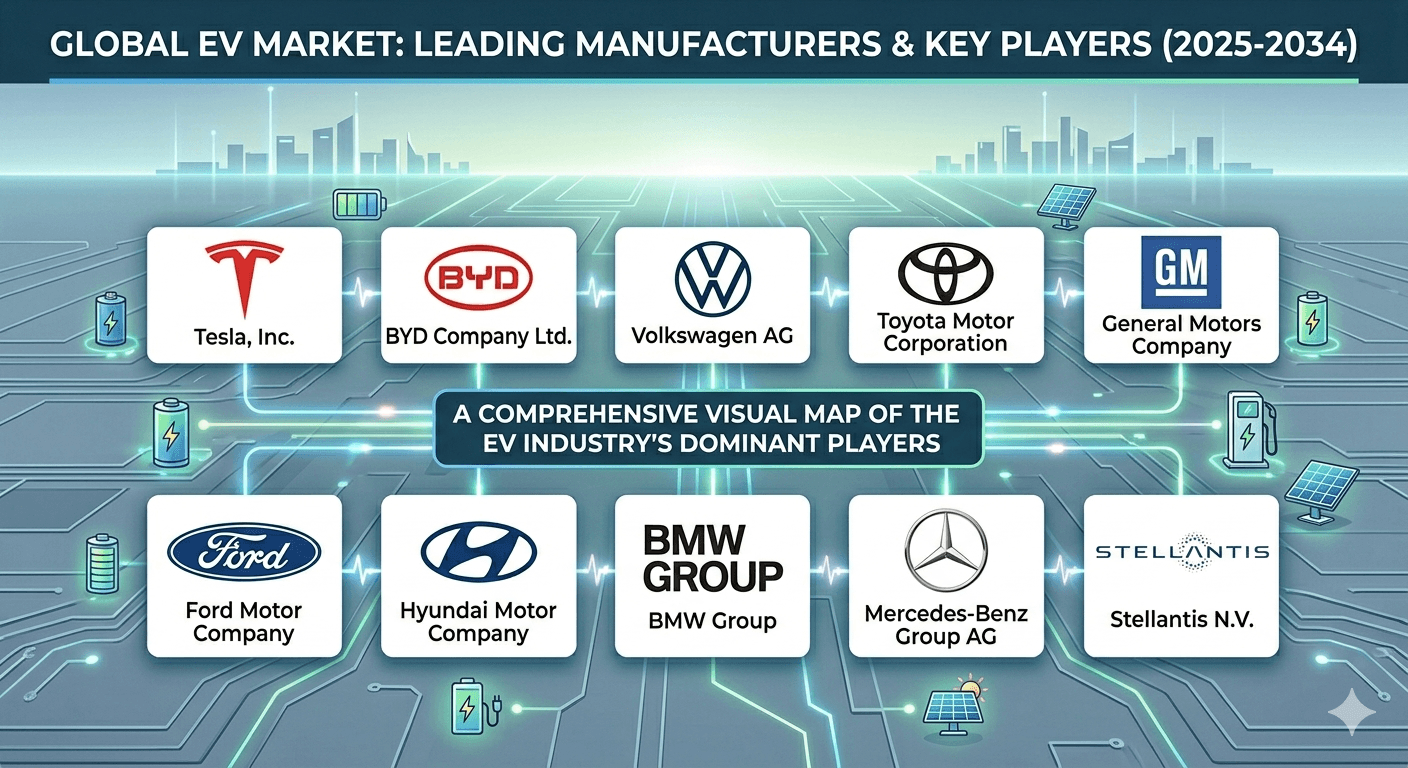
- Tesla, Inc.
- BYD Company Ltd.
- Volkswagen AG
- Toyota Motor Corporation
- General Motors Company
- Ford Motor Company
- Hyundai Motor Company
- BMW Group
- Mercedes-Benz Group AG
- Stellantis N.V.
FAQ
1. What is driving the growth of the Electric Vehicle Market?
The Electric Vehicle Market is growing because people are worried about the environment. The government is also helping by giving incentives. The Electric Vehicle Market is getting better because of battery technology and fuel prices are going up.
2. Which region dominates the Electric Vehicle Market?
The Asia-Pacific region is doing well in the Electric Vehicle Market. This is because they are very good at making things and the government is supporting them. Many people in countries like China and Japan are buying Electric Vehicles.
3. What are the major challenges faced by the Electric Vehicle Market?
The Electric Vehicle Market is facing challenges. The vehicles are very expensive. There are not places to charge them. The Electric Vehicle Market is also having trouble getting the materials they need.. They are worried about what to do with old batteries.
4. Which battery type is commonly used in Electric Vehicles?
The Electric Vehicle Market is using Lithium-ion batteries the most. This is because they can hold a lot of energy and they last a time. They are also very good, at charging.
