
Global Managed DNS Services Market Overview
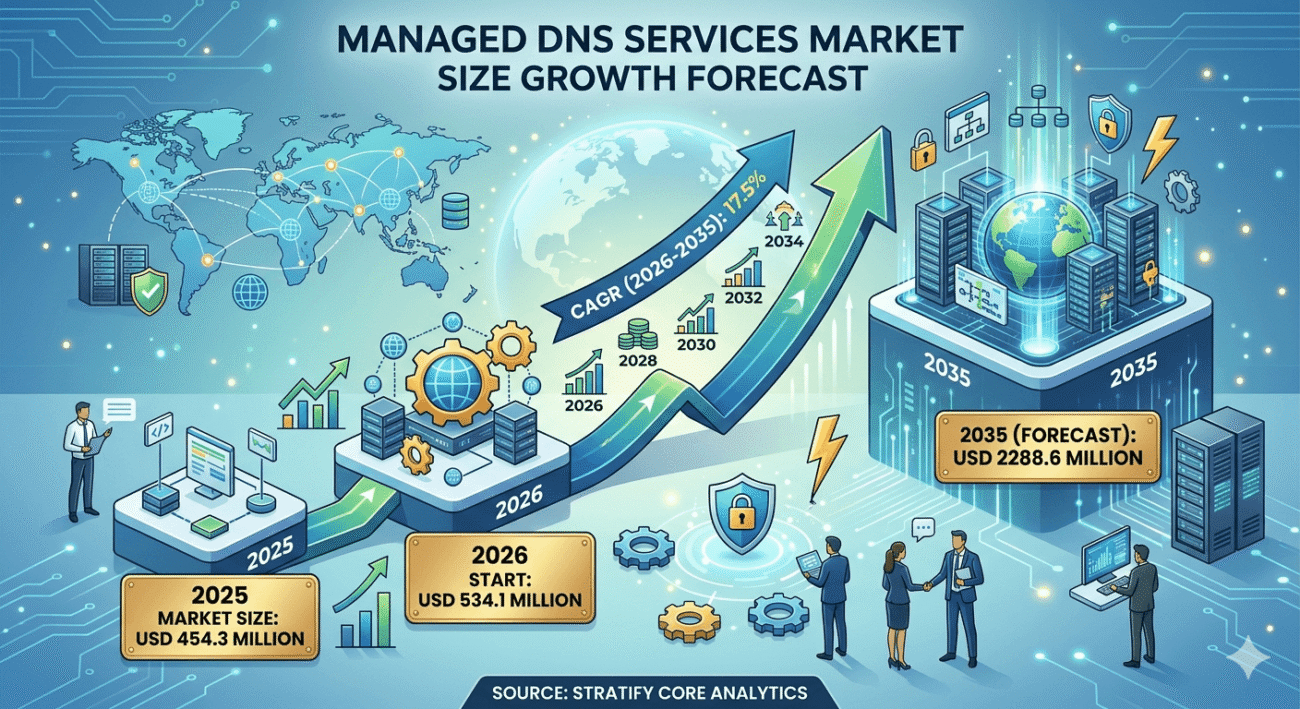
The global managed DNS services market size was calculated at USD 454.3 million in 2025 and is predicted to increase from USD 534.1 million in 2026 to USD 2288.6 million by 2035, expanding at a CAGR of 17.5% from 2026 to 2035.
The global managed DNS services market has emerged as a critical component of modern digital infrastructure, driven by the increasing dependency on cloud computing, digital applications, online services, and enterprise internet connectivity. Managed DNS services refer to outsourced Domain Name System solutions that help organizations improve website availability, performance, security, and traffic management through specialized DNS providers. These services ensure that internet users can access websites and applications quickly and reliably by translating domain names into IP addresses with high efficiency and redundancy.
The rapid expansion of digital transformation initiatives across industries has significantly accelerated the demand for managed DNS solutions. Enterprises are increasingly migrating workloads to hybrid and multi-cloud environments, creating the need for scalable and resilient DNS architectures capable of handling dynamic traffic patterns. Managed DNS providers offer centralized administration, intelligent routing, real-time monitoring, and enhanced uptime guarantees, making them attractive for organizations seeking uninterrupted online presence.
The rise in internet penetration, e-commerce activities, online banking, streaming platforms, and SaaS-based applications has contributed substantially to market growth. Businesses operating in competitive digital environments require fast-loading websites and low-latency application delivery to maintain customer engagement. Managed DNS platforms help optimize network performance by directing users to the nearest or most efficient server locations using geographic load balancing and traffic steering technologies.
Cybersecurity concerns have also become a major growth catalyst for the market. DNS infrastructure is increasingly targeted by cybercriminals through Distributed Denial-of-Service (DDoS) attacks, DNS spoofing, cache poisoning, and ransomware campaigns. Managed DNS service providers offer integrated security capabilities such as DNSSEC, DDoS mitigation, threat intelligence, firewall protection, and traffic anomaly detection. These advanced security features enable enterprises to strengthen digital defenses while reducing the operational burden on internal IT teams.
The market is witnessing widespread adoption among large enterprises as well as small and medium-sized businesses. While large organizations leverage managed DNS for global traffic management and business continuity, SMEs are increasingly adopting cloud-based DNS solutions due to affordability, ease of deployment, and reduced infrastructure management costs. The subscription-based pricing models offered by providers further support adoption among budget-conscious organizations.
Several industry verticals are heavily investing in managed DNS services, including:
- Banking, financial services, and insurance (BFSI)
- Retail and e-commerce
- Healthcare and life sciences
- Telecommunications
- Government and public sector
- Media and entertainment
- Information technology and cloud services
- Manufacturing and logistics
The increasing deployment of IoT devices and edge computing infrastructure is further expanding market opportunities. Connected devices rely heavily on efficient DNS resolution for seamless communication, data exchange, and application performance. Managed DNS services help organizations support massive device connectivity while maintaining low latency and high network reliability.
North America currently dominates the managed DNS services market due to the strong presence of cloud service providers, advanced digital ecosystems, and high cybersecurity investments. The region benefits from widespread adoption of cloud-native technologies and extensive enterprise digitization initiatives. Europe also holds a significant market share driven by stringent data protection regulations and growing cloud adoption across industries.
The Asia-Pacific region is expected to witness the fastest growth during the forecast period. Rapid internet expansion, increasing smartphone penetration, digital commerce growth, and government-led digital transformation programs in countries such as China, India, Japan, and Southeast Asian nations are driving demand for reliable DNS infrastructure. Growing startup ecosystems and increasing investments in hyperscale data centers are further supporting regional market expansion.
The competitive landscape of the managed DNS services market remains highly dynamic, with providers focusing on innovation, automation, AI-driven traffic management, and integrated cybersecurity offerings. Strategic partnerships, acquisitions, and global data center expansions are commonly observed strategies among market participants seeking competitive advantage.
As enterprises continue prioritizing digital resilience, application availability, and cybersecurity readiness, the global managed DNS services market is expected to maintain strong long-term growth momentum across both developed and emerging economies.
Key Managed DNS Services Market Trends
The managed DNS services market is evolving rapidly due to technological advancements, increasing internet traffic, and the growing complexity of enterprise digital ecosystems. Organizations are prioritizing network reliability, cybersecurity, and application performance optimization, leading to several transformative market trends shaping the future of managed DNS services globally.
One of the most prominent trends is the increasing adoption of cloud-native DNS infrastructure. Enterprises are shifting from traditional on-premises DNS systems to cloud-managed environments that offer scalability, automation, and operational flexibility. Cloud-based managed DNS services enable organizations to efficiently manage large-scale traffic volumes without investing heavily in physical infrastructure.
Another major trend is the integration of artificial intelligence and machine learning technologies into DNS management platforms. AI-powered DNS services help organizations detect anomalies, predict traffic spikes, automate routing decisions, and improve threat detection capabilities. Machine learning algorithms analyze network behavior patterns to optimize DNS query resolution and enhance application performance in real time.
The growing importance of cybersecurity is significantly influencing market trends. DNS security has become a strategic priority due to rising cyber threats targeting internet infrastructure. Managed DNS providers are increasingly offering advanced security features such as:
- DDoS attack mitigation
- DNSSEC implementation
- Zero-trust DNS security frameworks
- Threat intelligence integration
- Encrypted DNS protocols
- Malware domain filtering
- Real-time traffic anomaly detection
Organizations are also showing growing interest in multi-cloud and hybrid cloud DNS management. Enterprises operating across multiple cloud environments require centralized DNS visibility and traffic orchestration to ensure consistent application availability. Managed DNS platforms now provide unified dashboards, API-driven automation, and seamless integration across cloud ecosystems.
Edge computing adoption is another influential trend contributing to market expansion. As businesses deploy applications closer to end users to reduce latency, DNS services are becoming essential for efficient traffic distribution and edge workload optimization. Managed DNS providers are expanding edge network capabilities to support real-time data processing and ultra-low-latency services.
The proliferation of IoT ecosystems is also shaping DNS service requirements. Billions of connected devices require secure and scalable DNS resolution to maintain uninterrupted communication. Managed DNS providers are increasingly focusing on high-capacity infrastructure capable of supporting massive DNS query volumes generated by smart devices and industrial IoT networks.
Automation and Infrastructure-as-Code (IaC) practices are gaining popularity in DNS management. Enterprises are adopting programmable DNS solutions that integrate with DevOps pipelines and CI/CD workflows. This trend enables faster deployment cycles, reduced configuration errors, and improved operational efficiency.
Another emerging trend is the growing demand for premium traffic management services. Businesses with global customer bases require intelligent DNS routing to optimize user experiences across geographic regions. Managed DNS providers now offer advanced traffic steering capabilities, including:
- GeoDNS routing
- Latency-based routing
- Weighted load balancing
- Failover automation
- Real-time performance monitoring
- Application-aware routing
Regulatory compliance and data sovereignty concerns are further influencing market developments. Organizations operating in regulated industries are seeking managed DNS providers that offer compliance-ready infrastructure aligned with regional data protection standards. Providers are responding by establishing localized data centers and enhancing governance frameworks.
The market is also witnessing increasing adoption among SMEs due to the availability of affordable subscription-based pricing models. Smaller businesses are recognizing the importance of reliable DNS infrastructure for maintaining online visibility and customer trust. Simplified deployment options and managed security capabilities are helping accelerate adoption within this segment.
Strategic collaborations between cloud providers, cybersecurity vendors, and telecom operators are becoming increasingly common. These partnerships help deliver integrated networking and security solutions while expanding global service coverage.
Overall, the managed DNS services market is transitioning toward highly intelligent, automated, and security-focused infrastructure solutions designed to support the growing demands of digital enterprises worldwide.
Key Managed DNS Services Market Restraints
Despite strong growth prospects, the global managed DNS services market faces several restraints and challenges that may limit adoption rates and impact market expansion. These barriers include security complexities, cost concerns, technical limitations, regulatory issues, and operational dependency risks associated with outsourced DNS infrastructure.
One of the primary restraints affecting the market is the growing sophistication of cyberattacks targeting DNS systems. Although managed DNS providers offer advanced security solutions, DNS infrastructure remains highly vulnerable to attacks such as DDoS campaigns, DNS hijacking, cache poisoning, and tunneling attacks. Large-scale DNS outages can disrupt business operations, damage brand reputation, and lead to significant financial losses.
Concerns regarding third-party dependency also present a major market challenge. Organizations relying heavily on external DNS providers may face operational risks if service disruptions occur at the provider level. Even brief outages can impact website accessibility, cloud applications, customer transactions, and enterprise communications. Businesses operating mission-critical digital platforms often remain cautious about outsourcing complete DNS management.
Data privacy and regulatory compliance complexities are additional restraints influencing market adoption. Different countries enforce varying data governance laws, cybersecurity mandates, and internet regulations. Enterprises handling sensitive customer data may hesitate to adopt global DNS providers without clear compliance assurances. Regulatory fragmentation creates operational challenges for providers serving multinational organizations.
Cost considerations can also limit adoption, particularly among small businesses and startups with constrained IT budgets. While cloud-based DNS services reduce infrastructure investments, premium managed DNS offerings with advanced security, analytics, and traffic management capabilities can become expensive over time. Organizations must often balance performance requirements with budget limitations.
The shortage of skilled cybersecurity and network professionals represents another important challenge. Effective DNS management requires expertise in networking, cloud infrastructure, cybersecurity protocols, and traffic optimization. Many organizations lack the technical resources needed to properly configure and monitor advanced DNS environments, increasing dependence on external service providers.
Interoperability and integration challenges may further hinder market growth. Enterprises using complex multi-cloud architectures or legacy infrastructure may experience difficulties integrating managed DNS services with existing systems. Migration from traditional DNS infrastructure to managed platforms can involve:
- Configuration complexities
- Application compatibility issues
- Network downtime risks
- Operational disruptions
- Security policy conflicts
- Data synchronization challenges
Latency concerns in certain geographic regions can also affect service quality. Although managed DNS providers operate global server networks, underserved regions with limited internet infrastructure may still experience slower DNS resolution times and inconsistent connectivity. These limitations can impact user experience and application performance.
Vendor lock-in is another restraint influencing enterprise purchasing decisions. Organizations integrating deeply with a specific DNS provider’s ecosystem may face migration difficulties if they later choose to switch vendors. Proprietary configurations, APIs, and management frameworks can create long-term dependency challenges.
The increasing complexity of enterprise IT environments further complicates DNS management strategies. Organizations must manage growing numbers of applications, cloud services, remote endpoints, and connected devices. Maintaining visibility and control across distributed infrastructures can become operationally challenging, even with managed DNS solutions.
Limited awareness among smaller organizations also remains a market barrier. Many SMEs continue relying on basic DNS solutions offered by domain registrars without fully understanding the benefits of advanced managed DNS services. Insufficient cybersecurity awareness and low prioritization of DNS optimization may slow adoption rates within this segment.
Economic uncertainty and fluctuating IT spending patterns can additionally impact market growth. During periods of economic slowdown, businesses may postpone infrastructure modernization projects and reduce investments in premium networking services. This can particularly affect discretionary spending on advanced DNS performance optimization solutions.
Despite these restraints, continued advancements in cybersecurity, cloud networking, AI-driven automation, and regulatory compliance frameworks are expected to gradually address many of the current market limitations. Providers focusing on reliability, transparency, and flexible deployment models will likely strengthen their competitive positioning in the evolving managed DNS services landscape.
Managed DNS Services Market Key Opportunities
The growing need for managed DNS services among businesses across all sectors of the economy is creating enormous opportunities for growth in the managed DNS services market. Organizations across all industry sectors are increasingly focusing on digital transformation, cloud-native architecture, and securing internet access to deliver applications. Organizations are keenly realizing the significance of DNS management in keeping their applications up and running, lowering their latency, and enhancing their cybersecurity infrastructure; therefore, creating a growth-conducive environment for managed DNS service providers globally.
One of the most significant opportunities emerging in the managed DNS services market is the increasing penetration of cloud computing technologies. Businesses are migrating their applications and services to public, private, and hybrid cloud platforms for increased flexibility and enhanced scalability. Managed DNS services are an integral part of cloud computing, as they enable seamless traffic routing, intelligent load balancing, and optimized network performance across the cloud infrastructure. As the scale of cloud infrastructure grows, the need for robust DNS management services will certainly enhance significantly.
An increasing level of sophistication in cyberattacks is presenting significant opportunities to the managed DNS service providers in the managed DNS services market. DDoS attacks, DNS spoofing, cache poisoning, and ransomware attacks are proving to be a major menace for government institutions and businesses worldwide, making it imperative for organizations to consider managed DNS security features such as DDoS mitigation, DNSSEC, traffic filtering, and threat intelligence for their network. Outsourcing the DNS management services and their related security issues is becoming the preferred choice for organizations to keep themselves safe in terms of cyberattacks, generating long term opportunities.
Expansion of edge computing and content delivery networks (CDNs) is driving the demand for managed DNS services in the market. With an increasing demand for faster content delivery across the globally distributed locations and to keep applications up and running on low latency, demand for sophisticated DNS services is being witnessed in various regions of the world. Enterprises engaged in e-commerce, media and entertainment, gaming, and healthcare are increasingly adopting edge computing to manage and deliver services at local endpoints, which directly escalates the demand for intelligent DNS services for seamless routing of traffic among edge locations.
Proliferation of IoT devices is yet another segment that presents an opportunity for the managed DNS vendors. Billions of internet connected devices across varied industrial verticals need reliable connectivity for its efficient working. As the market for IoT devices expands across smart cities, manufacturing plants, automotive, smart health, and many other verticals, enterprises are realizing the critical role of managed DNS services in managing the device authentication, traffic routing and network scalability for seamless connectivity of devices at a large scale.
Small and medium-sized enterprises (SMEs) form a lucrative market segment of the managed DNS services. SMEs do not usually possess sufficient resources or technical skills to manage complex DNS infrastructures and security practices on their own, creating an opportunity for cost effective and subscription-based managed DNS solutions. Driven by the accelerating pace of digital transformation, SMEs worldwide are increasingly adopting managed services to manage their infrastructure, which makes them a key market opportunity for the service providers in the coming few years.
The integration of artificial intelligence (AI) and machine learning (ML) in managed DNS management systems provides the service providers with an immense opportunity for differentiation and innovation in the managed DNS services market. AI/ML solutions allow the service providers to identify abnormal traffic behavior, predict congestion on networks, detect sophisticated cyber threats in real-time, and automate network management for optimum performance of applications and networks and bolster the security posturing, thereby giving a competitive edge to the technology adopters in the managed DNS services market.
Emerging network infrastructure, such as 5G, will further amplify the opportunities for growth in the managed DNS services market. With the rapid adoption of 5G technologies, there is a need for ultra-low latency network performance, increased speeds of data transfer, and better scalability of the network architecture. Managed DNS services cater to these demands by offering an optimal network routing along with reduced latency in data transfer, hence leading to increased demand for such services. Telecommunications vendors and enterprises utilizing 5G driven applications and services are likely to drive market growth for managed DNS services in the coming years.
The adoption of multi-cloud and hybrid IT environments is another strong market opportunity for managed DNS services. In these environments, it becomes challenging for enterprises to maintain application consistency, ensure traffic routing to multiple environments, and perform failovers with efficiency. Managed DNS services provide robust capabilities to simplify the complexity of managing network traffic for multi-cloud, as they enable traffic management, automated failovers, and centralized monitoring, thereby creating increased market opportunities for the managed DNS service providers across all regions.
The growing importance of regulatory compliance and data security is another key driver of market growth in the managed DNS services market. Global and local governments are increasingly focusing on the strict enforcement of data privacy and cybersecurity norms, pushing businesses toward the adoption of more secure and compliant solutions. Managed DNS service providers are enabling organizations to comply with these standards by offering secure infrastructures, encrypted DNS protocols and consistent network monitoring to enhance the network security for organizations in highly regulated industries such as healthcare, banking, and government.
Unpenetrated opportunities in emerging markets in the Middle East, Latin America and Asia-Pacific are giving a substantial opportunity for managed DNS vendors to expand their market. Rapid internet penetration, increasing the use of smart devices, and the rising pace of digitization are forcing enterprises in these regions to focus on improving their network performance so as to manage a growing customer base, thereby boosting the demand for managed DNS services in these regions.
Managed DNS Services Market Key Drivers
The expanding requirements for a reliable infrastructure, as well as continuous connectivity at each online presence, are being regarded as primary growth drivers for the managed DNS services market. With enterprises expanding their digital presence, DNS management has become a business-critical requirement that is integral to maintaining web accessibility and application performance as well as network stability, prompting a majority of organizations across industries to look for solutions in managed DNS.
The rapid adoption of cloud-based services and platforms is a key factor contributing to the expansion of this market. Many organizations are shifting towards the utilization of SaaS applications, E-Commerce applications and services hosted on the cloud; and these applications demand smart traffic control as well as a stable and scalable infrastructure. The availability of intelligent routing offered by managed DNS solutions enhances application uptime, minimizing latency. Increased movement of applications and systems towards the cloud is helping expand the managed DNS market significantly.
The increasing number of cybersecurity attacks also plays a vital role in this market. DNS infrastructure is constantly under threat from cyber criminals through various attacks such as DDoS attacks, malware infections, phishing activities and DNS hijacking attempts. Enterprises are increasingly turning to managed DNS services that offer robust security features aimed at protecting their networks and digital infrastructure. Vendors are providing integrated traffic filtering capabilities and detection of threats, as well as real-time monitoring features, making it a crucial element of the cybersecurity strategy.
High dependency on the web in terms of online customer interaction as well as digital commerce is an additional contributing factor for this market. Websites handling the sale of products, live streaming, online financial transactions, or digitally delivered media need a very high network availability so that end-users are satisfied with the user experience; any downtime, even of a few minutes, can result in significant losses of revenue and damage the company’s reputation. Managed DNS services help keep the operations running and ensure better performance delivery at each global location.
The increasing integration of hybrid and multi-cloud infrastructure is another important driver in the market. Organizations are migrating to the cloud; however, many are considering multiple cloud providers for their flexibility and scalability, along with disaster recovery capabilities. Managing network traffic becomes critical for applications deployed across multiple clouds, and intelligent DNS management provides centralized traffic control, automatic failover, and load balancing across cloud architectures. This trend is prompting a greater adoption rate for managed DNS services by enterprises globally.
The widespread adoption of a remote work culture and geographically dispersed workforce have contributed to a growing need for reliable as well as secure internet connectivity. Businesses are increasingly relying on work-from-home models, which demand seamless connectivity, optimized routing, and secure access to applications. Managed DNS is enabling such businesses to ensure reliable and stable connections and also optimize performance and network security for distributed workforces. This trend gained substantial momentum, especially after the widespread adoption of the work-from-home strategy across businesses following the COVID-19 pandemic.
The proliferation of mobile internet devices and internet-connected technologies in everyday life has also acted as a major driver for this market. With the increasing use of smartphones and internet-connected devices to access services and applications, the number of internet users is continuously growing, and the need to provide efficient network performance to such a large population is a critical requirement. Managed DNS solutions assist enterprises in managing large volumes of traffic at each network segment efficiently, along with providing a consistent performance across varying network and geographical parameters.
The proliferation of IoT systems has also been adding momentum to this market. Billions of internet-connected devices are entering the market that need an efficient communication channel and robust security to operate and data transfer from such a large ecosystem. Managed DNS platforms play an integral role in efficient traffic management for IoT devices, provide easy setup, enhance network availability and scalability of the network to accommodate all the devices from industries such as logistics, manufacturing, healthcare, smart city development, etc.
Advancements in the domain of DNS automation and analytics are also playing a critical role in market growth. New intelligent and advanced DNS solutions are offering improved functionalities, such as artificial intelligence and machine learning based traffic analytics and predictive analysis. These tools not only assist in efficient resource management but also enable automated traffic control and fast response to issues like failure and outages thereby minimizing the time on manual intervention for any kind of network failure or disruption. This further boosts the adoption of such managed solutions.
The deployment of 5G technology is another critical element playing a key role in this market, since the performance of any cloud-based application or website is strongly dependent on the underlying network infrastructure, and a high-speed internet technology like 5G necessitates efficient bandwidth allocation and optimization. The enhanced capacity of the networks for higher data throughput needs advanced solutions in DNS management that can intelligently route the traffic, enabling faster performance.
Finally, the ongoing focus towards increasing business continuity and disaster recovery planning has added considerable momentum to the growth of the managed DNS services market. Enterprises are increasingly inclined toward developing resilient infrastructure by setting up redundant sites and deploying failover systems to combat risks associated with various threats such as physical disasters, natural calamities, and hardware failures as well as cyberattacks. Managed DNS solutions facilitate quick traffic redirection and network resilience through failover mechanisms and load balancing, thereby reducing the risk and enhancing operational sustainability.
Managed DNS Services Market Segment Insights
Managed DNS services market segmentation is classified based on the deployment mode, service type, organization size, end-user industry and geography. These market segments vary based on growth rate, technology evolution, cybersecurity requirements and digital transformation initiatives of end-user industries.
Deployment mode-based market segmentation is divided into cloud-based and on-premises.
- Cloud-based managed DNS services: High growth is witnessed in this segment owing to its scalable, flexible and cost effective architecture. It is observed that the increasing move of organizations towards cloud-based environments makes the cloud-based DNS management very suitable for modern enterprise operations.
- On-premises managed DNS services: On-premises-based managed DNS solutions continue to cater to those organizations that have very strong regulatory and security compliance. In sectors like government, defense and banking the enterprises would not like to move their services to the cloud in order to have much closer control over the sensitive data.
Service type-based market segmentation includes DDoS protection, geo-routing, anycast network services, load balancing and DNS firewall services.
- DDoS protection services: This segment accounts for a notable market share owing to growing numbers of cyber-attacks on the enterprise network. Organizations are looking to safeguard their services with the use of robust DNS security services.
- Geo-routing services: It is increasingly used by enterprises to reduce response time and the user’s experience is enhanced by routing the user to the closest service location based on their geographical position.
- Anycast network services: Widely adopted for enhancing network redundancy. They play a crucial role in distributing the load among various available servers so that none of the servers gets overloaded. The user query is instantly routed to the nearest and available server which improves the response time significantly.
- Load balancing services: These services play a critical role in distributing the incoming network traffic to several backend servers; this prevents the possibility of overload of any single server and therefore application performance can be maintained.
- DNS firewall services: Increasingly adopted to prevent the use of malicious domain, to provide effective anti-phishing service for enterprises.
Organization size-based market segmentation is divided into large enterprises and small and medium-sized enterprises (SMEs).
- Large enterprises: Dominate the market as they have more complex and expansive network and therefore depend more on the uninterrupted operation of the internet services. These enterprises spend more on advanced DNS management solutions.
- Small and medium-sized enterprises (SMEs): Show rapid growth. As digital transformation grows among small businesses, managed DNS services cater to these businesses with an economical yet scalable network management solution without the need for skilled professionals in-house.
End-user industry-based market segmentation includes IT & telecommunication, banking & financial services, healthcare, retail & e-commerce, media & entertainment, manufacturing, and the government.
- IT & telecommunication: One of the largest segments by end-users due to high demand in networking services and connectivity over the cloud.
- Banking & financial services: requires highly secure DNS infrastructure to protect the sensitive data of their customers and to support various digital services such as online banking, money transfer, etc.
- Healthcare: DNS services are being implemented by healthcare industries to protect medical equipment connected on the network, to provide security to EHR systems and for telemedicine services.
- Retail & e-commerce: The DNS services are required for the continuous availability of websites or online shopping stores and to boost the efficiency of online transaction processing as well as enhance the customer experience.
- Media & entertainment: The enterprises look for high speed content delivery services and hence are seen increasing the use of managed DNS services for providing seamless entertainment to their customers globally.
- Manufacturing: Implements DNS services for industrial IoT networks and smart factories.
- Government: Protects digital services of the public sector and critical national information systems.
Geographically, North America dominates the market for managed DNS services, as it has well-established cloud adoption and a mature IT infrastructure. The European market is also anticipated to grow at a steady pace due to the growing emphasis on stringent data protection regulations and the ongoing digital transformation across organizations. The Asia-Pacific market is predicted to grow at the fastest pace due to rising levels of Internet penetration, increasing cloud ecosystems, and the growing adoption of digital services in emerging nations. Latin America, the Middle East & Africa markets also show an upsurge due to the modernization of infrastructure by enterprises.
Regional Analysis
The global managed DNS services market’s sustained demand across various regions is on account of escalating growth in cloud deployment, rising concern for cybersecurity and burgeoning demand for high available online services. Businesses across all industry verticals are increasingly deploying managed DNS solutions to enhance their website performance, improve network security and obtain high availability. The proliferation of digital transformation trends and internet based applications is further boosting the demand across various regions.
The market for managed DNS services in North America region holds the lion’s share of the overall market on account of the stringent adoption of latest IT infrastructure, leading cloud service providers and high prevalence of cybersecurity technology. Countries such as the United States and Canada significantly contribute to market growth with growing investments in managed DNS solutions to thwart DDoS attacks and improve application availability. Rapid growth of e-commerce, FinTech and SaaS platforms has surged the demand for secure and scalable DNS management services.
- High uptake of cloud computing technology
- Strong focus on cyber security spending
- Presence of leading DNS service providers
- Growing adoption of IoT and connected devices
- Increasingly digitally focused enterprises
Europe region constitutes a major market as it is supported by a strict regulatory framework of data protection laws coupled with increasing awareness of secure network among enterprises. With Germany, UK and France spearheading the use of managed DNS services, banking, retail, and healthcare industries have boosted the demand for these services due to a focus on data security, operational continuity, and traffic optimization.
- Stringent data protection and privacy regulation framework
- High demand among SMB and large organizations
- Increasing trend toward remote working infrastructure
- Growing proliferation of cloud based enterprise applications
- Rising concern over DNS security threats
The managed DNS services market in the Asia Pacific region is predicted to exhibit the highest growth rate during the forecast period. Driven by strong industrial development and an increase in the proliferation of internet infrastructure, the demand for managed DNS services is gaining momentum across China, India, Japan and South Korea on account of flourishing e-commerce sector and rising smartphone penetration. Government and enterprises across various sectors have boosted cloud and cybersecurity infrastructure for faster growth.
- Rapid transformation to digital services in enterprises
- Growing adoption of cloud and hybrid IT solutions
- Increasing rise in internet and connected device users
- Increasing incidences of cyber attacks on DNS infrastructure
- Strong establishment of data centers and telecom network infrastructure
The growth of the Latin American market is gradually witnessing a promising development due to rise in the uptake of internet infrastructure and cloud computing in enterprises. Organizations are rapidly shifting toward adopting managed DNS solutions owing to significant rise in investments made by countries like Brazil and Mexico to support digital banking, e-commerce, enterprise mobility, and security solutions. The increasing necessity for robust DNS management for high availability is also pushing the market growth.
- Increasing internet and smartphone penetration rate
- Growing adoption of cloud infrastructure by enterprises
- Rising security awareness among enterprises and users
- Exponential growth in digital payments sector
- Increasing rate of IT modernization in businesses
Middle East & Africa region is experiencing steady growth due to high government investment in digital transformation and an escalating need for high secure online services. Smart city and high advanced ICT initiatives launched by the governments across the gulf region are spurring the demand for managed DNS services. The increasing adoption of digital banking, government online portals and online healthcare solutions further bolster the market demand in the region.
- Rising investments by government for digital transformation
- High adoption of smart technology in business
- Growth in the telecom infrastructure and cloud networks
- Increased attention for network resilience and cybersecurity posture
- Rising demand for business continuity solutions for data safety
The managed DNS services market is estimated to grow significantly across the global scenario on account of increasing reliance of enterprises over low latency, better website performance, high network stability and security from ongoing cyber threats. The market growth will continue to remain strong for all major regions on the account of expanding use of cloud, edge computing and different digital platforms.
Top Key Players operating in the Managed DNS Services Market
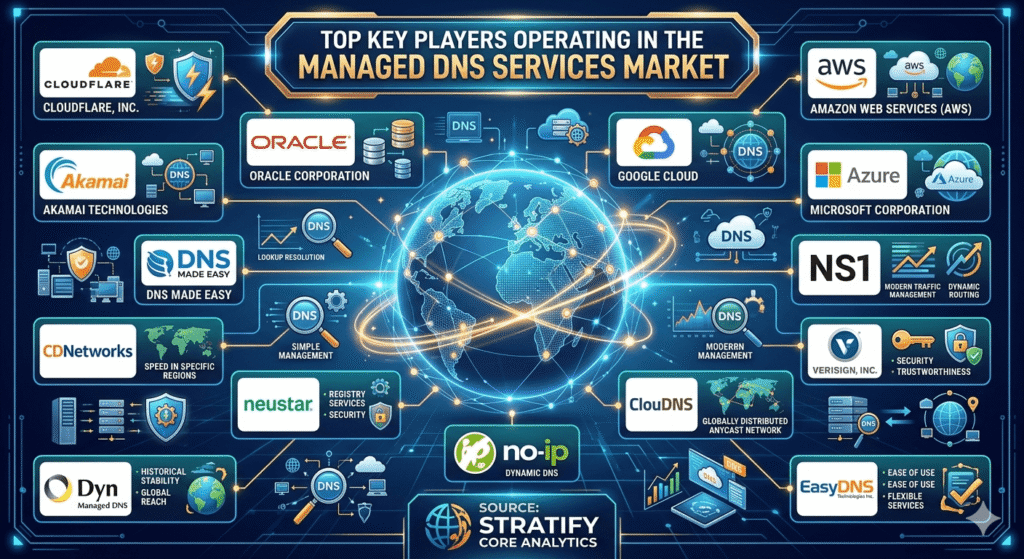
- Cloudflare, Inc.
- Amazon Web Services (AWS)
- Oracle Corporation
- Google Cloud
- Akamai Technologies
- Microsoft Corporation
- DNS Made Easy
- NS1
- CDNetworks
- Verisign, Inc.
- Neustar
- ClouDNS
- Dyn Managed DNS
- No-IP
- EasyDNS Technologies Inc.
In the competitive landscape of managed DNS services, the competitive rivalry between firms focuses on building strategic business partnerships, technological innovation, acquisitions, and the expansion of cloud-based security services. The providers are also investing more on reduction of latency and improving protection against Distributed Denial of Service (DDoS) security threats. Firms are further developing artificial intelligence (AI) based traffic management and analytical capabilities that assure operational efficiency and enhanced customer experience.
Companies are also launching combined domain name system (DNS) solutions with security features integrating DNS filtering, threat information, and advanced failover systems. The rising demand for the most reliable digital infrastructure and persistent internet services is also forcing these vendors to strengthen their servers globally and improve scalability.
FAQ
1. What are Managed DNS Services?
Managed DNS Services are cloud-based solutions that help organizations manage domain name system operations efficiently. These services improve website performance, security, uptime, and traffic routing.
2. What factors are driving the growth of the Managed DNS Services market?
The market is driven by increasing cloud adoption, rising cybersecurity threats, growing internet traffic, expansion of digital services, and increasing demand for reliable network performance.
3. Which region is expected to witness the fastest growth in the Managed DNS Services market?
Asia-Pacific is expected to experience the fastest market growth due to rapid digital transformation, increasing internet penetration, and expanding cloud infrastructure investments.
4. Who are the major players in the Managed DNS Services market?
Major companies operating in the market include Cloudflare, Amazon Web Services, Oracle Corporation, Google Cloud, Akamai Technologies, Microsoft Corporation, and Verisign, among others.
