
Global Container Fleet Market Overview
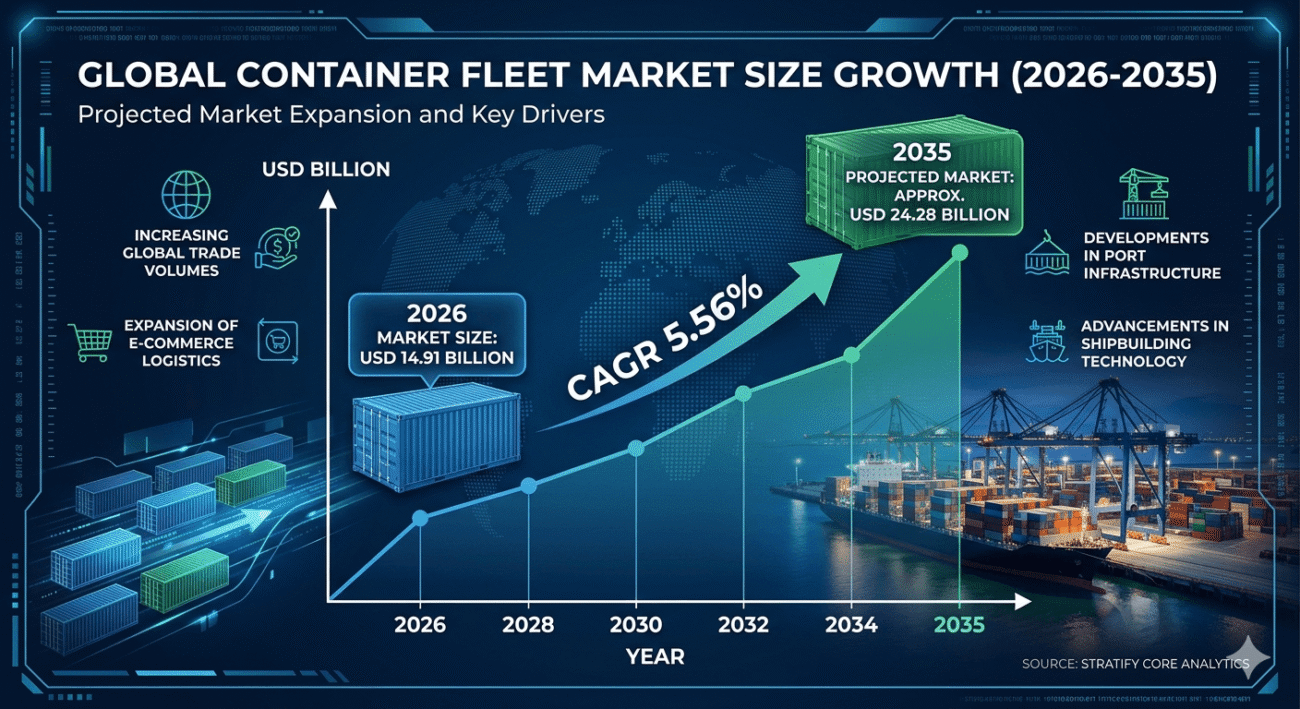
With an expected size of about $24.28 Billion in 2035 from $14.91 Billion in 2026, the global container fleet market size is predicted to rise at a compound annual growth rate (CAGR) of 5.56% from 2026 to 2035. The global container fleet market represents an essential element of the international trade and supply chain sector.
Container fleets, including various container types such as dry storage containers, tank containers, flat racks, reefer containers and specialized cargo units, are utilized for the transport of goods via seafaring vessels. Over the last couple of decades, the market has seen significant shifts on account of global geopolitical tensions, fluctuations in shipping rates, innovative technologies and an alteration of trade patterns and policies around the global. Shipment of containers on marine voyages is deemed the backbone of global commerce.
According to the UNCTAD, container trade in the year 2025 declined due to an uncertain economic situation, challenges to supply chains, and soaring transportation costs, though the overall demand for containers has been robust considering continued global trade activities and expansion in e-commerce businesses across borders.
The market has been showing moderate progress despite these operational challenges in recent times, and reports indicate that a considerable increase in container throughput crossing 183 million TEU in 2024 from diverse hubs across Asia Pacific, Europe and North America was witnessed on account of rising trade activities, especially between countries in Asia Pacific and North America.
Container fleet expansion and large scale investment in modern large mega-vessels and related equipment have become a defining feature of the sector over the last several years. Top global shipping players have embarked on ambitious initiatives and allocated substantial funding toward scaling up the fleet size and capacity, enhancing operational efficiency and bringing down container shipping costs. The growing popularity and adoption of refrigerated containers (reefer containers) by many stakeholders is a notable market segment of the global container fleet market.
Due to surging global demand for cold chain products like medicines, perishable goods and fresh food items, many companies have started building bigger reefer capacities to accommodate cold chain products. Smart containers fitted with IoT sensors are progressively entering use as they give real-time visibility into shipment tracking, security, and inventory control.
Geopolitical conflict has been a constant disrupting element for the global container fleet market in recent years, leading to shipping route disruptions and increasing transit times. Ongoing turmoil in regions such as the Middle East has resulted in major shipping lines rerouting ships around the Cape of Good Hope to bypass potential dangers and high risks, resulting in higher fuel consumption and costs, as well as increased port congestion at certain locations globally.
Increased vessel congestion can also lead to elevated freight rates as ship owners and operators are compelled to charge higher prices for transporting cargo through these challenging environments and complex routes to maintain profitability. Investment towards environmentally friendly shipping solutions is an upward trending factor in the container fleet market, as several shipping companies are embracing the use of alternative fuels. Investments are being poured into LNG and alternative fuels for cleaner shipping practices and compliance with stringent environmental regulations enforced across the world.
Smart containers with tracking systems and an increasing automation level within port operations are contributing to enhanced logistics efficiency and cost-effectiveness for market stakeholders. However, the container fleet market also faces concerns regarding overcapacity due to orders of new container ships, which, according to industry analysts, will likely outpace trade growth for the coming few years, thereby putting pressure on freight rates and profitability for many key industry players.
The situation will thus require efficient fleet utilization and cost-cutting strategies for industry stakeholders to overcome challenges of market profitability during this period. Advanced automation, digitization, artificial intelligence, and big data analytics are gradually being adopted to enhance the efficiency of the entire value chain, right from production to end-users, of the global container fleet market.
Such technologies have resulted in efficient inventory management, optimizing logistic routes, and speeding up clearance times at customs points and border gates. In terms of geography, Asia-Pacific dominates the global container fleet market as the region is home to major manufacturing bases and has well-developed ports with extensive connectivity, contributing significantly to global export trade volume. In Asia Pacific, countries like China and Singapore are leading players with their vast port infrastructure and significant presence in global container traffic.
European nations and the United States are also major contributors owing to their extensive trade networks and increasing efforts towards sustainable shipping operations and solutions. The growth of the container fleet market in the future will be primarily driven by increasing international trade, robust demand for cold chain logistics, a focus on the sustainability of the transportation sector, as well as ongoing trends of digital transformation in all supply chain management processes.
Key Container Fleet Market Trends
The container shipping fleet industry globally is in the midst of a period of significant and far-reaching change, with container ship lines, container lessors and logistics players struggling to adapt to the changing contours of trade, the increasingly pressing demand for greater environmental compliance, and rapidly developing new technologies.
Because the container shipping industry acts as the foundation of international commerce, with over 80% of all goods traded across borders via water-borne transit routes originating with this sector, everything, including globalization, the rapid rise in e-commerce, the customer’s expectation for speed and the reordering of supply chain priorities, impacts its market trajectory.
One of the first major trends in the global container fleet is the increasing global need for the biggest ships and a larger concentration of energy efficiency. Shipping lines are progressively investing in the latest series of ships, which have a bigger capacity and are more energy efficient to improve overall cost efficiencies. Container lines have placed orders for ships at a record pace in recent years to increase capacity and optimize their service offerings.
Millions of TEU in new capacity orders are planned from the world’s largest owners, signaling a belief in global long-term trade volume but also warning of potential market oversupply in the near-term and pressure on shipping rates as container capacity expands at an accelerated pace.
Secondly, environmental concerns and climate impact are gaining more serious consideration in the maritime sector. International maritime agencies are imposing stringent restrictions on ship operators to cut greenhouse emissions and implement greener technologies in ships. The industry accounts for about 3% of total CO2 emissions produced worldwide, and greener options are becoming essential from dual fuel vessels to green methanol ships, ammonia-powered ships and other energy-efficient solutions. Shipping companies including major lines are actively seeking partnerships and joint ventures around these areas and are engaged in projects focused on low-emission shipping fuels and carbon neutral logistics.
Digitalization of processes is another growing trend influencing container leasing. From ship management to fuel conservation and tracking of vessel operations, telematics, artificial intelligence (AI) and analytics are being deployed to offer significant cost benefits through improved scheduling, better maintenance management, and efficient resource deployment. Better routing and optimized schedules are some of the benefits that carriers are availing with this digital innovation.
Ship managers are anticipating an expansion in global fleet digital integrated platforms over the coming decade, as transparency in the global supply chain increases and many companies begin harnessing the potential of Internet of Things (IoT) technology to enhance visibility in cargo tracking.
The rise of shipping companies choosing to lease instead of buy will likely further increase as a result of this growing focus on asset lightness. Leasing is growing in prevalence; a vast number of newly purchased containerized equipment globally are being controlled by leasing entities instead of carriers themselves. The growth of leasing firms allows shipping lines to remain flexible, scale up and down as needed without the heavy upfront capital costs required for direct asset ownership. Lease container shipments represent more than half of the world’s container ship fleet as an increasing number of shipping lines embrace asset light structures.
In addition to increasing asset light structures and greater focus on eco ships, shipping patterns are also changing globally with more container vessel lines favoring moderately sized and flexible Ships. More broadly, a rebalancing of global manufacturing hubs away from China and other more traditional economies is taking place, and with that there is a redesign of global container vessel routes. China’s increasing shift to a consumption-driven economy and the growth of India and Vietnam as new manufacturing powers mean that cargo patterns and transit points are constantly in flux, meaning the flexibility of fleet will be highly rewarded.
Further to flexibility, partnerships in the shipping sector are a more recent yet growing trend. Companies involved in shipping now more frequently cooperate and co-invest in infrastructure and vessels to enhance route and service coverage. Container firms cooperate to make most use of vessel capacity, reduce overall operating costs and provide better network reliability and punctuality for the delivery of services. Most global shipping companies are now actively engaging in major alliances and strategic cooperation with partner carriers, offering a comprehensive service without owning a fleet covering the full transit system.
Smart infrastructure in the sector also contributes to greater efficiencies in vessel operations and the broader transport system. With increased focus on efficiency, ports around the world continue to invest significantly in automated cranes, electronic customs management systems, and AI integrated logistics which can further reduce cargo congestion and shipping lines’ vessel turnaround time in ports and shorten their transit time for their clients. Automation and integration with ports can provide more time for container vessels in ports and therefore maximize the use and productivity of assets and optimize the overall time in the journey.
To sum up, the container shipping industry now stands at the threshold of a radical shift where the need to improve sustainability and environmental impact goes hand in hand with capitalizing on new technologies to boost efficiencies and the ultimate goal of greater resiliency and supply chain security. We will probably soon witness the growth of specialized fleet solutions, and increasingly sophisticated asset management and planning tools from innovative vendors which ship lines can adopt and exploit.
Container Fleet Market Key Restraints
The container fleet market for the last decade always recorded an increasing trend that led by rising global trade, complicated logistics and growing container transportation demand. Container fleets a significant component of the global supply chain assist in the movement of goods from ports to the road and railway system. Though this positive scenario and huge market potential the container market is facing several restrictions that inhibit growth and smooth sailing of the market.
Those restriction coming from increasing operational costs, supply chain volatility, regulations, policy challenges, evolving trade landscape and inadequate technology. To become and sustain profitability in complex industry like logistics and shipping, a full understanding of those barrier need for stakeholders.
In terms of market restrictions a strong barrier affecting the market is the manufacturing and cost associated with container maintenance. Generally produced from steel and aluminium that are capable of withstand all types of shipping conditions including adverse weather and shipping stresses; increase cost of these materials leads to increasing production cost of containers which impact on profitability of shipping firms and fleet operator, such type of maintenance includes repair of damaged containers, painting of containers, anti-rust paint as well as meeting with International safety standards that all added burden to expenses of the fleet operator and makes small and medium size of fleet operators less competitive and unable to expand their businesses and update container fleets.
Global trade is one major impediment to the growth of the container market because trade volumes depend on several factors, for instance economy and political situations, global trade restrictions, the introduction of tariffs in particular markets and others governmental restrictions. Political disputes between economic blocs, the unrest caused by political crises and wars usually lead to a decrease in trade, and affect the smooth sailing of global shipping routes.
As such low level of global trade generally lead to lower demand for container shipping which means a decreased utilization rate for the fleet of shipping companies, hence reducing their profitability. Moreover global trade may get disrupted due to sudden events such as natural disasters and pandemics, resulting to delays to shipping, congestion of ports and short of containers at worldwide.
High level of port congestion and shortage of facilities have posed serious concern and challenges to the container fleet market. Many of the world largest ports are hampered by various kinds of problems which are mostly result from aging of infrastructure, low productivity of cargo handling equipments and inadequate storage capacity of goods in terminals.
The enormous increase in ship traffic usually overburdens the limited facility of a port thus prolonging the waiting time for ships, resulting in delays and disturbance of the flow of container transportation. Such inefficient operations within the ports and shipping sector lead to additional operational costs and delays. Also the inadequate inland logistics network that links a port with a logistical hub in certain developing economies has caused issues in moving containers between locations.
Increased attention on the environment and concern about sustainable business development are among ongoing issue facing container fleet sector, as environmental policies imposed to the market by government in different parts of the world encourage reduced greenhouse gas emissions and environment-friendly practices in shipping business, such policies require to invest heavily for environment technology (including modern ship designs, innovative propulsion systems, and efficient cargo handling systems), and eco-friendly cargo solutions for fleet operators thus lead to huge costs. Investing in environmentally-friendly operations and upgrading fleets for the better could be another important concern.
Price fluctuation of fuel has always been a potential threat to shipping market profitability. Shipping fuels account for a substantial portion of costs and the oil prices jump affects shipping costs adversely and significantly, as well as it impacts directly to the transportation costs and the price volatility of fuel makes shipping businesses facing huge risk for their operating expense estimation and calculation since fuel market dynamics affected by political situation, demand and supply factors and health of the world economy; higher costs lead to lower demand.
Container shortages and imbalances are another factor to restrict the market’s growth; The trade surplus and deficits between exporting countries and importing ones lead to misallocation of the number of containers globally. Shortages may take place at certain locations while elsewhere there are ample empty containers, which transport is a costly process that also complicates the logistics supply chain. Shortages occur more often at the time of rising demand, especially after a recession or during the time when countries are recovering their economy like seen during the pandemic.
The development of Technology and the threat from cyber security risks are challenging barriers to container market growth. Although the containerization sector expects to witness innovative and intelligent container technologies that will revolutionize the logistics industry, high cost to implement tracking, automation, and smart management systems is not a significant hurdle to the small sized fleet operators without significant funding and adequate technological capacity. The increasing reliance of the shipping industry over technology exposes the sector to higher risks from hacking and virus related malicious activity, and can have a significant negative impact on its operation.
Labor issues and workforce deficiency in the market continue to bother the container fleet sector. Skilled professionals are needed for managing fleet, port operations, cargo logistics and maintenance; however the lack of a qualified workforce occurs in many parts of the world due to several reasons such as aging workforce, poor workplace conditions, individuals preferences and others which cause workforce disputes and strikes impacting schedule delivery of goods.
Container Fleet Market Key Opportunities
The world’s container fleet market is growing at a rapid pace with increasing international trade volumes, a high demand for effective ways to transport cargo, and the growth of intermodal logistics networks. Shipping containers provide a critical function in international trade and commerce by offering a way to transport goods across long distances in a secure and cost-effective way. With industries’ transition toward digitalization and environmentally responsible measures becoming prevalent, the container fleet market is presented with a number of significant opportunities that can pave the way for its future growth.
The rapidly expanding global trade. One significant opportunity within the container fleet market is the accelerating rise of global trade activities. More and more developing nations in Asia-Pacific, Latin America, and Africa are increasing their import and export business activity, boosting the need for container transport services.
The increasing presence of online shopping and transnational trade continues to encourage the global movement of goods. Shipping corporations are investing in larger and also extra advanced container fleets to fulfill the requirements for larger cargo sizes and more efficient business operations. The growing adoption of smart container technology.
A second significant opportunity comes from the utilization of smart container innovation. The newest shipping containers are now furnished with internet of things (IoT) sensors, Global Positioning System (GPS) trackers, and real-time observing answers to aid transport operators track cargo condition, shipment movement, and supply chain visibility. Intelligent containers assist in decreasing risks of cargo damage, theft, and delays whilst improving functional transparency.
As digital logistics rise to become a dominant pattern within the transportation business, the demand for intelligent container fleets will surely expand. Sustainability and also ecological regulations. Sustainability as well as ecological guidelines also represent a considerable growth possibility for the container fleet industry.
Federal governments as well as global maritime organisations are implementing tougher exhaust criteria to lower the environmental effect of shipping, prompting fleet drivers to obtain ecologically friendly containers and energy-efficient transportation solutions. Environmentally conscious containers made from recyclable materials and sustainable transport practices are also becoming more common, while business that implement eco-friendly strategies may boost their brand name and also achieve an edge in the market while maintaining compliance. An expanding reliance on refrigerated containers or reefers.
A third major growth possibility arises from the increased need for refrigerated containers (reefers). It has ended up being more frequent for perishable products like food products, medication, dairy items, and chemicals to be transported in this way. Refrigerated containers are created to maintain temperature throughout transit and, consequently, ensure the quality and stability of products.
Organizations and also companies involved in healthcare and food export are in a high need for modern reefer containers that consist of a range of cooling tools and remote observing solutions. Container leasing solutions are becoming much more widespread. One of the most compelling growth opportunities for business and also fleet operators lies in container leasing arrangements rather of possession.
Numerous shipping businesses and also logistics suppliers prefer to rent containers so as to lessen expenses and boost flexibility, whereas leasers of containers boost their inventories and offer modified leasing solutions for various customers. This type of framework has advantages for small and also average sized companies (SMEs) by offering affordable transport options without large capital expenses. The development of port and logistics infrastructure.
Growing ports as well as logistics center facilities globally are helping to bolster container fleet industry development. Many countries have invested in upgrading and modernizing their port facilities, along with implementing smart logistics infrastructure and also rail links in order to obtain quicker cargo handling times and enhance supply chain performance. Automated ports, digital paperwork systems, and incorporated transport networks reduce transit times and supply chain efficiency.
Growing demand for intermodal transportation arrangements. As supply chain activities become increasingly complex and international, there is a need for an intermodal transportation option that connects numerous modes of transport, such as sea vessels, trains, and also trucks, making the movement of products more efficient. The ability of containers to be easily moved between various transport modes has been paramount in promoting intermodal transportation, therefore minimising transit times and freight damages.
Enhancements in fleet administration software and big data analytics. Numerous technological developments in fleet administration software application and big data analytics provide many more opportunities for market participants to optimize routing, monitor fuel intake and also, to be frank, schedule preventative upkeep. Such enhancements can aid in improving profitability by predicting demand changes or pinpointing locations of poor efficiency in the existing transportation and distribution processes that organizations or ships should pay extra attention to, thereby enabling them to offer services more promptly and reliably to consumers.
As international trade continues to grow in extent as well as impact, alongside growing pressures towards sustainable and smart logistics and transportation, as well as increasing demand for intermodal transport and reefer logistics, the worldwide container fleet market is set for substantial future growth. Companies that adapt quickly and are prepared to capitalize on the new and also arising chances readily available will thrive and become global leaders in the industry.
Container Fleet Market Key Drivers
Growing global trade, surging demand for shipping containers and the adoption of advanced technologies drive the expansion of the container fleet market worldwide. The cost-effective, efficient, standard and secure transportation of goods is the key to global trade as containers have always been an essential part of the shipping process across the world. However with the growth of industry, globalisation and surging e-commerce sector, the container fleet market is gaining momentum at an exceptional rate in the upcoming year.
Container Fleet Market to experience remarkable Growth in the upcoming year; Global trade activity rises to a new high! Increasing global trade is one of the fundamental reasons for the burgeoning container fleet market, which has gained momentum in the last few years as it expanded at a brisk rate following the growth in trade volumes across the world due to extensive industrialization in the growing economies such as China, India, Vietnam and so on.
While the manufacturing industry in these developing economies witnesses high-level expansion, resulting in a rise in trade among the import and exports, with a rise in demand for shipment services and container handling services between the two regions. The booming e-commerce business is one of the major factors contributing to the rise of the global container fleet market, as modern e-commerce industry necessitates well-established global logistic services to ensure swift movement of goods and thereby help in the smooth running of business on the consumer end across various parts of the world.
Furthermore, cross border e-commerce trade rises due to increased preference among consumers to use online services, which has resulted in a huge number of purchases in one country from another. Also many established players like Amazon, eBay, Flipkart and many other international and local Players have already started investing heavily in the expansion of container fleets so that they can enhance logistics and supply chain efficiency to ensure better delivery to the consumers.
Adoption of advanced technological equipment in the container fleet market. Technology is one of the major contributors to the expansion of the container market as numerous state-of-the-art equipment and devices such as IOT, Artificial Intelligence, and Blockchain technology have helped in providing efficient ways for fleet and asset tracking and providing better security to containers, and also helping the companies to cut the costs of operation.
State of the art devices like GPS Tracker, sensor technology in containers can track down any route that is being taken by the containers, it maintains the condition of products inside the container such as optimum temperature for carrying refrigerated goods such as meat, fish, dairy, medicines, food and so on. These technologies assist to a great extent in decreasing the delays for shipping and delivery. Increasing demand for refrigerated containers. Reefer containers are one of the types of containers used in the transport of perishable food items, drugs and other temperature-sensitive commodities over a lengthy distance for preservation.
Increasing global consumption of perishable food, the pharmaceutical sector in the world, and a healthcare industry need for efficient preservation of sensitive medicines etc. This leads to growing market share for reefer containers, the firms are increasing investment in high-tech refrigerated containers that provide effective preservation to a variety of such goods for transporting them safely to the destination, while adhering to the standard transportation policies and norms for the goods, thereby expanding the container fleet market.
Port infrastructure development and investment. Port construction and investment of new maritime shipping and logistics facilities, including intelligent cargo handling, port automation, and expansion in new shipping corridors, are also playing an expanding role as many public & private sectors are investing in such developments.
Growth is boosted with increased traffic in containers and expansion of fleets in order to cater to high volumes of containers in the newly built facilities & automated ports & to ensure minimal turnaround time for shipping lines. Environment-friendly initiatives taken by companies Being eco-conscious about maintaining a lower carbon footprint, businesses across the world are adopting newer environment-friendly ships along with green containers, which aids the shipping and transportation industry to adopt international green shipping standards. The International Maritime Organization has strictly announced emissions related regulations which led to growth for greener fleets and more innovative, sustainable technology.
Using greener means of transport can create enough opportunity for the stakeholders of the market, i.e. vendors. Rising popularity of intermodal transport mode. As containers are efficient and suitable in moving across ships, railways, and trucks, the containerised transportation using multiple modes of transportation has gained much popularity due to its efficiency in transport and also due to cost-effectiveness of the same, this form of transport mode helps to lower cost, risk, and improve lead time, increasing the efficiency.
Demand for leased containers Leasing is emerging as an alternative for the companies wanting to move into the container business for transport of various commodities that are transported in the container, as these firms often do not want to spend on purchase and the lease cost can be effectively utilized, it thus also offers much higher operational flexibility, while the lease providers have a wider range of customisable solutions for the leasing customer catering their specific needs in terms of capacity and requirement of space.
Economic Recovery and Industrial Expansion. With the market recovering from the widespread disruption caused by the global disruptions over the past few years, there is optimism among business owners which is helping them to invest more in their businesses. Higher demand for various consumer products and growing industrial output due to the economic revival post-COVID and better global supply chains are expected to increase the shipping requirements and thus boost the market for container fleet technologies.
Container Fleet Market Segment Insights
Over the past ten years the world’s container market has grown due to worldwide e-commerce, growth in international trade, and demand for efficient logistics services. These containers allow the transport of goods across borders from a country and around a continent thereby facilitating smooth movement in ships, railways and road networks around the globe. Based on the type of containers, size, application, owner, and region, these fleets consist of the world’s supply chains with their respective roles.
Dry storage containers currently have the largest share in the container fleet market because they transport general goods which comprise many products such as electronics, chemicals, and clothes. Hence the demand for these containers is very high as the trade is happening around the globe, especially between major nations like the USA and China. These are cheap, strong and able to transport goods over a very wide expanse.
Refrigerated containers, commonly referred to as reefers, are also seeing much growth as goods that are prone to spoiling, such as pharmaceuticals and foodstuffs, are carried between nations across and within the continent. This rise in international transport and trade in such temperature-sensitive commodities has also increased the funding in refrigerated fleets equipped with the right monitoring and tracking systems. In terms of the size of the containers, the world is very divided.
There are the 20-ft and the 40-ft, the latter size container accounts for most share of the market as it is used more for transport as the companies and logistics providers save cost and also use space most optimally on ship; but yet 20ft containers are still in demand as they can be used to transport extremely heavy products and can also be used in areas where space is very constrained, like in port areas with less capacity.
There are also the specialized containers such as high cube containers, open top, etc which are finding more utility in the specialized industries where such containers are most needed. In relation to application in the market, manufacturing companies and retail industries are some of the major sectors that consume, not just consume a chunk of these containers but also employ the containers to their benefit.
These industries due to the expanding international manufacturing hub, cross border e-trade are highly reliant on efficient logistics solutions like container transport. In addition to this, even the increasing e-commerce sector has led to much greater demand for container transport services as seen in regions like Asia. Also food and beverage companies use this service as an important part of their business.
On the ownership aspect, the companies that own large fleet of containers can either be a shipping line or a company that rents its containers. As regards owning, many firms prefer leasing container as an instead of buying them outright. This leads to lower capital expenditure on the firms’ side and increases their flexibility.
Container leasing companies have seen an influx of customers over the years. The leasing of the container can also involve advanced technology to track and manage fleet, such as using IOT and digital technologies. Geographically, it’s predicted that the Asia Pacific region will rule the world’s fleet of containers market due to a rapid increase in its manufacturing industries and trade between nations within and outside.
China as a global exporting nation uses a lot of containers and has large scale infrastructure for seaport transportation. Apart from that, the North American and European regions are not far behind, as both areas are considered as developed markets where the use of container transport and logistics is widespread. The emerging markets of the Middle East and Africa region and Latin America are expected to grow more in the coming decade with an increase in infrastructure and trade within nations.
In the modern age, with advancements in technology, there is a greater impact on how transport systems and logistics services are run across the board. In the container transport fleet market, Smart Container, which uses IoT, GPS and data logging to manage fleet, is gaining prominence. It aids companies in ensuring cost effectiveness and reliability, as such systems may predict the maintenance issues and may lead to cost reduction for its users.
Along with smart containers, automation in port activities is also having an impact on the day-to-day functioning of ports globally. In spite of positive growth prospects, the container fleet is faced with issues such as fluctuating fuel prices, supply chain blockage, geopolitical instability that has an impact on world trade, as well as environmental issues such as carbon emissions, which have led many countries to pass regulations on it. Therefore, the container fleet market is predicted to grow steadily and expand further in the near future, considering factors such as global trade growth and the rise in e-commerce.
Container Fleet Market Regional Analysis
The worldwide container fleet market, the fastest-growing market among all market types in recent years, grew due to numerous factors like the growing volumes of international trade, increasing popularity of e-commerce, and the need for faster transportation of goods. The containers are an essential element of the worldwide supply chain that enables the smooth movement of goods across the sea, rail and road networks.
A specific set of reasons drives each of these key regions toward its contribution in the ever-growing market ranging from the level of industrialization and port infrastructure availability to trade agreements and modernization investment. Hence the different markets like North America, Europe, Asia Pacific, Latin America, and the Middle East & Africa play different roles in driving this entire worldwide container fleet market.
The Asia Pacific region currently dominates the worldwide container fleet market and it is predicted that it will hold its leading position throughout the entire forecast period. The reasons behind this dominance are the position of the region as a major worldwide hub for manufacturing, owing to its vast economies like China, India, Japan, and South Korea. China is considered one of the biggest global exporters that significantly impacts the worldwide shipping volumes and ultimately the worldwide container demand.
Constant industrialization of the region, booming exports, focused industries, and increasing volumes of international trade are considered significant factors for the growth in the Asia Pacific region. Additionally, enormous investments were made in developing port capacities and increasing international maritime trade links, which strengthen the regional logistics structure. The countries like Southeast Asian countries and India are developing as key logistics centers due to increasing foreign investments.
The North America region has maintained a well-established yet consistently growing market of container fleet in the worldwide container fleet market. The USA and Canada are mainly considered as the key contributors to the growth of the market based on their vast export-import activities, well-established logistics network and infrastructure. The rise of the e-commerce sector and the need for effective intermodal logistics solutions are compelling the logistics providers to develop the capacity of their container fleet.
Increased penetration of smart container solutions with real time tracking feature and IoT enabled devices is also playing a key role in the North American market with increasing efficiency in logistic operations. Expansion in port infrastructure and the development of rail connectivity between various regions are key factors for growth in this market. Supply chain resilience is also a key issue on account of increased shipping in sophisticated containers across North America after some disruptive events globally.
The European region has held a sizable proportion in the worldwide container fleet market based on the hyper-connectedness of trade networks and the well-established shipping industry. Germany, the Netherlands, the UK, and France are main key drivers of the market in this region. Growing efforts toward eco-friendly and sustainability practices and the strict rules in the environment sector is also leading to an increase in demand for environmentally friendly logistic containers.
Logistic companies are more willing to invest in specialized containers like advanced reefer containers with sophisticated tracking devices. The high importance of maritime trade, top ports like Rotterdam and Hamburg are making the region a prominent player in the worldwide container fleet market. Increased investments in the digital freight management system are expected to accelerate this growth.
Latin America has been registering moderate growth rates in the global container fleet market due to developing trades as well as logistic infrastructure expansion. Economic growth and strategic investments in port facilities and overall logistic infrastructure in nations like Brazil, Mexico and Chile have been contributing significantly towards strengthening their international trade capacities.
High volumes of exports of agricultural goods, mining materials and manufacturing goods to other regions drive the market in this region. Despite the limited infrastructure and potential economic instabilities, increasing participation of Latin American countries in worldwide trade activities and foreign investment in shipping lines will surely result in a positive market trajectory.
The Middle East & Africa region is emerging as an important market for the global container fleet due to increased investment in trade infrastructure, along with focus on economic diversification. The Gulf countries, particularly the UAE and Saudi Arabia, are strategically positioning themselves to become dominant logistics and trans shipment hubs for global trade.
These countries are making huge investments in developing port facilities and free trade zones, resulting in rising demand for the transportation of goods in containers. Africa’s developing trade infrastructure and public & private investment toward the construction of infrastructure in this continent is generating significant demand for logistics services. The volume of imports in Africa of consumer goods and industrial components is also rising.
Trends in the regional expansion of the container fleet market are greatly influenced by economic development, volumes of trade, technological improvements and government policies for the infrastructure and transportation sector. While Asia Pacific is still holding a dominant position of being the largest market due to high volumes of production and exports, countries of North America and Europe are taking steps towards modernizing their old systems and investing in greener logistics.
Emerging economies like Latin America and Middle East & Africa are all set to provide numerous opportunities for stakeholders while global trade expands and logistics networks broaden. Use of technology and efficient use of resources in terms of an intelligent fleet management system and automated solutions are sure to play a critical role in the sustained growth of the market worldwide.
Top Key Players Operating in the Container Fleet Market
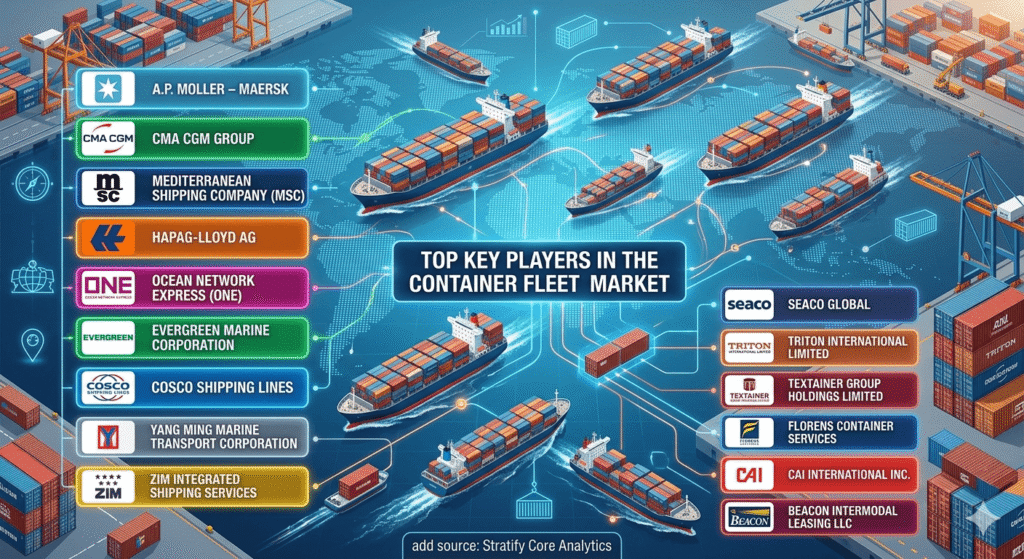
- A.P. Moller – Maersk
- CMA CGM Group
- Mediterranean Shipping Company (MSC)
- Hapag-Lloyd AG
- Ocean Network Express (ONE)
- Evergreen Marine Corporation
- COSCO Shipping Lines
- Yang Ming Marine Transport Corporation
- ZIM Integrated Shipping Services
- Seaco Global
- Triton International Limited
- Textainer Group Holdings Limited
- Florens Container Services
- CAI International Inc.
- Beacon Intermodal Leasing LLC
Frequently Asked Questions
1. What is the Container Fleet Market?
The container fleet market refers to the global industry involved in the manufacturing, leasing, management, and transportation of shipping containers used for cargo movement across sea, rail, and road networks.
2. What factors are driving the growth of the Container Fleet Market?
Growth is primarily driven by increasing international trade, expansion of e-commerce, rising demand for intermodal transportation, and advancements in smart container tracking technologies.
3. Which regions dominate the Container Fleet Market?
Asia-Pacific dominates the container fleet market due to strong manufacturing activity, major export hubs, and the presence of leading shipping companies in countries such as China, Japan, and South Korea.
4. What are the major challenges faced by the Container Fleet Market?
Key challenges include fluctuating fuel prices, container shortages, supply chain disruptions, port congestion, and strict environmental regulations impacting shipping operations.
