
Commercial Vehicle Market Overview
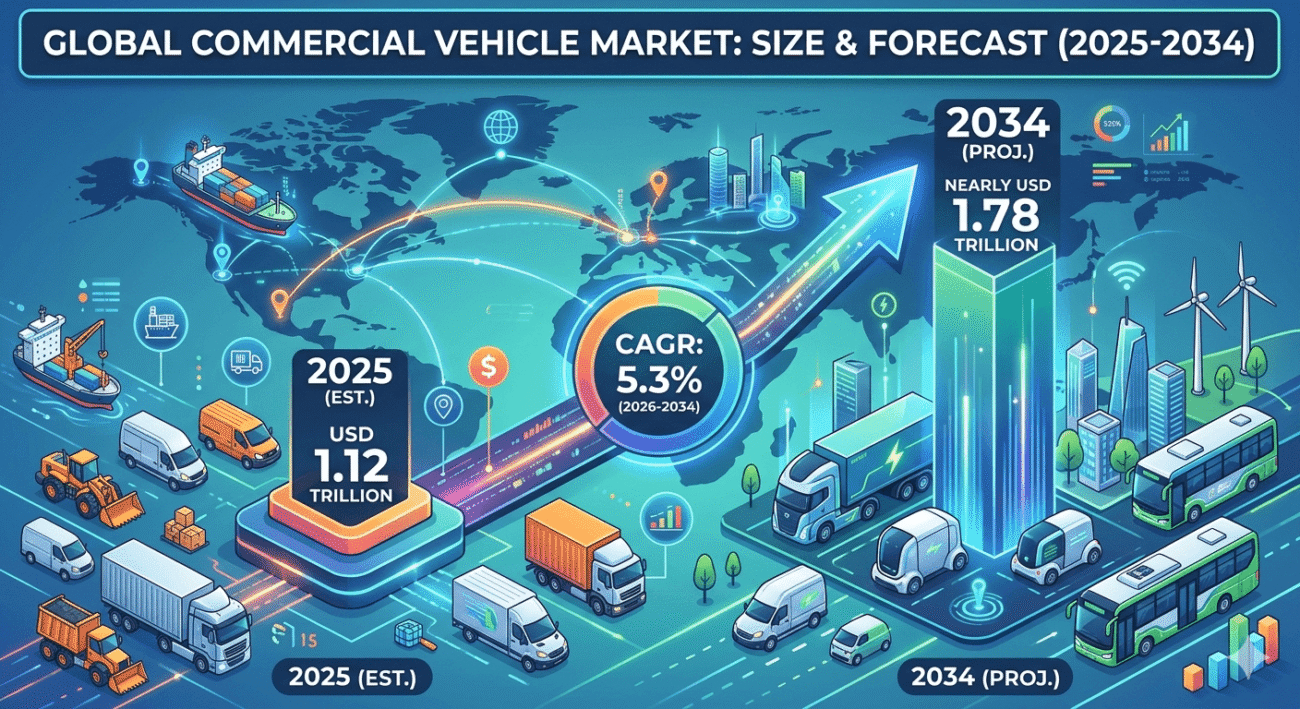
The global Commercial Vehicle Market was worth around USD 1.12 trillion in 2025 and is expected to reach almost USD 1.78 trillion by 2034, growing at a CAGR of 5.3% during 2026 to 2034.
The global commercial vehicle market has been growing tremendously over the last decade, buoyed by sustained economic development, escalating demand for logistics and transportation services, rapid global population growth, high rate of urbanization, and increasing need for global manufacturing and construction. Commercial vehicles refer to vehicles that are designed and used for commercial purposes. They include a wide array of vehicles ranging from trucks, buses and trailers to vans, used in logistics, manufacturing, construction, mining and transportation services. It is clear that Commercial Electric vehicles and commercial autonomous vehicles are slowly gaining presence on the market due to their benefits in efficiency, safety, as well as in reduced carbon footprint and operation costs.
The ever-increasing demand from the logistics sector and more specifically the e-commerce sector, due to which the demand for the supply and fulfillment trucks for e-commerce companies, for final-mile delivery of parcels, and for overall logistics services has been the major contributor to the growth of the commercial vehicle market globally. Furthermore, the increased number of infrastructure developments in developing and mature countries, both of which demand the transport of raw material as well as machinery to the various construction sites of large projects and also construction itself, has contributed immensely to the expansion of this market. Another fact driving significant commercial vehicle market size growth is the stringent government regulations on emissions.
Growing environmental concerns regarding global pollution and carbon footprint have resulted in governments enforcing tough emissions standards, especially for commercial vehicles. Such policies further encourage the purchase of newer, more fuel-efficient, and cleaner Commercial vehicle models. Thus, the increasing demand for smarter, more efficient, safe and sustainable solutions has helped the growth of the Commercial Vehicle industry.
The demand for Commercial Electric Vehicles is gaining traction due to a more promising reduction in fuel operating costs. This is also compelling companies such as auto manufacturers and component suppliers to ramp up investment in technology and development of various electric and hybrid commercial vehicle products, such as light commercial trucks and buses, and also Heavy commercial trucks and buses to meet the government’s fuel efficiency mandates and the demand from customers concerned over the carbon footprint. Several governments also support the widespread adoption of electric commercial vehicles and fleet electrification through several incentives, including subsidies, tax credits and loans. Technological Advancements in the Commercial Vehicle Industry. Driven by global supply chain efficiency gains, increased efficiency, comfort and safety for the vehicle operator, there has been an introduction of several technology features in the commercial vehicles market, which is a trend that is contributing to increased revenues across the globe.
Among the key advancements are: Telematics and Connected Commercial Vehicles- Connectivity solutions that enables communication between vehicles for tracking, vehicle diagnostics and in-vehicle diagnosticsTelematics, vehicle monitoring, and Fleet Management Systems – connectivity between commercial vehicle and vehicle fleet for efficiency and trackingThe Commercial vehicle market has been able to drive advancements across several areas such as Predictive Maintenance andADAS (Advanced Driver-Assistance Systems), that offer greater reliability and driver support. The size of the commercial vehicles market has seen a dominant presence of the Asia Pacific region, predominantly due to intense industrial growth, expanding e-commerce, and an ever-increasing number of urbanized cities in countries such as China and India.
Substantial investments are being channeled into developing the regional infrastructure and logistics network, propelling its market share. Significant contributions also come from Europe, on account of the increased focus on connecting the vehicles to communicate data and move toward eco-friendly alternatives.
North America’s market too has a significant share in the commercial vehicle segment on account of rapid industrial growth and technology-driven logistics services. Commercial Vehicle Market Growth By Vehicle Type. The Light Commercial Vehicle segment is primarily propelled by small enterprises that are continuously looking for economical yet reliable solutions for carrying products. This has also been reinforced by large delivery service providers working in e-commerce and a growing number of small and Medium Enterprises that have online delivery channels for their products.
The Heavy Commercial vehicle section (HCVs), including trailers, semi-trailers, and large truck fleets that are commonly used to transport goods of significant volume and weight and also used extensively by heavy vehicle operators for construction sites, construction-related material movements, have also demonstrated tremendous expansion across different economies across different regions worldwide.
The increased need for refrigerated commercial vehicles in order to deliver time-sensitive products like medications and food products and other consumer perishable products is also a growing trend in the market, which is adding speed to the commercial vehicle market growth. The Commercial vehicle Market size can best be represented by analyzing the players that comprise the market, i.e. Commercial Vehicle Manufacturers. The market is intensely competitive due to the presence of globally renowned OEMs vying for a large market share. Continuous investments in R&D and innovative product developments to introduce energy-efficient, environment-friendly, smart commercial vehicles are being made by major players.
The OEMs are focused on leveraging technologies such as connected vehicle technologies, automation and ADAS to increase the efficiency, safety and driver convenience. Apart from increasing adoption of commercial electric trucks, significant growth is seen in alternative-fueled commercial vehicles like hydrogen and compressed natural gas.
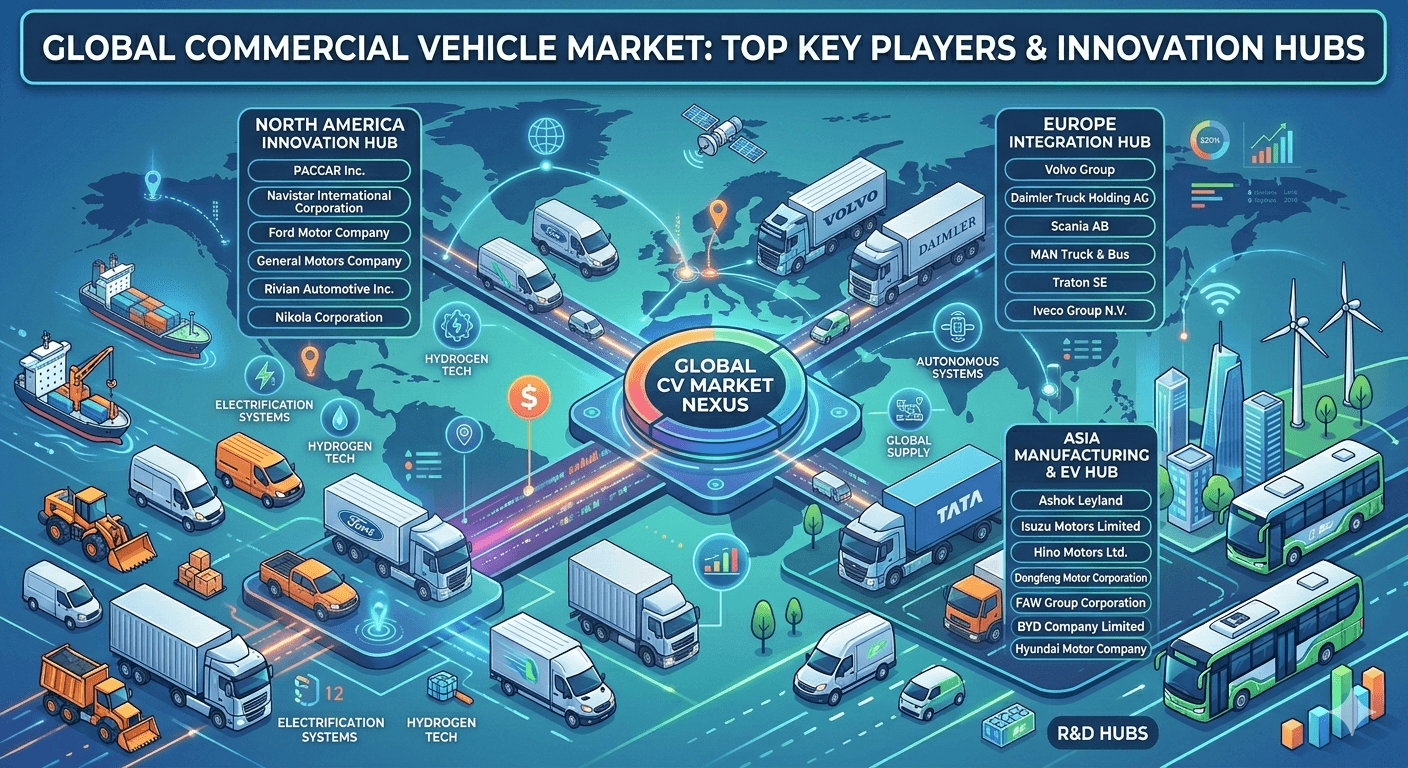
The market has been dominated by key players such as Ford, Scania AB, Volvo Group, PACCAR Inc., Mercedes-Benz Group AG, Hino Motors Ltd., Stellantis N.V., MAN SE, Navistar International Corporation, and Isuzu Motors Limited who cater to the vast demand of the commercial vehicle market globally and are also key players of new technology implementation such as of electrification and automation into the various commercial vehicles offered by them. Although the market size forecast and expected future opportunities look strong for market stakeholders in the commercial vehicle industry across the value chain, certain factors may create disruptions and challenge market participants. Fluctuating fuel prices, operating and maintenance costs of the commercial vehicles, and recent disturbances in the global supply chains all have a bearing on market growth.
Key Commercial Vehicle Market Trends
The commercial vehicle market is witnessing several emerging trends that are reshaping the transportation and logistics industry worldwide. One of the most significant trends is the increasing adoption of electric commercial vehicles. Governments and automotive manufacturers are focusing on reducing greenhouse gas emissions and promoting sustainable transportation solutions. Electric trucks and buses are becoming increasingly popular due to lower maintenance costs, reduced fuel dependency, and improved environmental performance.
The expansion of e-commerce platforms has created a major surge in demand for delivery and logistics vehicles. Online retail companies require efficient transportation systems for same-day and next-day delivery services. This trend has increased the adoption of light commercial vehicles for urban and last-mile delivery operations. Fleet operators are investing in technologically advanced delivery vans equipped with GPS tracking, route optimization software, and real-time monitoring systems.
Connected vehicle technology is another important trend in the commercial vehicle market. Fleet management systems integrated with telematics and IoT technologies allow operators to monitor vehicle health, fuel efficiency, driver behavior, and route performance. These technologies help businesses reduce operational costs, improve productivity, and enhance vehicle safety. Real-time data analytics is becoming an essential component of modern fleet operations.
Autonomous driving technology is gaining attention in the commercial vehicle industry. Several manufacturers are investing in self-driving trucks and automated transportation systems to improve logistics efficiency and reduce labor costs. Autonomous commercial vehicles have the potential to minimize human errors, enhance road safety, and optimize fuel consumption. Although fully autonomous vehicles are still under development, semi-autonomous features such as adaptive cruise control and lane-keeping assistance are already widely adopted.
The growing emphasis on fuel efficiency and emission reduction is influencing vehicle design and manufacturing processes. Automotive companies are developing lightweight commercial vehicles using advanced materials such as aluminum and high-strength steel. Lightweight designs help improve fuel economy and reduce overall operational costs. Additionally, manufacturers are increasingly adopting aerodynamic vehicle designs to enhance efficiency.
The use of alternative fuels is becoming more common in the commercial vehicle sector. Natural gas-powered trucks, hydrogen fuel cell vehicles, and hybrid commercial vehicles are gaining popularity as businesses seek cleaner transportation solutions. Hydrogen-powered heavy-duty trucks are particularly attracting attention for long-distance freight transportation because of their quick refueling capabilities and extended driving range.
Digitalization and automation are transforming logistics and fleet operations. Cloud-based fleet management software, predictive maintenance tools, and AI-driven analytics are helping transportation companies optimize operations and reduce downtime. Predictive maintenance technology allows operators to identify potential mechanical issues before they lead to costly breakdowns, improving vehicle reliability and reducing maintenance expenses.
Another major trend is the increasing demand for smart public transportation systems. Governments are investing in electric buses, intelligent transportation systems, and smart mobility infrastructure to improve urban transportation efficiency. The adoption of smart buses equipped with passenger information systems, surveillance cameras, and automated ticketing solutions is rising in many urban areas.
The commercial vehicle aftermarket segment is also growing rapidly. Fleet operators are focusing on vehicle maintenance, spare parts replacement, and performance upgrades to extend vehicle lifespan and improve operational efficiency. The demand for advanced tire technologies, connected maintenance solutions, and fuel-efficient components is increasing steadily.
Strategic partnerships and collaborations between automotive manufacturers, technology companies, and logistics providers are becoming increasingly common. These collaborations aim to accelerate innovation in electric mobility, autonomous driving, and digital fleet management solutions. As the industry continues to evolve, technological innovation and sustainability will remain key trends shaping the future of the commercial vehicle market.
Key Commercial Vehicle Market Key Restraints
Despite strong growth opportunities, the commercial vehicle market faces several restraints that may limit its expansion during the forecast period. One of the primary challenges is the high cost of commercial vehicles, especially electric and technologically advanced models. Fleet operators and small transportation businesses often struggle with the significant initial investment required to purchase new vehicles equipped with advanced technologies and emission-compliant systems.
Fluctuating fuel prices represent another major restraint for the commercial vehicle industry. Sudden increases in diesel, gasoline, and alternative fuel prices directly impact transportation costs and profitability for fleet operators. Rising fuel expenses can reduce operational efficiency and create financial pressure on logistics companies, particularly in regions heavily dependent on road transportation.
Stringent government regulations related to vehicle emissions and safety standards are increasing manufacturing costs for automotive companies. Compliance with evolving environmental regulations requires manufacturers to invest heavily in research, development, and emission-control technologies. These additional costs are often passed on to customers, making commercial vehicles more expensive.
Supply chain disruptions and shortages of raw materials have significantly affected commercial vehicle production in recent years. The automotive industry has experienced challenges related to semiconductor shortages, rising steel prices, and disruptions in global trade routes. These issues have delayed vehicle deliveries, increased production costs, and impacted overall market growth.
The lack of charging and fueling infrastructure for electric and alternative fuel commercial vehicles is also limiting market adoption. Many regions still lack sufficient charging stations, hydrogen refueling facilities, and maintenance infrastructure to support large-scale deployment of electric commercial fleets. This infrastructure gap creates operational challenges for fleet operators considering a transition to sustainable transportation solutions.
Economic uncertainty and inflationary pressures can negatively affect commercial vehicle demand. During periods of economic slowdown, businesses often reduce investments in fleet expansion and transportation infrastructure. Declining industrial production, reduced trade activities, and lower consumer spending can directly impact the demand for commercial vehicles.
Driver shortages are becoming a growing concern in the transportation and logistics industry. Many countries are facing a shortage of qualified truck and bus drivers due to aging workforce populations, demanding work conditions, and changing labor market dynamics. Labor shortages can affect fleet productivity and increase operational costs for transportation companies.
Maintenance and operational costs remain a significant challenge for fleet operators. Commercial vehicles require regular servicing, spare parts replacement, insurance coverage, and compliance inspections. Heavy-duty trucks and long-haul transportation vehicles often incur substantial maintenance expenses, reducing profitability for logistics businesses.
Cybersecurity risks associated with connected and autonomous commercial vehicles are also emerging as an important restraint. As vehicles become increasingly connected through telematics and IoT systems, the risk of cyberattacks and data breaches grows. Fleet operators and manufacturers must invest in advanced cybersecurity solutions to protect sensitive operational data and ensure vehicle safety.
Environmental concerns related to battery disposal and raw material sourcing for electric vehicles present additional challenges for the industry. The production of lithium-ion batteries requires significant amounts of raw materials such as lithium, cobalt, and nickel. Supply limitations and environmental concerns surrounding mining activities may impact the long-term sustainability of electric commercial vehicle production.
Lastly, intense market competition and pricing pressures among manufacturers can affect profit margins. Automotive companies are continuously competing through pricing strategies, technological innovation, and product differentiation. This competitive environment can create financial strain, particularly for smaller manufacturers and suppliers operating in the commercial vehicle market.
Commercial Vehicle Market Key Opportunities
The commercial vehicle market offers significant potential for manufacturers due to the pace of Technological advancements, the growing rate of industrialization and, and the overall expansion of the global logistics networks. Some of the most promising opportunities in this market are listed below: the electric vehicle market; the advent of online shopping has further elevated the demand for commercial vehicles.
The use of online ordering is now a standard across many of the regions and effective and agile delivery networks have become a necessity to facilitate customer satisfaction and. to support same-day and next-day deliveries. Companies across the regions are boosting their light commercial vehicle fleet to handle logistics. Infrastructure development in the developing economies: rapid development of the transportation infrastructure in the emerging economies of the world has given a boost to the commercial vehicles market, particularly the heavy-duty vehicles. Numerous infrastructure developments planned, such as highways, industrial corridors, ports, airports and smart cities, will further enhance the demand.The
development of commercial autonomous and connected vehicle technologies, telematics, GPS tracking systems and preventive maintenance solutions will continue to drive smart mobility initiatives by logistics operators and vehicle makers alike. Modernization of the public transportation systems: With the development of smart cities, public transport systems are witnessing a significant transformation. The old, diesel-driven public transit buses are being replaced by hybrid electric public transit buses and a new generation of smart bus systems offering features such as Wi-Fi, in-bus security, and digital fare collection systems.
hydrogen fuel cell and alternative fuel vehicles such as CNG and LNG, offering superior performance and environmental advantages in some applications. Commercial vehicles replacement cycle and maintenance: the need to replace the existing aging fleet with the newer technology driven by strict emission regulations in place for developed regions such as North America and Europe. Development of commercial Refrigerated Transport facility: the requirement for refrigerated transport services in the pharmaceutical, healthcare and food and beverage industry will give rise to new commercial transport business in the form of cold-chain transport. Digitization: A rapid increase in demand for fleet management services as well as smart technology-equipped vehicle solutions that leverage big data Analytics, AI and cloud platform for better tracking, planning and fleet maintenance.The vast underdeveloped market: vast, underdeveloped economies such as Asia Pacific, Latin America and Africa, possess a considerable untapped business potential due to increasing urbanization, mounting populations and expanding economies.
Commercial Vehicle Market Key Drivers
The commercial vehicle market is primarily influenced by the broadening of the transportation and logistics sector across the globe. The upward trend of trade activities, manufacturing and exporting from various regions has fuelled the need for commercial vehicles for inland transportation. Most of the logistics organizations are expanding their larger vehicle fleets in an attempt to cater to the rising demand for freight transportation and to provide a seamless supply chain.
It is being observed that growth in the global e-commerce revolution is one of the biggest drivers affecting the commercial vehicle market. Rise in the online shopping preferences because of convenience and speedy delivery services has created an uptrend in the demand for cargo cars for usage in the urban transportation sector and last-mile delivery applications. E-commerce giants and parcel delivery companies are likely to invest heavily in increasing their delivery car fleets to optimally serve their customers.
Population and urbanization boom is another factor significantly opening up the market for commercial cars as urban settlements are projected to have high public transportation needs, construction activities and transportation of goods needs. Governments are taking initiatives in smart city projects, metro rail networks, motorway projects and building urban infrastructure like roads and bridges, positively impacting the commercial car industry. Rapid industrialization and manufacturing growth in emerging economies like China, India, Brazil and Indonesia are leading to heightened demand for goods transportation and logistics service providers.
The manufacturing sector is highly dependent on commercial vehicles for transportation of raw material, packaging of manufactured products and forwarding them to various distribution centres. Continuous evolution in technology has been playing a vital role in propelling the commercial vehicle industry and is likely to do so in the future as well. Introduction of advanced driver assist systems (ADAS), telematics, internet of things-enabled connectivity and fleet management software enables operational safety, efficiency and cost management of vehicles, promoting purchase and lease options.
Favorable government policies to promote a cleaner transportation system are further likely to boost the market growth; the government’s incentives in the form of subsidies, financial incentives and tax benefits in adopting electric and hybrid commercial vehicles are boosting their sales, driven by the mission towards sustainable transportation. Rising costs of fuel and shareholders’ increasing demand for vehicles with better fuel economy and lower equivalent operational costs are also positive drivers for the commercial vehicle market. Automotive manufacturers are investing in lightweight designs, aerodynamically efficient exteriors, and advanced drive techniques to improve the fuel economy of commercial cars.
Wide-scale development of Public transport networks significantly drives buses and related commercial vehicle demand. Governments are channelizing investments toward the establishment of electric mini buses, school transport arrangements, and smart public transport solutions to cater to urban commuting needs. Fuels and new electric vehicles are receiving subsidies and assistance for establishing EV infrastructure, thus driving sales of electric commercial vehicles.
Fast expansion of cold chain logistics business- food, medicine and temperature-sensitive commodities- supports the market significantly. Rising digital trade of perishable goods and food items is positively supporting the demand for refrigerated trucks or specialized commercial vehicles. Increasing advancement in infrastructure projects across all regions of the globe continuously supports the sales of heavy commercial vehicles.
Construction activities need a variety of dump trucks, cement mixers and heavy commercial conveyance vehicles to cater to the needs of infrastructure development. Developing economies are investing in new roadways, airports, old roadways maintenance, industrialization and construction sector developments to support growth in heavy commercial vehicles. Availability of vehicle leasing options is supporting the growth of the commercial vehicle industry as businesses now are acquiring commercial vehicles with ease and the availability of new vehicles on lease eases the total cost of ownership by an easier replacement.
Commercial Vehicle Market Segment Insights
The commercial vehicles market is classified into segments according to vehicle type, fuel type, application, and end-user industry, all of which represent potential sources of revenue and areas of growth for the sector. The detailed analysis of these segments is very useful for commercial vehicle manufacturers as well as for investors who are considering investing in this market.
According to the vehicle type, the market is divided into the following sub-segments: light commercial vehicles (LCV), medium commercial vehicles (MCV) and heavy commercial vehicles (HCV). The LCV segment has a large share in the commercial vehicle sales due to its range of applications, such as urban transportation, distribution and last-mile delivery, which have seen a vast increase due to the significant growth of the e-commerce industry. This growing pace of courier and e-commerce services around the globe has led to the demand for pickup trucks and vans for last-mile operations.
Medium commercial vehicles are largely used for regional freight transportation and industrial distribution as they provide both efficient loading and unloading and good cargo capacity. Due to growing manufacturing industries, expansion in supply chain operations and a significant industrial sector in geographies such as the Asia Pacific and Latin America the demand of medium commercial vehicles in these regions.
The HCV segment comprises a large portion of the transportation of cargo for long distances and is also used for construction purposes. These heavy vehicles, like dump trucks, trailers, tankers, and trucks, are largely used in activities such as oil and gas transportation, mining activities, industrial chemical and raw material movement and finally transporting finished products. The rising number of infrastructure development projects in developing countries and the expansion in various industries are responsible for boosting the sales of heavy commercial vehicles.
According to the type of fuel, the commercial vehicles market is divided into diesel, petrol, electricity, hybrid and natural gas driven commercial vehicles. Though the sales of diesel commercial vehicles are dominant in the commercial vehicle market due to high torque, good efficiency at low fuel consumption and in applications of high loads, government regulations are surely pushing towards the growth of electric commercial vehicles in the market.
The electric commercial vehicles are fastest growing segments in the commercial vehicles market due to government subsidies and initiatives. The sale of electric and hybrid commercial vehicles is growing due to a large number of positives, such as sustainability, conservation and lesser pollution, which are not achieved by traditional fuel-based commercial vehicles. Many logistics companies have now installed electric commercial vehicles in their fleets to maximize fuel efficiency, achieve sustainability goals and also at the same time save costs. The sale of natural gas-driven commercial vehicles is also increasing with good fuel efficiency and less emission. It is mostly used in urban transport and deliveries, though CNG and LNG-driven trucks are popular in the transportation of goods in these areas.
According to the application, the global commercial vehicles market is divided into logistics and transportation, construction, public transport and mining, agriculture, etc. The logistics and transportation segment is dominant in the commercial vehicles market because of the widespread global trade and expansion in the e-commerce industry. Transportation of goods is one of the very essential aspects for logistic and fleet operators who look for sustainable, affordable and reliable ways to carry their goods in different geographies and across various destinations.
The construction segment of the commercial vehicles market holds a huge proportion due to the consistent rise in global infrastructure projects. Construction sites use dump trucks, cement mixers and other heavy vehicles for many construction processes and tasks. According to various studies on smart cities projects and ongoing developmental programs around the world, growing urbanization is positively contributing towards the growth of the construction sector of the commercial vehicle market.
The public transport sector also shows a sharp increment in the revenue of the electric and hybrid electric buses due to the heavy investment from governments towards creating efficient and sustainable public transport networks to deal with the issues of rising traffic and air pollution in the metropolitan cities. There are many projects underway to make public transport more attractive, where people would travel via high-capacity commercial vehicles.
Commercial Vehicle Market, Regional Analysis
Geographically, the global commercial vehicle market exhibits significant regional variation in the demand patterns, depending on the levels of economic development, types of industrial activities, level of infrastructure investments and transportation requirements. Some of the most critical regions discussed in the global commercial vehicle market are North America, Europe, Asia Pacific, Latin America and the Middle East & Africa region. In the Asia Pacific, the global commercial vehicle market has dominated and would also retain its prominent position throughout the forecasted period.
Rapid industrialization and urbanization have been instrumental in increasing infrastructure development in countries like China, India, Japan, and South Korea; consequently, these developments drive commercial transport solutions for numerous end users. The huge manufacturing sector of China, robust logistics network and significant acceptance of EV commercial vehicles contribute to China being one of the largest global markets for commercial vehicles. India continues to attract significant attention as a growth market due to mounting demand for transport solutions on the back of expansion of the e-commerce sector, upgrading road infra and increasing construction activities in the nation.
Rising focus on electric mobility and the modernization of public transportation in the Indian continent boost commercial vehicle sales in India. Besides, domestic and international companies contributing towards the commercial vehicle industry of the Indian continent is also increasing, which leads to boosting the commercial vehicle market. The North American commercial vehicle market has remained stable but technologically advanced, with the U.S. and Canada being the dominant players in the region in terms of logistic support and traffic of freight.
The increasing e-commerce and last-mile deliveries, for instance, same-day delivery, have consequently added new topologies for light commercial vehicles for the transportation solution. Increasing focus on autonomous vehicles and Electric Trucks is making headlines, with various top-level automotive companies investing significantly in electric heavy-duty trucks as a sustainable solution. Many global leaders of the automobile industry are heavily investing in the new generation of Electric heavy duty truck, connected fleet management, and smart and advanced transportation technologies.
Strictest regulations for the air quality also play a significant role in promoting newer and more efficient transportation technologies. Europe accounted for a sizable portion of the global market owing to strict emission regulations, advanced automotive technology base and presence of strong public transportation system across most of the countries, with countries such as Germany, Italy, France & United Kingdom being at the forefront in this regional market share. A rapid rise in electric buses & other alternative fuel solutions has captured the interest of several countries of the region, who aims for cleaner air by reducing greenhouse gas emissions. A rise in the transportation sector, driven by the growth of local and export-oriented manufacturing, has resulted in growing adoption and demand for a variety of commercial vehicles in Latin America, especially in countries such as Brazil and Mexico.
Demand growth in the agricultural, mining and transportation sectors supports the demand for various vehicle sizes from light to heavy-duty commercial vehicles. The Middle East & Africa regional market has witnessed moderate growth due to investments in the mining, oil & gas transportation sector & infrastructure development sector. With growing interest in smart transport systems, transit modernization programs in African countries and expansion projects being undertaken in Gulf states are pushing up the commercial vehicle sales.
Government policy interventions, fluctuations in fuel prices, trade relations and prevailing economic conditions have impacted each region differently, where developing countries emphasize infrastructure growth and fleet expansion, whereas developed nations are moving towards electrification and more technological advancement in the respective segment. The increasing transport needs with ever-changing global and local requirements are likely to provide robust demand for commercial vehicles in all major regions in the coming years across a variety of applications.
Top Key Players in the Commercial Vehicle Market
- Volvo Group
- Daimler Truck Holding AG
- Tata Motors Limited
- Ashok Leyland
- PACCAR Inc.
- Scania AB
- MAN Truck & Bus
- Navistar International Corporation
- Isuzu Motors Limited
- Hino Motors Ltd.
- Dongfeng Motor Corporation
- FAW Group Corporation
- BYD Company Limited
- Ford Motor Company
- General Motors Company
- Rivian Automotive Inc.
- Nikola Corporation
- Hyundai Motor Company
- Traton SE
- Iveco Group N.V.
FAQ
What is Driving the Growth of the Commercial Vehicle Market
The commercial vehicle market is growing because of many things. The growth of the logistics and supply chain industries is one of the drivers. The adoption of commercial vehicles is also becoming more popular as governments implement rules to reduce pollution and companies look for ways to save money. The development of technologies, such as autonomous vehicles and advanced telematics systems is also driving the market. The growth of e-commerce and the need, for efficient transportation systems are also contributing to the markets growth.
The commercial vehicle market is driven by the growth of the logistics industry and the increase in e-commerce. This is also because of new infrastructure being built and more people moving to cities.. People are using electric commercial vehicles more and more.
What is the biggest part of the commercial vehicle market?
Right now logistics and transportation are the biggest part of the commercial vehicle market. This is because more things are being shipped around and the supply chain is getting bigger over the world.
Why do people like electric commercial vehicles so much?
Electric commercial vehicles are a good choice because they cost less to run and do not make as much pollution. The government also gives incentives to people who use them.. They are better for the environment, which is good for people who have big fleets of vehicles.
Which part of the world has the biggest commercial vehicle market?
Asia-Pacific has the biggest commercial vehicle market. This is because the area is becoming more industrialized quickly. It also has an infrastructure, for making things and a lot of transportation going on.
