
Global Circuit Breaker Market Overview
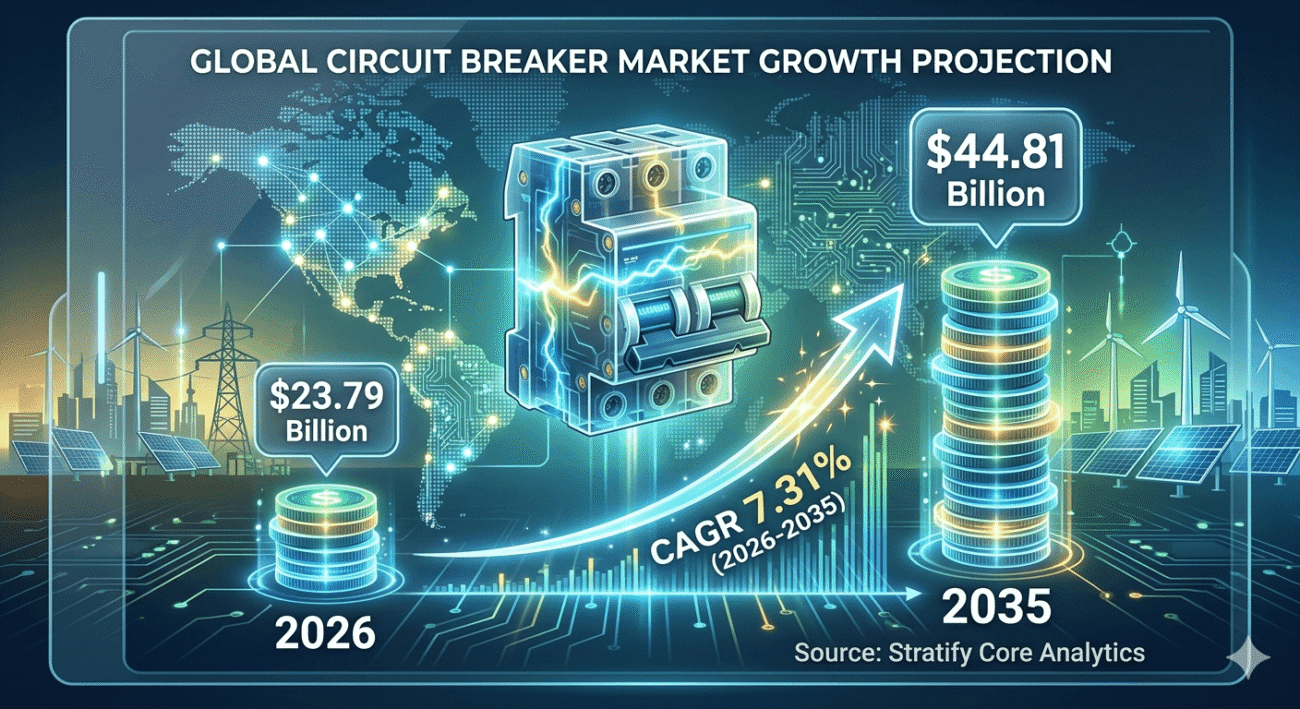
The Global Circuit Breaker Market size is predicted to increase from USD 23.79 Billion in 2026 to approximately USD 44.81 Billion by 2035, expanding at a CAGR of 7.31% from 2026 to 2035.
The worldwide circuit breaker market has been experiencing tremendous growth in the last decade due to increased demand for secure and dependable power distribution systems, growing investments in the infrastructure of renewable energy resources, and speedy industrialization in developing nations. Circuit breakers are devices used for the protection of an electrical circuit from the damaging effects of overcurrent, short circuit, or another fault. They are utilized in various applications such as residential, commercial, industrial, and utility for an assured, uninterrupted power supply.
Escalating demand and expansion of power generation and transmission networks across the world are the prime factors contributing to the overall growth of the circuit breaker market. Investments from government and private players are rising at a brisk pace for the development of smart grid and modernized electrical infrastructure to meet the burgeoning electricity requirement. Thus, the consumption of sophisticated circuit protection devices has increased rapidly. Furthermore, growing implementation of construction projects for urban development, data centers, manufacturing plants, etc have augmented the requirement of circuit breakers across several end-user industries.
Based on voltage type, insulation type, end-user industry, and geography, the market has been classified. By voltage type, the market is divided into low, medium, and high voltage circuit breakers. Low-voltage circuit breakers are widely used in commercial buildings and homes; however, high-voltage circuit breakers are anticipated to witness robust growth due to large investments in high-power transmission projects and renewable energy integration.
Circuit breakers are classified as air circuit breakers, oil circuit breakers, vacuum circuit breakers, and gas-insulated circuit breakers based on the type of insulation. Increasing usage of vacuum and gas-insulated circuit breakers as they possess high performance characteristics, compact design, and low maintenance needs. Gas-insulated circuit breakers, especially SF6 circuit breakers, are highly popular in high-voltage applications due to their exceptional insulation and arc-quenching characteristics.
Growing integration of renewable energy sources like solar and wind power provides numerous opportunities for the circuit breaker market. Modern renewable energy systems need sophisticated electrical protection equipment to facilitate effective power transmission and stability. Accordingly, Manufacturers are coming up with technologically advanced and environmentally friendly circuit breakers to support modern energy infrastructure.
Advancements in technology have an important role to play in modernizing the circuit breaker industry. Companies are embedding digital monitoring systems, IoT connectivity, and predictive maintenance capabilities into circuit breakers for enhanced operational efficiency and reliability. Smart circuit breakers help in real-time monitoring of the electrical systems, allowing users to diagnose faults instantly and reduce downtime.
Regionally, Asia-Pacific dominates the circuit breaker market in the world owing to the quick industrialization, rapid urbanization, and increased investment in the development of power infrastructure. The increasing demand for electricity and the expansion of the grid in countries like China, India, Japan, and South Korea are the main driving forces behind the demand for circuit breakers. China is a large manufacturer of electrical appliances as well as the largest contributor to the market revenue. North America also shows a high share in the market owing to the upgrades of old power systems and an increase in the application of renewable energy technologies. The investment from the U.S. in the modernization of the grid and smart energy system also opens up opportunities for the circuit breaker manufacturers. The European market is the largest and grows well because of the need for energy efficiency, renewable energy installation, and industrial automation.
The Middle East and African countries will grow stably with their increasing investment in the development of infrastructure, oil and gas projects, and utilities network expansion. While in the Latin American countries, growing urbanization and industry growth have led to the demand for stable electric systems.
The competitive landscape for the global circuit breaker market is highly fragmented as various domestic and global players are competing to gain a foothold in the market. Major players in the market are looking for opportunities to expand market presence through merger & acquisition, new product development, and joint ventures to strengthen product portfolios and reach across geographic boundaries. The leading players are investing in research & development to make energy-efficient and environment-friendly products available for a variety of applications.
The top players operating in the global circuit breaker market are Schneider Electric, Siemens AG, ABB Ltd., Eaton Corporation, Mitsubishi Electric Corporation, Toshiba Corporation, General Electric, and Hitachi Energy. The major players in the market are actively engaged in bringing out innovative technologies to satisfy the needs of utility providers, industrial customers, and commercial users.
However, the market is experiencing various challenges, such as volatile prices of raw materials, stringent environmental regulations on SF6 gas emission, and the high cost of installation of high-technology circuit breaker systems. But the growing demand for smart grids, renewable energy, and industrial automation applications will compensate for such challenges.
The worldwide market for circuit breakers is expected to register considerable growth in the coming years, owing to the ever-growing demand for effective power protection systems, the upgrading of power networks, and the focus on power saving and safety. Moreover, improvements in digital technologies and increasing usage of renewable energy resources will provide more profitable prospects to the stakeholders.
Key Circuit Breaker Market Trends
The changing global circuit breaker market is booming, fueled by increased electricity demands, the modernization of the grid, the increasing use of renewables, and the growth of industrial automation. Circuit breakers, vital components used for electrical system protection against faults, such as overloads and short-circuits, are crucial across all segments of the market, including residential, commercial, industrial, and utility segments. Strong growth is predicted over the next decade as governments and industries invest large sums in the update of electrical infrastructure and energy-efficient equipment.
One important trend in the market is the rapid adoption of smart circuit breakers. Smart circuit breakers feature capabilities like digital monitoring, remote control, and preventive maintenance. Smart circuit breakers have become increasingly favored in smart homes, smart buildings, and smart industries because they ensure both improved operational performance and less downtime. According to market research, the smart circuit breaker market is anticipated to expand considerably in the coming few years as more smart electrical systems with Internet of Things technology and industrial automation solutions are deployed.
The increasing development of smart grids globally represents another important market trend. Countries and electric utilities are upgrading old electrical distribution and transmission networks to ensure the reliability and control of electricity delivery. With the proliferation of smart grids, the need for intelligent circuit protection devices that can manage dynamic power flow and renewable energy sources is growing exponentially. This has given a spur to the demand for smart communication and monitoring capabilities, thereby boosting the market for medium and high voltage circuit breakers. Growing economies with high and fast-growing electricity demands are leading in smart grid development.
The increasing connection of renewable power generation has given rise to ample opportunities in the circuit breaker industry. This is because solar, wind, and energy storage facilities need robust and reliable protection systems for their operational safety and the stability of power systems. Circuit breakers are important components required for coupling new renewable power generation facilities with existing electricity grids while managing potential faults and overloads, thus protecting the power systems. As governments increasingly invest in renewable energy resources in pursuit of their clean energy targets, the market for high-quality circuit breakers will expand significantly.
The build-up of the EV infrastructure represents one of the other crucial areas of growth for the market. The continued establishment of electric vehicle charging stations in residential, commercial, and public sectors will demand enhanced electrical protection measures. The charging stations, particularly the fast charging stations, will necessarily rely on high-capacity circuit breakers with high performance for electrical load handling and user safety. Given the governmental boost towards mobility driven by the incentive programs and the building up of infrastructure throughout the globe, demand for the circuit breakers specifically designed for EVs will rise steadily in coming few years.
The automation trend in the industry and the digital transformation trend also stand as the other major forces impacting the growth of the market. Automation is increasingly finding its use in the manufacturing sector, data centers, and industrial plants, where the systems will always need a continuous power supply and advanced protection methods to work efficiently. Today’s circuit breakers come with advanced features such as real-time monitoring of electric supply and fault analysis and protection capabilities, which will help the industries boost production and also lower the maintenance costs. In addition, due to increased deployment of data centers and cloud infrastructure, demand for the low-voltage and medium-voltage protection systems has also increased considerably.
Another prominent technology trend in this industry is the growth of solid-state circuit breakers. In comparison to mechanical circuit breakers, solid-state circuit breakers offer super-fast fault interruption and increase the overall system reliability. These breakers are becoming highly prevalent in systems related to renewable energy sources, electric mobility, and data centers, as they offer more efficiency and lower maintenance needs. Advancements in materials science regarding semiconductor materials such as silicon carbide (SiC) and gallium nitride (GaN) are enabling solid-state circuit breakers to become more feasible commercially and power-efficient.
Regional expansion trends also continue to affect the landscape of the global market. The APAC region continued to be the fastest-growing regional market owing to ongoing urbanization, industrialization, and infrastructural development, particularly in nations like China, India, and those from Southeast Asia. The market in APAC is expected to grow with huge investments in power distribution networks, smart cities, and industrial applications. Reports show that the APAC region accounts for the majority of global market share and will maintain its robust growth in the forecast period.
Product innovation in the circuit breaker market is being driven by sustainability and energy efficiency regulations. Governments and regulatory bodies are imposing tight safety and energy efficiency standards on electrical components and devices. Manufacturers, in turn, are coming up with innovative, highly energy-efficient, and environmentally friendly, as well as space-saving circuit breakers. Heavy investment in research and development activities in order to develop innovative products that comply with new standards and customer needs can be seen among various manufacturers. The competitive landscape in the market is turning very competitive as key players are going in for mergers and acquisitions, strategic partnerships, and new product launches.
ABB, Siemens, Schneider Electric, Eaton, and GE are focusing on Smart technology, grid modernization technology, and energy efficiency technology in tune with the worldwide rising demand, and innovation and diversification will only intensify the competition. The circuit breaker market is moving forward fast due to advancements in technology, growth in renewable energy and electrification, as well as expansion in the digital infrastructure; high reliability in power distribution, improved safety performance, and smarter energy management will remain the driving force for higher global demand for the intelligent circuit breaker technologies
Circuit Breaker Market Key Restraints
The global circuit breaker market is witnessing consistent growth driven by an increase in investments for power infrastructure, renewable energy incorporation, and industrial automation, among others. Although the demand for circuit breakers has been substantial across residential, commercial, and industrial sectors, the market is also subject to several constraints, which are likely to limit the growth of the market over the forecast period. The various restraints related to the market include high installation costs, technical constraints, regulatory issues, and fluctuating raw material prices.
The high cost of sophisticated circuit protection systems is one of the main restraints for the circuit breaker market. Advanced circuit breaker devices, such as digital and smart circuit breakers, use advanced sensing, monitoring, and component technology, which raises the manufacturing and installation cost of circuit breakers. Small and medium enterprises (SME) hesitate to invest in advanced technology circuit breakers, especially in developing countries, owing to budget constraints. The cost of modifying the electrical infrastructure system with advanced circuit breaker technology adds to the retrofitting cost.
Fluctuations in the price of raw materials pose another important challenge for the circuit breaker market. Circuit breakers require materials like aluminum, copper, silver, insulating materials, etc., to perform operations. Price fluctuation of these materials directly impacts the production cost and profitability for the manufacturer. The increasing price of metals, supply chain interruptions, and global tension have challenged the procurement process in the past few years. Manufacturers may find it difficult to keep product prices competitive while at the same time meeting desired quality standards.
The stringent and complex regulatory and safety standards are another factor that acts as a constraint in the circuit breaker market. Electrical safety standards are different for different countries, which in turn requires manufacturers to abide by several approval and testing standards to introduce the product in a country. Acquiring approval from the regulatory bodies takes time and expense, especially for companies seeking to expand their reach into different countries. Violation of rigorous compliance requirements could lead to penalties or a product recall, or slow down product introduction, which would directly affect the growth of the market.
A low level of awareness and lack of technical know-how in developing countries form another restraint. In most of the emerging countries, the end users still prefer conventional fuse systems or older forms of electrical protection devices due to the lack of awareness of the benefits of modern circuit breakers. Also, there is a deficiency of technical experts who can manage the installation and maintenance of sophisticated circuit protection systems, which would then slow down the adoption. The lack of technical knowledge is more profound in remote rural and underdeveloped areas.
The evolving nature and increasing complexity of electrical networks are giving rise to operational challenges for circuit breaker manufacturers as well. Modern electrical grids are being decentralized with the integration of solar and wind power generation to combat the growing global need for energy, creating more complex grid architectures where highly reliable and intelligent circuit protection technologies are needed to deal with changing load profiles and fault conditions. Developing these types of circuit breakers in a cost-effective manner presents a significant engineering hurdle to players.
The presence of counterfeit and low-quality products in the electrical network market can hinder growth. Customers of circuit breakers will purchase less expensive units that often do not conform to international safety standards in the face of price-sensitive consumer buying decisions. Such fake circuit breakers threaten to increase electrical failures, fire risks, and the possibility of equipment damage, undermining consumer confidence, creating uneven competition with manufacturers making large investments in R&D and quality assurance efforts.
Another critical limitation observed in recent years is the supply chain disruptions. Major global events such as global pandemic, geopolitical events, transportation congestion, and so on have led to a shortage of supply of components and raw materials needed for the manufacturing of circuit breakers. This delay in production schedules and escalation of logistics costs have hit the manufacturers throughout the value chain. The manufacturers who rely on international suppliers can suffer from the consequences and face issues in carrying out the projects within the schedule.
Environmentally related issues concerning some types of circuit breakers are another factor that poses constraints in the market. For instance, sulfur hexafluoride (SF6) used in high voltage circuit breakers acts as an insulating agent, and it is well known to have a high global warming potential (GWP). In response to environmental regulations aimed at decreasing the level of greenhouse gases, manufacturers have been encouraged to develop environmentally sustainable circuit breakers. The adoption of eco-friendly technologies demands substantial investment in research, product development, and testing, thereby leading to a rise in the cost.
Competition in the circuit breaker market is also high, which narrows margins further. The market contains a variety of global and local firms that compete based on price, innovation, and distribution. As the need for new technology at competitive price points becomes a prerequisite to compete, circuit breaker manufacturers’ margins may erode further. Small firms may also face issues competing against the strong brand name and resources of established firms.
Finally, market demand is subject to economic downturns and to the building and construction industries. Circuit breakers can be applied to residential housing, large construction projects, manufacturing facilities, and electrical distribution networks. This will limit revenue growth for market participants. During times of recessionary economic conditions, spending on construction and industrial growth declines, leading to lower demand for all forms of electrical equipment.
While there is potential for market growth in the circuit breaker industry on account of the growth of power infrastructure, as well as the development of new technologies, there are some restraints hampering industry development. These restraints include relatively high installation costs of the product, price volatility of raw materials, stringent regulatory policies, supply chain disruptions, and environmental issues. Overcoming these restraints with innovation, environmentally friendly products, and capital investments will remain crucial in the sustained development of the global circuit breaker market.
Circuit Breaker Market Key Opportunities
Increasing power consumption, rising levels of industrialization, and rapid development of urban infrastructure globally have increased the global market for circuit breakers significantly. The circuit breaker is an electrical safety device, used for the protection of an electrical circuit from overload conditions, short circuit, and other such hazards, for the prevention of damage to electrical apparatus. Continued investment by both governments and private sectors in smart grids, renewable energy integration, industrial automation, and upgrading old electricity distribution systems offers promising opportunities for various manufacturers, suppliers, and technology providers across the globe.
A significant opportunity is available in the circuit breakers market due to the expansion in renewable energy projects across the world. Modern renewable energy sources like solar, wind, and hydro power generation require a modern and advanced electrical protection system to secure stable and smooth transmission of power. This electricity distribution system operates on various load conditions, due to which there is a higher demand for high-tech circuit breakers capable of controlling varying loads. Asian Pacific, European, and North American countries are investing hugely in clean energy production systems, increasing the market demand for novel circuit protection solutions.
The increasing implementation of smart grids presents itself as a further opportunity. Smart grids demand intelligent electrical systems that can analyze and report in real-time, detect faults automatically, and restore power quickly. In such an environment, circuit breakers that have digital monitoring and IoT-enabled features are considered a necessity. Smart circuit breakers not only help in improving energy efficiency but also minimize system downtime and provide better overall grid stability. Utilities and power suppliers across the globe are opting for smart electrical solutions over traditional electrical systems, providing long-term growth opportunities for the market.
Emerging economies with accelerated urbanization and infrastructure growth are also creating a niche of demand for the circuit breaker market. Countries like India, China, Brazil, and some Southeast Asian economies are undergoing huge investments in residential infrastructure development, transport networks, commercial infrastructure, and industrial establishments. The growth in construction of smart cities and metro railway networks would raise the demand for electrical protection equipment, which assures to maintain unhindered power supply to protect against electrical incidents.
Industrial automation and modernization of manufacturing are two of the prominent factors for the increase in demand for circuit breakers. Modern industries like automotive, oil and gas, chemical, food and beverage processing, mining, etc. Are growing in terms of the installation of automated machinery and robotics for increasing production rates and enhancing their operational efficiency. Automated systems rely heavily on electrical protection equipment to protect costly equipment from electrical faults. With industries switching to Industry 4.0, the demand for intelligent, high-current capacity circuit breakers is expected to grow rapidly in the coming years.
The data center industry is turning out to be a booming market for circuit breaker manufacturers. Driven by an increase in cloud computing, AI, e-commerce, digital services, and other modern technologies, the number of hyperscale and colocation data center constructions has exploded across the globe. These centers need an uninterrupted power supply along with high-tech electrical protection systems to maintain the smooth functioning of their services and protect sensitive equipment from being affected by power surges and failures. The growth in data centers is expected to create the largest growth segment for low-voltage and medium-voltage circuit breakers.
The expansion of EV infrastructure will also provide opportunities. Many countries, on a global level, support electrically driven vehicles through subsidies, regulations concerning the emission levels and the installation of charging station infrastructure for electric vehicles. High-quality and reliable circuit breakers are needed in electric vehicle stations to distribute electricity safely and efficiently. Since the sales are globally expected to increase, the sales volume of circuit breakers dedicated to home charging stations, public, and commercial are also expected to increase regularly.
Technological improvements have led to new opportunities in the circuit breaker market as well. The market stakeholders are increasingly focusing on eco-friendly,energy-efficient circuit breakers according to the modern emission rules. Thus, vacuum circuit breakers and SF6-free circuit breakers have become very popular due to their low environmental impact and high performance during their operational mode. Besides that, industrial and utility sectors are showing interest in digital circuit breakers that have remote controls, remote diagnoses, and predictive maintenance, as these types offer good advantages in lowering costs of maintenance, fault analysis, and efficiency.
The replacement of old electrical equipment on a large scale in developed nations has provided a large growth for maintenance and after-market services. The modernization and retrofitting of existing old electrical protection systems with the modern circuit breakers in industrial facilities, utilities, and the commercial sector will increase the revenue and sales of the market stakeholders. Therefore, service providers are expected to gain from installation and inspection services.
Regionally, the Asia Pacific region is anticipated to grow as the fastest-growing market because of rapid industrialization, a rise in urban population, and heavy investments made in power infrastructure. China and India are still contributing most of the regional demand as both countries possess aggressive government plans that promote electrification and renewable energy adoption. On the other hand, Europe and North America are currently concentrating on modernizing the electrical grid, accelerating the adoption of renewable energy sources, and encouraging technological innovations. This trend will consequently open up more demand for intelligent circuit breaker solutions.
The market for circuit breakers is poised for significant growth and expansion based on renewable energy expansion, the modernization of the smart grid, infrastructure development, increased industrial automation, a growing number of data centers, and the widespread adoption of electric vehicles. With greater focus on safety, technological innovation is being widely used to accelerate circuit protection systems across all sectors. This sector favors smart, energy-efficient, and environmentally safe circuit breaker technologies, where companies focused on these innovative technologies are expected to have a competitive edge over others in the global market.
Circuit Breaker Market Key Drivers
The circuit breaker market across the globe is poised to grow at a brisk pace on the back of increasing electricity demand, booming industrialization, increasing infrastructure projects, and the growing implementation of renewable energy sources. A circuit breaker is an electrical safety device intended to protect an electrical circuit from overcurrent, overloads, and electrical shorts. In line with the advancements and interconnections of power distribution networks, the demand for robust and effective circuit protection systems continues to rise in residential, commercial, and industrial sectors.
The growing electricity demand worldwide is one of the major drivers of the circuit breaker market. The increasing population and rise in urbanization have led to an immense demand for electricity globally. Developing countries are investing in the upgradation of power generation and transmission infrastructure to support the rising electricity needs of their respective populations. Simultaneously, utility companies and governments are making investments in strengthening the transmission lines and in enhancing the modern transmission grids, and in doing so, have increased the demand for highly advanced circuit breakers. High-voltage and medium-voltage circuit breakers are among the most widely used circuit breakers in utility and industrial sectors.
The expansion of renewable energy sources across the world is another dominant driver of the circuit breaker market growth. The rise in the installation of solar power stations, wind power stations, and hydropower stations has enhanced the demand for adequate electrical protection systems for operational safety and power fluctuation management. Power integration into national grids through renewable energy systems has induced the market growth for modern circuit breakers capable of withstanding variable energy inputs and providing consistent output. Implementation of clean energy policies and investment in sustainable power infrastructure in various countries are among the key enablers of the circuit breaker market.
The quick growth in the industrialization and manufacturing sectors is further boosting the circuit breaker market. Industries like automotive, oil & gas, mining, chemical, construction, and data centers make use of an enormous number of electric appliances and automation control systems. These devices demand safe, dependable circuit protection equipment to prevent apparatus failure and reduce work interruptions and safety hazards. The increased use of industrial automation and smart manufacturing is further accelerating the circuit breaker market demand.
The building industry is also contributing to the market growth due to the expanding number of new residential and commercial building construction works. The electric distribution systems in modern buildings require complicated electric control systems for supplying power for lights, HVAC systems, lifts, appliances, and communications networks. The circuit breakers play a critical role in protecting the systems and preventing electrical fires. With the increased demand for smart and intelligent buildings and houses, smart and small in size, with power-efficient and technically advanced circuit breakers, has become a major product of interest.
The technological advancement in electrical protection systems is also one of the driving forces for the circuit breaker market. The companies are constantly striving to produce circuit breakers with Internet of Things, Artificial Intelligence, and real-time control and supervision features that are smart circuit breakers. With predictive maintenance, fault diagnostics, energy management, and remote operational control features, these smart circuit breakers reduce overall working costs and enhance working efficiency. The spread of smart grids and digital substations is driving the application of smart circuit breakers.
Another factor influencing the circuit breaker market positively is government regulation and safety standards. Various governments across countries have framed the electrical safety regulations that would minimize electrical accidents, equipment failure, and fire occurrence. Following the electrical safety standards has been made mandatory in residential, commercial, and industrial electrical systems. Thus, it is leading the businesses and consumers toward buying the highest quality of circuit protection devices to comply with regulations and maximize workplace safety.
Investment in power transmission and distribution infrastructure will expand the market size in the forthcoming years. Countries have been focusing on developing existing grid systems in an attempt to decrease energy inefficiency and transmission losses and to meet the energy demand from customers. Smart grid development and rural electrification schemes are creating a need for circuit breakers in substations, transmission, and distribution lines. Developing countries in regions like Asia-Pacific, the Middle East, and Africa are investing huge sums in power transmission and distribution projects, which have helped the market grow.
Growth in Electric Vehicles (EVs) and the development of charging infrastructure are contributing to the emergence of a new market driver for circuit breakers. High-load power systems are incorporated in charging devices of electric vehicles, which require additional safety to operate efficiently. Many governments around the world are facilitating the uptake of electric mobility through the provision of grants and incentives to develop electric vehicle charging infrastructure, and thus promoting the demand for low and medium-voltage circuit breakers. Adoption of Battery Energy Storage Systems is also expected to grow the market.
In addition, the growth of data centers and the telecommunications sector is also driving market growth. Data centers require a consistent and reliable electricity supply to prevent system shutdowns and data loss, and circuit breakers play a crucial role in safeguarding servers, panels, and backup power units against electrical disturbances. Rising demand for cloud computing, artificial intelligence, and other digital applications has led to increased investment in data center construction, thereby augmenting demand for sophisticated circuit protection devices.
Overall, the circuit breaker market is anticipated to maintain a healthy growth trend throughout the forecast period, driven by factors such as increasing power consumption, rapid growth of renewable energy, growing automation in industries, infrastructure development, and technological innovations. Industry participants continue to heavily invest in research & development activities to bring to market energy-efficient, compact, and smart circuit breakers in response to dynamic industry demands. Amid growing focus from industries and governments on improvement of electrical safety, grid reliability, and energy efficiency, strong global demand for smart circuit breakers is expected to persist.
Circuit Breaker Market Segment Insights
The growing electricity demand and the accelerating rate of industrialization and urban infrastructure development, along with high investments in smart grid technologies, are major factors that have resulted in the substantial growth of the global circuit breaker market. A circuit breaker is an important safety electrical device that is utilized to protect electrical circuits against short circuits, overloads, and equipment failures. They are extensively employed across residential, commercial, industrial, and utility sectors for safe functioning and an uninterrupted supply of power. The widespread integration of renewable energy sources and the upgradation of the old power grid system are also leading to growth.
The circuit breaker market is further classified on the basis of voltage, type, installation, end-user industry, and geography. These segments are of immense importance in determining market dynamics and growth. However, technological innovation, compact and safety features, and digital monitoring systems are where the manufacturers are keen on investing to improve their market position.
By Voltage
The market is segmented into low voltage, medium voltage, and high voltage circuit breakers based on their voltage rating. The low voltage segment held the largest share of the global market due to its broad use in residential, commercial, and small industrial sectors. Low-voltage circuit breakers are utilized in distribution boards and electric appliances to prevent overload of current and short circuits.
The growth of the medium voltage segment is spurred by growing investment in industrial power systems, industrial plants, and renewable energy facilities. Medium voltage circuit breakers are generally used in substations, power distribution grids, and industrial automation systems to provide protection against electricity.
Steady growth in the high voltage segment is predicted with the rapidly expanding transmission and distribution networks in developing economies. High-voltage circuit breakers are most commonly utilized in power generation plants and utility sectors to handle high-voltage loads.
By Type
By type, the circuit breaker market is classified into air circuit breakers, vacuum circuit breakers, oil circuit breakers, gas circuit breakers, and molded case circuit breakers. Among the various types, vacuum circuit breakers are highly demanded owing to their efficient operation, reliability, low maintenance needs, and eco-friendly nature. This breaker is used in many of the medium voltage and industrial applications, and is more widely replacing other types of breakers.
Air circuit breakers are used more often for low-voltage applications, especially in industrial and commercial establishments, to ensure efficient distribution of power and maintenance of safety. Molded case circuit breakers are also in huge demand owing to their compact nature, cost efficiency, and easy installation characteristics.
Gas circuit breakers, particularly SF6 breakers, are widely utilized in high voltage applications due to their greater efficiency in quenching the arcs and good operational characteristics. But they pose harmful effects to the environment as they emit gases which are considered greenhouse gas hence leading to greater demand for earth-friendly types.
By Installation
According to the installation, the market is segmented into indoor and outdoor circuit breakers. The indoor circuit breaker holds a significant market share owing to the escalating construction of commercial complexes, data centers, apartments, and industries. Indoor circuit breakers are ideal for enclosed spaces and facilitate efficient operation while decreasing the maintenance requirements.
The outdoor segment is anticipated to witness significant growth owing to the increasing investments in utility infrastructure, renewable power plants, and transmission networks. Outdoor circuit breakers are specially designed to operate under severe atmospheric conditions and are installed at substations and power distribution systems.
By End-User Industry
The circuit breaker market is classified into several end-user industries, such as residential, commercial, industrial, utilities, transportation, and renewable energy industries. The utilities industry has a sizable share in the circuit breaker market as electricity transmission and distribution networks are continuously growing all over the world. Energy demand and government incentives to improve power grid efficiency are fueling segment growth.
The industrial industry is also growing at a rapid pace due to the increasing use of advanced machinery, automation, and smart manufacturing solutions. Industries like oil and gas, mining, chemicals, automotive, and manufacturing industries need efficient electrical protection to continue with operations safely. The renewable energy industry represents a promising market for circuit breaker manufacturers as solar, wind, and energy storage industries require efficient and modern protection devices to deal with fluctuating power demands and grid integration issues.
Regional Insights
Regionally, the market is divided into North America, Europe, Asia Pacific, Latin America, and the Middle East & Africa. Asia Pacific is currently holding the largest share in the global circuit breaker market owing to the fastest industrialization, urbanization, and huge investment made in the development of power infrastructure in the nations of China, India, Japan, South Korea, etc. In the region, initiatives by the government for rural electrification and the integration of renewable power are also driving the market.
The North American and European regions are exhibiting a stable market growth as the old electricity networks are being upgraded with advanced technology, and the demand for smart grids and investments in renewable energy sources is increasing at a rapid pace. The Middle East & Africa region will also grow at a substantial pace as it is experiencing growth in construction projects and power infrastructure projects. With technology innovation, growing electricity consumption, and a focus on electrical safety and efficiency, the global circuit breaker market is expected to register a stable growth rate in the forthcoming years.
Circuit Breaker Market, Regional Analysis
The global circuit breaker market is expected to witness robust growth owing to factors such as rising investments in the power sector, industrial growth, increasing urbanization, and a strong need for reliable power distribution systems. Circuit breakers are important safety devices in electrical circuits that are used for protecting them from damage arising from overloading, short circuits, and electrical faults. Growing investments in the upgradation of the power grid, along with a significant rise in renewable energy projects on a global scale is fuelling regional demand for advanced circuit breaker solutions.
A region-wise study of the global circuit breaker market indicates a different pace of growth in North America, Europe, Asia-Pacific, Latin America, and the Middle East & Africa regions, each one exhibiting a set of unique market characteristics such as growth based on industrialization, energy regulations and policies, investments in infrastructure, and technological advances. Increasing adoption of smart grids and integration of renewable energy systems is contributing to market growth on a global scale.
Asia-Pacific accounts for a dominant share in the global circuit breaker market, and is expected to retain its leading position during the forecast period. Growing demand for electricity in China, Japan, India, and South Korea, coupled with the increasing investments in the upgradation of power transmission and distribution systems to support rising industrial demand, is boosting market growth in the Asia-Pacific region. China accounts for a major market share on a global level due to rising electricity demand, a massive manufacturing base, and the implementation of large-scale renewable energy projects across the country. India is witnessing considerable market growth as a result of rising investments in power infrastructure upgradation, rural electrification projects, and smart city initiatives in the country.
The growing number of commercial buildings, industrial establishments, and housing projects being built across the Asia-Pacific also led to a growing demand for low-voltage and medium-voltage circuit breakers. Additionally, an increase in the adoption of electric vehicle charging stations and the installation of renewable energy plants will contribute to increasing opportunities for market growth. Players are expected to launch energy-efficient and technically advanced circuit breakers to cater to consumer demands and regulations.
North America: Growth of the North American market will be driven by upgrades to old electrical infrastructure, a rise in renewable energy deployments, and strong demand from industrial and commercial segments. In North America, the United States dominates the market as it invests significantly in the modernization of smart grids and grid enhancement programs. Demand for circuit breakers will also be propelled by increasing usage of automation technology in industrial manufacturing plants and data centers.
Energy efficiency and electrical safety regulations will promote the adoption of technically advanced circuit protection devices in the region. The increasing occurrence of power outages during natural disasters will further fuel the need for robust power distribution networks in North America. Steady growth in Canada can be attributed to infrastructure development projects and expanded capacity for renewable energy generation from sources such as wind and hydroelectric.
Europe: Stable growth in the European market is attributed to stringent energy efficiency regulations, a rise in the use of renewable energy sources, and the expansion of smart power grids. Countries such as Germany, the UK, France, and Italy are keenly focused on lowering carbon footprint and modernizing the electrical infrastructure in the region. The shift to a sustainable energy system is augmenting the demand for advanced circuit breakers.
Investment in electric vehicle infrastructure and industrial automation is another growth driver in the European market. Manufacturers are developing more environmentally friendly circuit breaker technologies with a lower impact on the environment so as to abide by environmental regulations. Increased adoption of digital substations and smart monitoring systems provides a growing demand for smart circuit breakers equipped with IoT technology and real-time analytic capabilities.
Latin America is slowly emerging as a lucrative market in the circuit breakers segment, owing to its increasing energy demands and continuous growth in infrastructure development. Brazil and Mexico are the primary contributors to the market growth in the region, owing to industrial developments, urbanization, and renewable energy developments across these nations. Governments across Latin America are making investments in the development of the transmission and distribution network of the grid so as to provide a stable electricity supply to all and reduce power losses. Economic fluctuations across a few countries might dampen the market growth in those areas, but still, the increased demand for electrical protection is fueling the market growth across Latin America.The
Middle East & Africa is showing a steady growth in the circuit breaker market owing to increasing infrastructure modernization, growing industrial base, and proliferation of energy projects. GCC countries are witnessing increased spending on smart cities, infrastructure in the commercial segment, and increasing usage of renewable energy, specifically solar power projects. Electrical infrastructure growth is witnessed in Africa due to increasing electrification efforts across the region and a subsequent rise in industrial development.
However, the need for circuit breakers with the ability to withstand the difficult operating conditions of the Middle Eastern oil and gas industry, and with increasing expenditure in power generation and transmission networks in African countries, will likely drive market growth in the next few years, although infrastructural limitations and economic obstacles will limit market penetration in some areas.
In summary, a variety of factors will see regional growth across the global circuit breaker market. Infrastructure upgrades, technological progress, and growing electricity demands are just some of the drivers that will contribute to increased market activity in all regions globally. The market in Asia-Pacific is predicted to lead the market in terms of regional growth, while the regions of North America and Europe will see a more modest market growth due to a focus on the modernization of the grid and on integrating renewable energies. Other promising markets that will continue to develop over the next few years are Latin America and the Middle East & Africa, due to a desire for greater electrification, the expansion of industries, and government interest in developing the market. An increasing number of new and improved smart, energy-efficient circuit breaker technologies could change this over the course of the next decade.
Top Key Players Operating in the Circuit Breaker Market
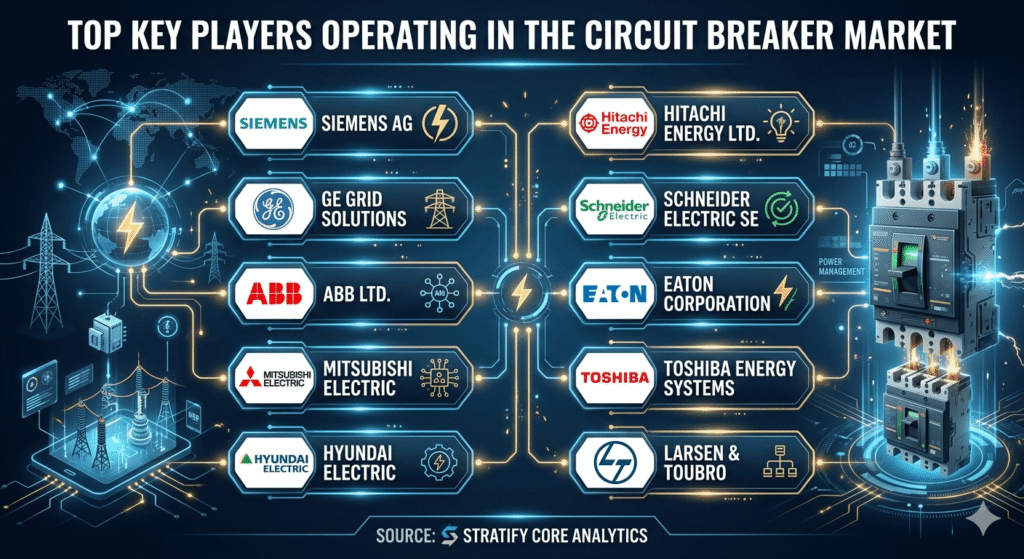
- Siemens AG
- Hitachi Energy Ltd.
- GE Grid Solutions
- Schneider Electric SE
- ABB Ltd.
- Eaton Corporation plc
- Mitsubishi Electric Corporation
- Toshiba Energy Systems & Solutions Corporation
- Hyundai Electric & Energy Systems Co., Ltd.
- Larsen & Toubro Limited
Circuit Breaker Market FAQ
1. What is driving the growth of the circuit breaker market?
The growth of the circuit breaker market is driven by increasing demand for reliable power distribution systems, rapid industrialization, expansion of renewable energy projects, and rising investments in smart grid infrastructure. Growing urbanization and the need for electrical safety in residential, commercial, and industrial sectors also contribute significantly to market expansion.
2. Which types of circuit breakers are most commonly used?
The most commonly used circuit breakers include air circuit breakers (ACB), molded case circuit breakers (MCCB), miniature circuit breakers (MCB), and vacuum circuit breakers (VCB). MCBs are widely used in residential applications, while MCCBs and VCBs are preferred for industrial and commercial electrical systems.
3. Which regions dominate the global circuit breaker market?
Asia-Pacific dominates the global circuit breaker market due to rapid infrastructure development, growing electricity demand, and increasing industrial activities in countries such as China and India. North America and Europe also hold significant market shares because of the modernization of aging power infrastructure and the adoption of advanced electrical protection systems.
4. What are the future trends in the circuit breaker market?
Key future trends in the circuit breaker market include the adoption of smart circuit breakers with IoT connectivity, integration of renewable energy systems, development of eco-friendly insulation technologies, and increasing demand for energy-efficient electrical protection devices. Automation and digital monitoring solutions are expected to further shape the market in the coming years.
