
Global Border Security Technologies Market Overview
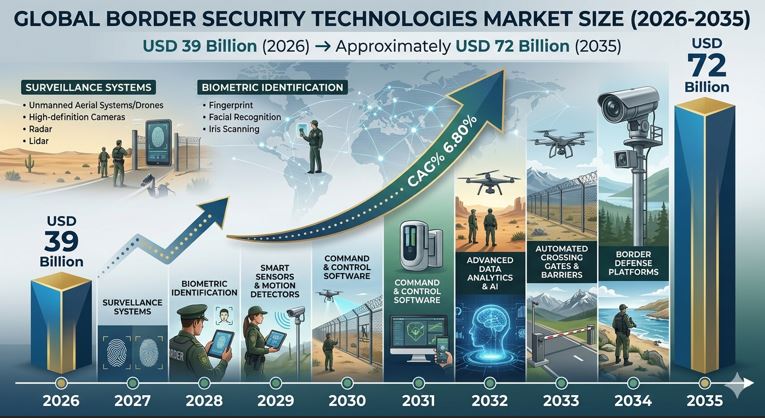
The global border security technologies market size is predicted to increase from USD 39 Billion in 2026 to approximately USD 72 Billion by 2035, expanding at a CAGR of 6.80% from 2026 to 2035.
The global border security technologies market has become a critical component of national defense and public safety strategies as governments face increasingly complex challenges related to illegal migration, terrorism, smuggling, human trafficking, and cyber-enabled cross-border crimes. Over the past decade, the scope of border security has expanded significantly beyond traditional physical surveillance to include advanced digital systems, integrated intelligence platforms, and automated monitoring solutions. This shift is driven by the need for faster threat detection, improved situational awareness, and coordinated responses across land, air, and maritime borders.
One of the primary factors fueling growth in this market is the rising geopolitical instability in several regions across the world. Conflicts, economic disparities, and climate-related displacement have led to increased cross-border movements, placing pressure on governments to strengthen surveillance and control mechanisms. In response, countries are investing heavily in modernizing their border infrastructure, deploying advanced technologies such as radar systems, biometric identification tools, unmanned aerial vehicles (UAVs), and integrated command and control systems.
Biometric technologies have emerged as a cornerstone of modern border security frameworks. Systems such as facial recognition, fingerprint scanning, iris recognition, and voice identification are widely used to verify traveler identities and reduce the risk of identity fraud. These technologies are increasingly integrated into e-passport gates, visa processing systems, and immigration checkpoints, enabling faster and more accurate passenger screening while maintaining security standards.
Another major segment driving market expansion is surveillance and detection systems. These include ground surveillance radars, thermal imaging cameras, infrared sensors, and motion detection technologies. Such systems are especially vital for monitoring remote or high-risk border areas where physical patrols may be limited. The integration of artificial intelligence and machine learning into surveillance systems has further enhanced their capabilities, allowing for real-time threat detection, automated alerts, and predictive analytics based on behavioral patterns.
Unmanned systems, particularly drones and autonomous ground vehicles, are also transforming border monitoring operations. UAVs provide aerial surveillance over difficult terrains such as deserts, mountains, and coastal regions, offering real-time imagery and video feeds to border control centers. These systems are often equipped with advanced sensors and communication modules, enabling long-range reconnaissance and rapid response coordination. Similarly, unmanned ground vehicles are used for patrolling and inspection tasks in hazardous environments.
Communication and data integration platforms form another essential pillar of the border security technologies market. Modern border management relies heavily on seamless data sharing between multiple agencies, including customs, immigration, coast guards, and intelligence units. Integrated platforms enable centralized command centers to process large volumes of data from various sources, improving decision-making and operational efficiency. Cloud computing and big data analytics are increasingly being adopted to enhance interoperability and scalability of these systems.
Cybersecurity has also become an integral part of border security strategies. As border management systems become more digitized and interconnected, they are increasingly vulnerable to cyber threats. Governments are therefore investing in robust cybersecurity frameworks to protect sensitive data, prevent system breaches, and ensure the integrity of digital border infrastructure. This includes encryption technologies, intrusion detection systems, and secure communication networks.
From a regional perspective, North America remains a dominant market due to significant defense spending, advanced technological infrastructure, and early adoption of integrated border security solutions. The United States, in particular, continues to invest in upgrading its border surveillance systems and immigration control technologies. Europe follows closely, driven by migration pressures and coordinated border management initiatives across the European Union. Meanwhile, the Asia-Pacific region is expected to witness the fastest growth, supported by increasing defense budgets, territorial disputes, and large-scale infrastructure modernization projects in countries such as India and China.
Despite strong growth prospects, the market faces certain challenges, including high implementation costs, concerns over data privacy, and the complexity of integrating legacy systems with new technologies. Additionally, the need for continuous technological upgrades and skilled personnel poses operational constraints for many countries.
Looking ahead, the global border security technologies market is expected to continue evolving toward more intelligent, automated, and interconnected systems. The adoption of artificial intelligence, machine learning, and predictive analytics will further enhance the effectiveness of border management operations. As security threats become more sophisticated, the demand for comprehensive, technology-driven border protection solutions will remain strong, shaping the future landscape of global security infrastructure.
Border Security Technologies Market Trends
The border security technologies market is undergoing a rapid transformation driven by technological innovation, evolving geopolitical risks, and the increasing need for integrated security frameworks. Governments across the world are no longer relying solely on traditional physical barriers and manual inspections; instead, they are adopting advanced, data-driven, and automated solutions to strengthen border control. Several key trends are shaping the future of this market, influencing how nations monitor, protect, and manage their borders.
One of the most significant trends is the growing adoption of artificial intelligence (AI) and machine learning (ML) in border surveillance and threat detection systems. These technologies are being used to analyze vast amounts of data collected from sensors, cameras, drones, and biometric systems. AI-powered platforms can identify suspicious behavior patterns, detect anomalies in real time, and generate automated alerts for border security personnel. This reduces human error and enhances response time, making border operations more efficient and proactive.
Another major trend is the increasing use of biometric authentication systems. Biometric technologies such as facial recognition, iris scanning, fingerprint identification, and even gait analysis are becoming standard tools at airports, seaports, and land checkpoints. These systems improve identity verification accuracy and reduce the chances of identity fraud or unauthorized entry. Many countries are integrating biometrics into electronic passports and digital identity systems, enabling seamless traveler verification while maintaining high security standards.
The expansion of unmanned systems, particularly drones and autonomous ground vehicles, is also reshaping border surveillance strategies. Drones equipped with high-resolution cameras, thermal sensors, and night-vision capabilities are widely used for monitoring remote and difficult-to-access border areas. They provide real-time aerial surveillance and can quickly relay information to command centers. Autonomous ground vehicles complement these efforts by patrolling sensitive zones, detecting intrusions, and supporting law enforcement operations without risking human personnel.
Integrated border management systems are another key trend gaining momentum. These systems bring together various security components—such as surveillance cameras, radar systems, communication networks, and databases—into a unified platform. This integration allows different agencies, including immigration, customs, and defense forces, to share real-time information and coordinate responses more effectively. Cloud-based platforms and big data analytics are increasingly being used to enhance the scalability and interoperability of these systems, enabling faster decision-making and improved situational awareness.
Cybersecurity has also emerged as a critical focus area within border security technologies. As border control systems become more digitized and interconnected, they are increasingly vulnerable to cyberattacks, data breaches, and system disruptions. To address these risks, governments are investing in advanced cybersecurity solutions, including encryption technologies, intrusion detection systems, firewalls, and secure communication protocols. Protecting sensitive traveler data and ensuring the integrity of border infrastructure has become a top priority.
Another important trend is the shift toward smart border infrastructure. Countries are investing in intelligent border checkpoints equipped with automated kiosks, e-gates, and sensor-based monitoring systems. These smart infrastructures reduce waiting times, improve passenger flow, and enhance operational efficiency while maintaining strict security controls. The use of Internet of Things (IoT) devices in these environments enables continuous monitoring and real-time data collection across multiple touchpoints.
Predictive analytics is also gaining traction in border security operations. By analyzing historical data and real-time inputs, predictive systems can forecast potential security threats, migration patterns, and smuggling routes. This allows border agencies to allocate resources more effectively and take preventive measures before incidents occur. The use of data-driven decision-making is transforming border management from a reactive approach to a proactive security strategy.
There is also a growing emphasis on maritime and coastal border security technologies. With increasing global trade and maritime traffic, securing ports and coastal regions has become essential. Advanced radar systems, sonar technologies, and satellite-based monitoring solutions are being deployed to track vessels, detect unauthorized activities, and prevent illegal trafficking by sea. Integration of maritime surveillance systems with land-based border control networks is improving overall security coverage.
Sustainability and cost efficiency are emerging as indirect but important trends. Governments are seeking solutions that not only enhance security but also optimize operational costs and energy consumption. Solar-powered surveillance systems, energy-efficient sensors, and modular security platforms are being explored to reduce long-term infrastructure expenses.
Key Border Security Technologies Market Key Restraints
The border security technologies market is witnessing steady growth due to rising geopolitical tensions, increased cross-border threats, and rapid adoption of advanced surveillance and detection systems. However, despite these positive drivers, the market faces several significant restraints that hinder its full-scale expansion. These challenges span financial, technological, operational, and regulatory domains, limiting adoption rates—particularly in developing and budget-constrained regions.
One of the most prominent restraints is the high cost of deployment and maintenance of advanced border security systems. Modern solutions such as integrated surveillance towers, biometric identification systems, unmanned aerial vehicles (UAVs), ground sensors, and artificial intelligence-based monitoring platforms require substantial capital investment. In addition to initial procurement costs, governments must also allocate ongoing budgets for system integration, software updates, hardware replacement, training, and cybersecurity maintenance. For many developing nations or regions with large and porous borders, these costs become prohibitive, resulting in partial or delayed implementation of advanced technologies.
Another major limitation is the complexity of system integration across diverse technologies and agencies. Border security infrastructure typically involves multiple stakeholders, including customs authorities, immigration departments, defense forces, and intelligence agencies. Each may use different legacy systems and communication protocols, making seamless integration difficult. Achieving interoperability between radar systems, biometric databases, surveillance cameras, and command-and-control centers often requires extensive customization. This complexity not only increases implementation timelines but also raises the risk of operational inefficiencies and data silos, reducing overall effectiveness.
Cybersecurity vulnerabilities also act as a critical restraint in the border security technologies market. As systems become more connected and reliant on digital networks, they are increasingly exposed to cyber threats. Hackers and hostile actors may attempt to infiltrate surveillance networks, manipulate data, or disable critical monitoring systems. The risk is particularly high in AI-enabled and cloud-based border management platforms. Ensuring robust encryption, secure data transmission, and real-time threat detection requires continuous investment and expertise, which many agencies struggle to maintain. Any breach in these systems can compromise national security, making governments cautious about full-scale digital adoption.
The market is further constrained by privacy concerns and legal restrictions. Many border security technologies, especially biometric systems such as facial recognition and fingerprint scanning, raise ethical and legal questions regarding surveillance and data usage. Civil rights organizations in several countries have raised concerns about mass surveillance and the potential misuse of personal data collected at borders. As a result, governments are often required to operate within strict regulatory frameworks, which can delay procurement and deployment processes. In democratic nations, public opposition to intrusive surveillance technologies can also slow down adoption rates.
Another restraint is the lack of skilled workforce and technical expertise required to operate and maintain advanced border security systems. Technologies such as artificial intelligence-based analytics, drone surveillance, and integrated command systems demand specialized training. However, many border agencies, especially in developing economies, face shortages of trained personnel. This skill gap leads to inefficient utilization of deployed systems and increases dependence on external vendors, which can further escalate operational costs.
Harsh and diverse geographical and environmental conditions also pose challenges. Borders often span deserts, mountains, dense forests, and maritime regions, where installing and maintaining high-tech surveillance infrastructure is difficult. Extreme weather conditions such as sandstorms, heavy rainfall, or snow can damage equipment and reduce system reliability. In such environments, even advanced technologies may fail to provide consistent coverage, limiting their effectiveness and discouraging large-scale investments.
Additionally, budgetary constraints and shifting government priorities act as a structural limitation. Defense and border security budgets are often reallocated based on immediate national priorities such as economic development, healthcare, or internal security challenges. In times of fiscal pressure, investments in advanced border technologies may be postponed or scaled down. This unpredictability in funding cycles creates uncertainty for technology providers and slows long-term market growth.
Finally, long procurement cycles and bureaucratic delays significantly impact market expansion. Government procurement processes for defense and border security equipment are typically complex, involving multiple stages of approval, testing, compliance checks, and vendor evaluations. These lengthy procedures delay technology adoption and discourage rapid innovation deployment. Vendors often face challenges in adapting to evolving requirements during these prolonged cycles, further slowing down market momentum.
Border Security Technologies Market Key Opportunities
The border security technologies market is evolving rapidly, driven by increasing global security concerns, technological innovation, and rising cross-border threats such as terrorism, smuggling, illegal immigration, and cyber intrusions. While the market faces certain challenges, it also presents substantial opportunities for growth and transformation. Governments worldwide are increasingly investing in advanced systems to strengthen border control, creating a favorable environment for technology providers, system integrators, and defense contractors.
One of the most significant opportunities lies in the rapid adoption of artificial intelligence (AI) and machine learning (ML) in border surveillance systems. AI-powered solutions can analyze vast amounts of data from cameras, sensors, satellites, and drones in real time, enabling faster threat detection and response. Machine learning algorithms can identify unusual patterns in movement, predict potential infiltration points, and reduce false alarms. As governments aim to move from reactive to predictive security models, AI-based border security platforms are expected to see strong demand across both developed and emerging economies.
Another major opportunity is the expansion of unmanned aerial vehicles (UAVs) and autonomous surveillance systems. Drones equipped with high-resolution cameras, thermal imaging, and night vision capabilities are increasingly being deployed for monitoring remote and difficult-to-access border areas. These systems offer cost-effective, flexible, and real-time surveillance compared to traditional manned patrols. In addition, autonomous ground vehicles and robotic monitoring systems are gaining traction for perimeter surveillance and reconnaissance missions. The growing affordability and technological advancement of UAVs are expected to significantly boost their adoption in border security applications.
The integration of biometric technologies also presents a strong growth opportunity in the market. Systems such as facial recognition, iris scanning, fingerprint identification, and voice recognition are becoming essential tools for efficient identity verification at airports, seaports, and land crossings. These technologies enhance accuracy, reduce processing time, and strengthen national security by preventing identity fraud. With increasing international travel and migration, governments are investing heavily in modernizing immigration checkpoints with biometric-enabled systems, creating long-term demand for such solutions.
A further opportunity is the increasing deployment of integrated command and control centers. Modern border security operations rely on centralized platforms that combine data from multiple sources, including radar systems, surveillance cameras, satellites, and ground sensors. These integrated systems provide real-time situational awareness and enable coordinated decision-making across multiple agencies. As countries move toward digitized border management frameworks, the demand for interoperable and scalable command-and-control infrastructure is expected to grow significantly.
The rise in smart border initiatives and digital transformation programs is another key driver of opportunity. Governments are increasingly investing in “smart borders” that use advanced technologies such as Internet of Things (IoT), cloud computing, and big data analytics. These systems enhance border efficiency by automating processes such as cargo inspection, traveler screening, and risk assessment. Smart border initiatives not only improve security but also facilitate smoother trade and travel, making them a priority for many nations engaged in global commerce.
Emerging economies represent a major untapped market opportunity for border security technology providers. Countries in Asia-Pacific, Latin America, the Middle East, and Africa are increasingly modernizing their border infrastructure to combat rising security threats and illegal cross-border activities. These regions often have long and porous borders, making them highly dependent on surveillance and monitoring technologies. As economic conditions improve and government defense budgets increase, demand for affordable and scalable border security solutions is expected to rise significantly.
Another promising opportunity is the growth of cybersecurity solutions integrated with physical border security systems. As border infrastructure becomes more digitized and interconnected, the risk of cyberattacks targeting surveillance networks, databases, and communication systems is increasing. This has created demand for advanced cybersecurity frameworks that protect sensitive border data and ensure uninterrupted system functionality. Companies offering combined physical and cyber protection solutions are likely to gain a competitive advantage in this evolving market landscape.
The development of satellite-based surveillance and space technologies is also opening new avenues for border monitoring. High-resolution satellite imaging, geospatial analytics, and space-based radar systems allow for continuous monitoring of large and remote border areas that are difficult to access physically. These technologies are particularly useful for maritime border surveillance, desert regions, and mountainous terrains. As satellite technology becomes more affordable and accessible, its adoption in border security applications is expected to expand.
Public-private partnerships (PPPs) also present a significant opportunity for market expansion. Governments are increasingly collaborating with private defense contractors and technology companies to develop, deploy, and maintain advanced border security infrastructure. These partnerships help share financial burdens, accelerate innovation, and improve operational efficiency. PPP models are especially beneficial in large-scale national security projects where long-term sustainability and technological upgrades are required.
Border Security Technologies Market Key Drivers
The border security technologies market is experiencing strong growth globally, driven by increasing geopolitical tensions, rising illegal cross-border activities, and rapid advancements in surveillance and defense technologies. Governments across the world are prioritizing border protection as a critical component of national security, leading to substantial investments in modern systems and integrated solutions. Several key drivers are fueling this market expansion and shaping its future trajectory.
One of the primary drivers is the increasing threat of terrorism and transnational crime. Illegal activities such as human trafficking, drug smuggling, arms trafficking, and unauthorized migration have become more sophisticated and organized over time. Criminal networks often exploit weak or poorly monitored borders, making it essential for governments to deploy advanced detection and surveillance systems. Technologies such as ground sensors, radar systems, drones, and AI-based monitoring tools are being widely adopted to counter these threats effectively. The growing complexity of security challenges is pushing governments to modernize their border infrastructure at an accelerated pace.
Another significant driver is the rising geopolitical tensions and territorial disputes between countries. In many regions, border conflicts and security concerns have increased the need for enhanced surveillance and rapid response capabilities. Nations are investing heavily in advanced border technologies to strengthen their defense posture and maintain territorial integrity. Military modernization programs often include border security enhancements, such as integrated command systems, unmanned aerial vehicles (UAVs), and automated surveillance towers. These investments are expected to continue as global political instability persists.
The rapid advancement of technologies such as artificial intelligence (AI), machine learning (ML), and big data analytics is also a major growth driver. AI-enabled systems can analyze large volumes of data from multiple sources, including cameras, sensors, satellites, and drones, to detect anomalies and predict potential threats. Machine learning algorithms improve over time, enhancing the accuracy of threat detection and reducing false alarms. Big data analytics enables authorities to process and interpret complex patterns in cross-border movement, improving decision-making and operational efficiency. These technological innovations are transforming traditional border management into a more intelligent and proactive system.
Another important driver is the increasing adoption of unmanned systems and automation technologies. Drones, autonomous ground vehicles, and robotic surveillance systems are being widely used for monitoring large and remote border areas. These systems provide real-time data, reduce the need for human patrols in dangerous environments, and improve operational efficiency. Unmanned aerial vehicles equipped with thermal imaging, night vision, and high-resolution cameras are particularly useful in detecting illegal crossings in difficult terrains such as deserts, mountains, and dense forests. Automation is significantly enhancing the speed and accuracy of border surveillance operations.
The growth of international trade and cross-border travel is also contributing to the expansion of the border security technologies market. As globalization increases, so does the movement of people and goods across international borders. This requires efficient yet secure border management systems that can facilitate smooth travel while ensuring strong security checks. Technologies such as biometric identification systems, automated passport control gates, and advanced screening systems are being deployed at airports, seaports, and land crossings. These solutions help balance security requirements with the need for efficient trade and travel flow.
Government initiatives and increasing defense and homeland security budgets are another strong driver of market growth. Many countries are allocating significant portions of their national budgets to strengthen border infrastructure and adopt modern security technologies. Large-scale government programs focused on smart borders, digital transformation, and national security modernization are creating sustained demand for advanced solutions. Funding support for research and development in defense technologies is also encouraging innovation and accelerating product deployment.
The integration of Internet of Things (IoT) and connected devices is further driving market growth. IoT-enabled sensors and devices allow continuous monitoring of border areas and real-time data sharing across multiple agencies. These systems enhance situational awareness and enable faster response to potential threats. Connected surveillance networks improve coordination between ground forces, command centers, and aerial monitoring systems, making border operations more efficient and responsive.
Another key driver is the increasing demand for real-time situational awareness and centralized command systems. Governments are adopting integrated command and control centers that consolidate information from multiple surveillance platforms. These systems provide a unified operational picture, allowing authorities to make informed decisions quickly. Real-time data integration from radars, cameras, drones, and satellites improves response times and enhances overall border security effectiveness.
Lastly, the growing emphasis on national security and public safety awareness is encouraging governments to invest more in advanced border technologies. Citizens and policymakers are increasingly aware of the risks associated with unsecured borders, including terrorism, illegal immigration, and organized crime. This awareness is driving long-term policy support for the adoption of modern surveillance and detection systems.
Border Security Technologies Market Segment Insights
The border security technologies market is segmented based on type, application, and end-user, each playing a crucial role in shaping the overall industry landscape. These segments collectively reflect how governments and security agencies are adopting advanced technologies to strengthen surveillance, detection, and response capabilities across national borders.
Based on type, the market includes surveillance systems, detection systems, communication systems, biometric systems, and command and control systems. Surveillance systems hold a dominant share due to their extensive use in monitoring large and remote border areas. These systems include radar units, CCTV cameras, thermal imaging devices, and infrared sensors that provide continuous monitoring and real-time data collection. Detection systems, such as ground sensors and intrusion detection technologies, are also widely deployed to identify unauthorized movement across borders. Communication systems ensure seamless data transfer between field units and command centers, enabling quick response to threats. Biometric systems, including facial recognition, fingerprint scanning, and iris recognition, are gaining rapid adoption at airports and border checkpoints to enhance identity verification and reduce fraud. Command and control systems integrate data from multiple sources, offering centralized monitoring and decision-making capabilities, making them a critical component of modern border security infrastructure.
In terms of application, the market is segmented into land border security, maritime border security, and air border security. Land border security accounts for the largest share due to the vast and often porous nature of land boundaries, which are vulnerable to illegal crossings, smuggling, and infiltration. Governments deploy a combination of physical barriers, sensors, drones, and surveillance towers to monitor these regions effectively. Maritime border security is also a growing segment, driven by rising concerns over illegal fishing, piracy, human trafficking, and smuggling activities. Naval surveillance systems, coastal radar networks, and satellite monitoring are widely used to secure maritime boundaries. Air border security focuses on protecting airports and airspace from unauthorized access and threats such as terrorism and illegal immigration. This segment heavily relies on biometric screening, advanced passenger information systems, and automated screening technologies to ensure safe and efficient air travel.
Based on end-user, the market is categorized into military and defense, homeland security agencies, customs and border protection agencies, and critical infrastructure operators. Military and defense organizations represent a major end-user segment due to their responsibility for national security and border defense operations. These agencies invest heavily in advanced surveillance, unmanned systems, and integrated communication platforms. Homeland security agencies are also key users, focusing on preventing illegal immigration, human trafficking, and cross-border crimes. Customs and border protection agencies play a vital role in managing the flow of goods and people while ensuring compliance with national laws and regulations. They increasingly rely on automated inspection systems, biometric verification, and data analytics tools. Critical infrastructure operators, including ports, airports, and transportation hubs, also adopt border security technologies to safeguard essential facilities from potential threats and ensure operational continuity.
Technological advancements are significantly influencing all segments of the market. The integration of artificial intelligence, machine learning, and Internet of Things (IoT) devices is enhancing the efficiency and accuracy of border security systems. These technologies enable predictive analytics, real-time monitoring, and automated threat detection, thereby reducing human error and improving response times. Additionally, the adoption of cloud-based platforms and big data analytics is enabling seamless data sharing across different agencies and jurisdictions.
Overall, the segmentation of the border security technologies market highlights the diverse applications and growing complexity of modern border management systems. Each segment contributes uniquely to enhancing national security, improving operational efficiency, and addressing evolving global threats.
Border Security Technologies Market, Regional Analysis
The regional analysis of the border security technologies market reveals varying levels of adoption and investment across different parts of the world, driven by geopolitical conditions, economic capabilities, and security priorities.
North America holds a dominant position in the global market, primarily due to high defense spending and early adoption of advanced technologies. The United States leads the region with substantial investments in border surveillance infrastructure, including drones, biometric systems, and integrated command centers. Strong government initiatives aimed at preventing illegal immigration, drug trafficking, and terrorism further support market growth. Canada also contributes significantly through modernization of its border management systems and adoption of smart surveillance technologies.
Europe represents another significant market, driven by increasing concerns over migration, terrorism, and cross-border crime. Countries within the Schengen Area have implemented advanced border control systems to strengthen external borders while maintaining internal mobility. The European Union has also introduced several initiatives to enhance border security through biometric identification systems, satellite surveillance programs, and coordinated border management frameworks. Growing collaboration among member states is further boosting the demand for integrated security solutions.
The Asia-Pacific region is expected to witness the fastest growth in the border security technologies market. Rising geopolitical tensions, territorial disputes, and increasing illegal cross-border activities are driving significant investments in defense and security infrastructure. Countries such as China, India, Japan, South Korea, and Australia are actively upgrading their border surveillance capabilities. The region’s large and often challenging geographical landscapes also necessitate the adoption of advanced technologies such as drones, sensors, and satellite monitoring systems.
The Middle East and Africa region is also experiencing steady growth due to ongoing conflicts, terrorism threats, and porous borders. Countries in this region are increasingly investing in advanced surveillance systems, UAVs, and integrated command platforms to enhance border protection. Strategic locations and oil-rich territories further emphasize the need for robust border security infrastructure.
Latin America is gradually expanding its adoption of border security technologies, driven by issues such as drug trafficking, organized crime, and illegal migration. Governments in countries like Brazil, Mexico, and Colombia are investing in modern surveillance and monitoring systems to improve border control effectiveness.
Top Key Players operating in the Border Security Technologies Market
The major players in the border security technologies market include Lockheed Martin, Northrop Grumman, BAE Systems, General Dynamics, Thales Group, RTX Corporation, Elbit Systems, L3Harris Technologies, Airbus , Leonardo S.p.A,. Teledyne FLIR, Saab AB, and Indra Sistemas.
FAQ
1. What are border security technologies?
Border security technologies are advanced systems and tools used by governments and security agencies to monitor, detect, and prevent illegal activities across national borders. These include surveillance systems, drones, radar systems, biometric identification tools, ground sensors, and integrated command and control platforms that help enhance border protection and situational awareness.
2. What factors are driving the growth of the border security technologies market?
The market is primarily driven by rising threats of terrorism, smuggling, illegal immigration, and cross-border crime. Additionally, increasing geopolitical tensions, advancements in artificial intelligence, growing defense budgets, and the adoption of smart border initiatives are significantly contributing to market expansion. The need for real-time monitoring and automated security solutions is also boosting demand.
3. Which technologies are commonly used in border security systems?
Commonly used technologies include surveillance cameras, thermal imaging systems, radar systems, unmanned aerial vehicles (UAVs), biometric systems such as facial and fingerprint recognition, ground sensors, and satellite-based monitoring. These technologies are often integrated into centralized command systems to provide real-time data analysis and coordinated response capabilities.
4. Which regions are leading in the border security technologies market?
North America currently leads the market due to high defense spending and advanced infrastructure, particularly in the United States. Europe follows with strong border control initiatives, especially within the European Union. The Asia-Pacific region is expected to grow the fastest due to rising security concerns and increasing investments in border modernization programs across countries like India, China, and Japan.
