
Automotive Predictive Maintenance Market Overview
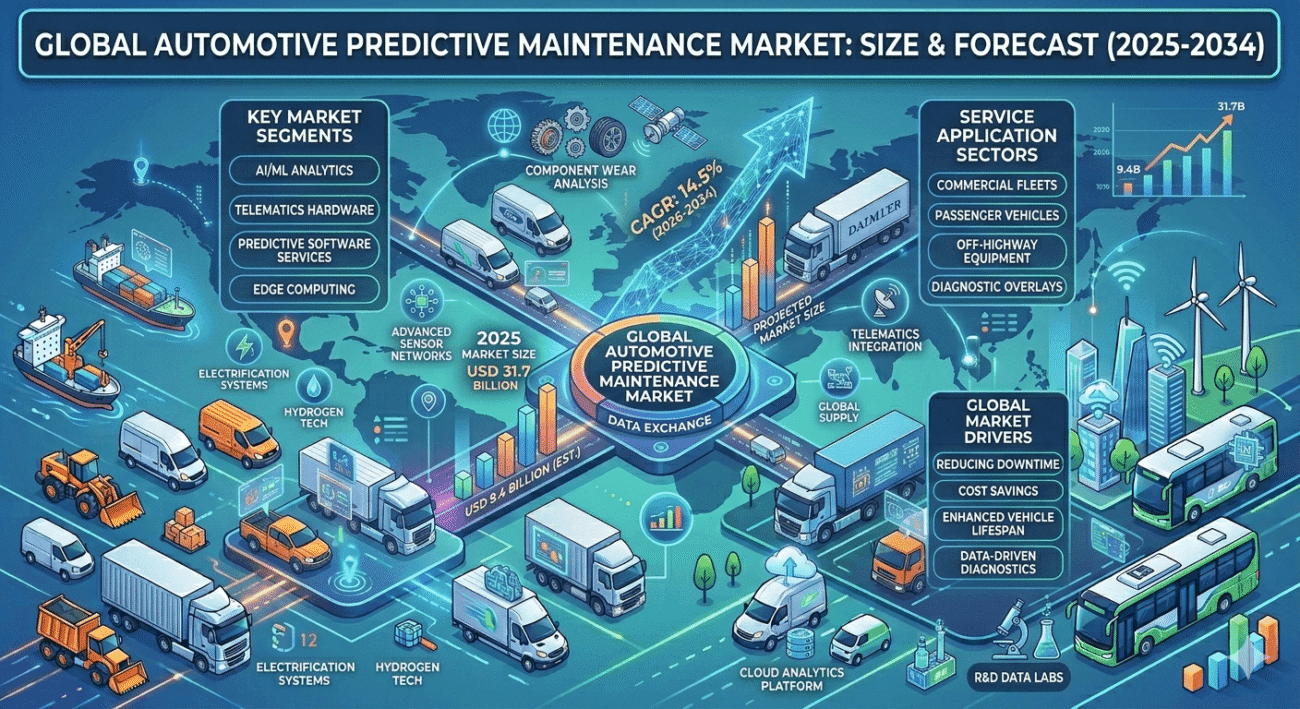
The worldwide Automotive Predictive Maintenance Market, valued at about USD 9.4 billion in 2025, is expected to grow to approximately USD 31.7 billion by 2034 with a Compound Annual Growth Rate (CAGR) of 14.5% during the forecast period 2026-2034.
The growth of the worldwide Automotive Predictive Maintenance Market is supported by rapid penetration of connected vehicle technologies, the emergence of Artificial Intelligence, and a growing requirement for optimized vehicle maintenance. Automotive predictive maintenance refers to utilizing data from advanced analytics, sensors, telematics, machine learning, and real-time vehicle monitoring for identifying possible vehicle mechanical failures in advance. This approach allows for minimizing vehicle downtime, enhancing performance and reducing maintenance costs among auto manufacturers, fleet operators and vehicle owners.
One of the main factors of growth of the automotive predictive maintenance market is the swift increase in connected vehicles. Automobiles today are embedded with various sophisticated sensors, in-vehicle diagnostic systems, IoT devices and telematics systems that can be used for collecting and transmitting real-time data about vehicle performance, thereby detecting vehicle mechanical wear and tear, engine malfunction, battery anomalies and component failure.
The significant growth of electric and autonomous vehicles is also a key contributor to the expansion of the Automotive Predictive Maintenance Market. Electric and Autonomous Vehicles rely on the most advanced monitoring systems to effectively control battery health, charging performance, motor operation and energy utilization. The predictive maintenance systems assist in reducing cost, improving performance and extending battery life.
The rise of Artificial Intelligence and Machine learning has a significant impact on the automotive maintenance segment. Predictive analytics systems driven by Artificial Intelligence process a massive amount of vehicle data for the identification of failure patterns and provision of preventive maintenance guidelines, thereby increasing accuracy and minimizing unexpected breakdowns.
Increased focus on effective fleet management systems is another major factor contributing to the market growth. Transportation companies and Commercial fleet managers adopt predictive maintenance to increase efficiency and reduce repair costs through vehicle condition monitoring, maintenance scheduling and prevention of breakdowns.
Cloud and edge computing are essential elements supporting the Automotive Predictive Maintenance Market growth. Cloud platforms help in remote storage and access to vehicle data, while edge computing improves the performance of vehicle data analysis by increasing real-time response.
An enhanced focus on vehicle safety and reliability also plays a vital role in the development of the Automotive Predictive Maintenance Market. Automotive manufacturers integrate various advanced diagnostics technologies to enable improved vehicle performance monitoring, boost customer satisfaction and minimize safety issues related to vehicle failures.
Strategic partnerships and collaborations between automotive manufacturers, software providers, chip manufacturers and telematics vendors are enabling advanced predictive maintenance systems.
North America and Europe led the market growth as a result of rapid adoption of connected vehicles, advanced manufacturing systems and significant investment in Artificial Intelligence. Asia-Pacific is also anticipated to grow with increasing vehicle production, adoption of electric vehicles and digitization.
The global Automotive Predictive Maintenance Market covers many solutions like Predictive analytics software, Telematics, Condition Monitoring Systems, Remote Diagnostics and Cloud-Based Fleet Management Solutions and caters to Passenger Cars, Commercial Vehicles, Electric Vehicles and Autonomous Systems.
Despite a high opportunity for growth in this market, there are several challenges, such as high initial investments, data security issues, integration complexity and data privacy concerns in the automotive predictive maintenance market. However, continued developments in Artificial Intelligence, IoT, Cloud Computing and Vehicle telematics are expected to drive major market growth.
Key Automotive Predictive Maintenance Market Trends
The automotive predictive maintenance market is being shaped by several key trends, including but not limited to growth in connected vehicle technology, increased implementation of artificial intelligence, digitization of the automotive industry, and an increase in automotive fleet maintenance. Key trends: Internet of Things technologies – the automotive market is witnessing growing application of IoT in vehicles for enhanced maintenance and functionality. Sensors and IoT-enabled devices in new age vehicles are continually monitoring the operating conditions and performance of the engine parts, tire pressure, battery, fuel level, among others.
Advanced role of artificial intelligence and machine learning – Artificial intelligence is a critical technology when we talk about predictive maintenance market growth. Artificial intelligence-enabled machines are capable of analyzing vast data from vehicles for performance and to help predict likely vehicle breakdowns. ML-enabled vehicles learn from their operational history and previous maintenance data, thereby making their diagnostic capabilities more effective with every operating cycle.
Connected vehicles are growing rapidly – the proliferation of Connected Vehicles (CVs) in the automotive market will directly drive a significant increase in predictive maintenance services by collecting real-time operational data. Telematics systems equipped in Connected vehicles transmit real-time data on the vehicle’s location, engine performance, fuel efficiency, etc. via a connectivity network with the cloud. Also, these connected vehicles enhance the diagnostic capabilities of vehicles by means of onboard diagnostics systems and also GPS technology.
Cloud-based predictive maintenance platform becoming common – Automotive industry’s adoption of cloud-based predictive maintenance platforms is on a consistent rise due to the flexibility and scalability these cloud-infrastructure offer. Remote data access and cloud storage for a longer period help fleet owners, OEMs and services companies monitor vehicle status in real time from any remote location via connected consoles and analytics Dashboards. Rise in edge computing in automotive – Edge Computing is a technology that allows a computer to perform data processing right in the place where the data is collected, instead of relaying it back to a central cloud for processing.
In automotive, connected devices are capable of doing real-time prediction without a strong reliance on the cloud and thus are a major benefit to predictive maintenance. Electric Vehicle Market to drive predictive maintenance – Increased vehicle sales from the electric vehicle segment for various modes of personal transport and also industrial applications, including light commercial vehicles, are set to accelerate the predictive maintenance market.
EVs will create demand for sophisticated diagnostic and maintenance systems, such as those monitoring battery health and operating thermal conditions of the power train. Fleet Management – growth in commercial fleets is one of the major driving factors for growing adoption of vehicle-based predictive maintenance, as fleet owners are increasingly adopting real-time data analytics and vehicle diagnostic technologies. Predictive Maintenance technology will help to ensure the maintenance time for vehicle components.
Big Data – as vehicle data generation in the automotive market rises from a billion vehicles, the large datasets from operational vehicles would be instrumental in determining potential issues within vehicle components and systems and help improve predictive maintenance models. Digital Twins – with the usage of data analytics on enormous data generated from different vehicles in operation, the automotive manufacturing sector can easily recreate a virtual duplicate of a physical vehicle and components for efficient predictive maintenance.
Remote Diagnostics and O-T-A software updates – connected vehicle are driving need for the system which are available over Internet as remote diagnostics and Over-the air updates would significantly reduce cost associated with maintenance, improve vehicle up time and also allow to enhance performance remotely without taking the vehicle into a Service station Cyber security as important trend – in connection with the increase use of IoT in automotive coupled with vehicle connectivity, there is always a cyber security risks related to the communication data between the vehicle and various stakeholders.
Hence, cybersecurity practices is emerging as a more prevalent concern among market players in the automotive predictive maintenance market. Strategic Partnerships in market- As a result, a wide array of companies, including automotive manufacturers (OEMs), third-party service providers, and software and technology developers, are collaborating in various ways to strengthen market growth prospects. OEMs and third-party partners often team up on diagnostic service provisions and support technologies for vehicle health management and predictive maintenance operations.
Key Automotive Predictive Maintenance Market Key Restraints
Despite strong growth opportunities and technological advancements, the automotive predictive maintenance market faces several significant restraints that may limit its expansion during the forecast period. One of the primary challenges is the high implementation cost associated with predictive maintenance systems. Automotive manufacturers and fleet operators must invest heavily in IoT sensors, telematics infrastructure, cloud platforms, software integration, and artificial intelligence technologies to establish comprehensive predictive maintenance solutions.
The complexity of integrating predictive maintenance systems with existing automotive infrastructure is another major restraint affecting the market. Many organizations operate legacy fleet management systems and vehicle platforms that may not be fully compatible with advanced predictive analytics technologies. Integration challenges can increase deployment time and operational costs.
Cybersecurity risks and data privacy concerns represent critical challenges within the automotive predictive maintenance market. Connected vehicles and cloud-based maintenance systems continuously collect and transmit sensitive operational data. This creates potential vulnerabilities related to hacking, unauthorized access, ransomware attacks, and data breaches that may compromise vehicle safety and operational integrity.
The lack of standardized communication protocols and interoperability between different automotive systems can also limit market adoption. Automotive manufacturers often use varying telematics platforms, diagnostic tools, and software architectures, creating compatibility issues for predictive maintenance service providers and fleet operators.
Limited technical expertise and skilled workforce availability present another challenge for the industry. Implementing and managing predictive maintenance systems requires specialized knowledge in artificial intelligence, machine learning, cloud computing, telematics, and data analytics. Many organizations face difficulties recruiting and training qualified professionals capable of managing advanced maintenance technologies.
Data accuracy and reliability issues can affect predictive maintenance performance and operational effectiveness. Inaccurate sensor readings, incomplete datasets, communication disruptions, or hardware malfunctions may reduce predictive accuracy and result in incorrect maintenance recommendations. Poor data quality can negatively impact system reliability and customer trust.
The high volume of data generated by connected vehicles creates significant storage and processing challenges. Predictive maintenance systems require advanced computing infrastructure capable of processing massive amounts of real-time vehicle data efficiently. Managing and analyzing this data can increase operational complexity and infrastructure expenses.
Resistance to digital transformation among traditional automotive service providers may also slow market adoption. Some businesses continue relying on conventional reactive maintenance models and may hesitate to invest in advanced predictive technologies due to budget constraints, operational disruption concerns, or a lack of awareness regarding long-term benefits.
Regulatory and compliance challenges can further impact market growth. Different countries and regions have varying regulations regarding vehicle data collection, telematics monitoring, cybersecurity standards, and consumer privacy protection. Companies operating internationally may face difficulties complying with diverse legal and regulatory frameworks.
The relatively high maintenance and upgrade costs of predictive maintenance platforms can also affect profitability for businesses. Continuous software updates, cybersecurity enhancements, cloud infrastructure management, and hardware maintenance require ongoing investments that may create financial challenges, particularly for small and medium-sized enterprises.
Connectivity limitations in remote and underdeveloped regions can negatively impact predictive maintenance performance. Many predictive maintenance systems rely on stable internet connectivity, cloud communication, and wireless data transmission for real-time monitoring and analytics. Poor network infrastructure may reduce system reliability and operational efficiency.
Lastly, uncertainty regarding return on investment (ROI) remains a challenge for some organizations considering predictive maintenance adoption. While predictive maintenance offers long-term operational benefits, businesses may be reluctant to invest in advanced technologies without clear short-term financial returns and measurable performance improvements.
Automotive Predictive Maintenance Market Key Opportunities
The global Automotive Predictive Maintenance Market is creating significant growth opportunities due to rapid advancements in connected vehicle technologies, increasing adoption of artificial intelligence, and growing demand for efficient fleet management solutions. One of the major opportunities in the market is the increasing penetration of connected vehicles equipped with Internet of Things (IoT) sensors and telematics systems. These technologies generate real-time operational data that can be analyzed to predict vehicle failures, optimize maintenance schedules, and improve overall vehicle performance.
The growing adoption of electric vehicles presents substantial opportunities for predictive maintenance solution providers. Electric vehicles require advanced monitoring systems to track battery health, charging cycles, thermal performance, motor efficiency, and energy consumption. Predictive maintenance technologies help improve battery lifespan, reduce maintenance costs, and enhance electric vehicle reliability.
Autonomous driving technologies are also generating major opportunities within the market. Autonomous vehicles rely heavily on sensors, software platforms, and advanced electronic systems that require continuous monitoring and diagnostics. Predictive maintenance systems can identify potential failures in autonomous driving components before operational disruptions occur, improving vehicle safety and reliability.
The rapid expansion of commercial fleet operations is another important growth opportunity for the market. Logistics companies, transportation providers, delivery services, and public transportation agencies are increasingly adopting predictive maintenance technologies to reduce vehicle downtime, optimize fleet utilization, and lower operational expenses. Fleet operators benefit from real-time diagnostics, preventive maintenance alerts, and AI-driven analytics that improve operational efficiency.
Artificial intelligence and machine learning integration offer strong opportunities for advanced predictive analytics solutions. AI-powered systems can analyze large volumes of vehicle data to identify performance anomalies, detect wear patterns, and forecast maintenance requirements with high accuracy. These technologies help businesses reduce repair costs and prevent unexpected breakdowns.
The increasing adoption of cloud-based predictive maintenance platforms is creating opportunities for scalable and remote vehicle monitoring solutions. Cloud computing allows automotive manufacturers and fleet operators to access maintenance data, diagnostics reports, and analytics dashboards from centralized digital platforms. Cloud-based solutions reduce infrastructure costs and improve operational flexibility.
Edge computing technology is emerging as another important opportunity within the market. Edge computing enables real-time processing of vehicle data directly within onboard systems rather than relying solely on cloud servers. This improves response times, reduces latency, and enhances predictive maintenance accuracy for connected and autonomous vehicles.
The growing focus on vehicle safety and regulatory compliance is also supporting market opportunities. Governments and transportation authorities are implementing stricter safety standards and fleet monitoring regulations, encouraging businesses to adopt predictive maintenance technologies that improve vehicle reliability and reduce accident risks.
Aftermarket service providers and automotive repair centers are increasingly adopting predictive maintenance platforms to improve customer service and operational efficiency. Predictive analytics help service providers identify maintenance needs in advance, optimize spare parts inventory, and reduce vehicle repair turnaround times.
Smart city development and intelligent transportation infrastructure projects worldwide are further expanding market potential. Connected mobility systems, smart traffic management platforms, and intelligent public transportation networks require advanced predictive maintenance solutions to ensure operational continuity and infrastructure reliability.
Emerging markets across Asia-Pacific, Latin America, and the Middle East present substantial untapped opportunities for automotive predictive maintenance providers. Rising vehicle production, increasing digital transformation, expanding transportation infrastructure, and growing adoption of connected mobility technologies are supporting market expansion in these regions.
Strategic collaborations between automotive manufacturers, AI companies, cloud service providers, semiconductor firms, and telematics companies are creating additional innovation opportunities. These partnerships help accelerate the development of next-generation predictive maintenance solutions with improved automation, analytics capabilities, and real-time connectivity.
Automotive Predictive Maintenance Market Key Drivers
Increasing adoption of connected vehicle technologies and the rising need for vehicle maintenance are major factors supporting the growth of the automotive predictive maintenance market. The widespread adoption of sensors, telematics, onboard diagnostics, and other Internet of Things (IoT) devices has resulted in the proliferation of operational data from modern vehicles. Predictive maintenance platforms can leverage this data to prevent mechanical failures as they occur.
The proliferation of connected vehicles is one of the key factors actively supporting the automotive predictive maintenance market growth. Connected vehicles facilitate communication of vehicle performance parameters in real-time to the cloud platform as well as service centers. This improved data availability enhances vehicle monitoring capacity in addition to enabling predictive analysis for maintenance prediction.
The rising applicability of artificial intelligence and machine learning is proving to be a critical factor supporting the adoption of predictive maintenance platforms. AI-enabled predictive diagnostics can tap into large amounts of vehicle data collected in real-time and in historical context to establish wear patterns, detect deviations, and make maintenance predictions with a high degree of accuracy. Machine learning enables this technology to improve through the analysis of operational data.
Growing adoption of electric vehicles (EVs) is another major trend positively influencing the automotive predictive maintenance market. Significant adoption of EVs has increased demand for monitoring systems targeting batteries, charging effectiveness, thermal management, and electric engine operation. Predictive diagnostics help improve EV reliability, prolong battery life, and optimize maintenance costs.
The rising need for fleet management optimization is an additional trend boosting the market growth. Various commercial fleet operating companies, such as logistics firms, transportation services, and public transportation authorities, are more oriented toward the development of predictive maintenance systems to lessen vehicle downtime, improve fuel economy, and lower maintenance expenses.
Increasing maintenance and operating costs compel companies to move toward implementing predictive diagnostics. These diagnostics are effective in avoiding costly unplanned component repairs in addition to reducing operational downtime. This allows organizations to adopt a proactive stance toward vehicle maintenance.
Growing investments in cloud infrastructure are an important factor propelling this market. Cloud computing technologies are widely adopted in predictive maintenance platforms owing to the ability to provide highly scalable data storage, real-time analytics, and remote monitoring solutions. Automotive OEMs and fleet operators can utilize these intelligent software systems to derive improved operational insight.
Increasing efforts by automotive OEMs and component manufacturers to ensure safety and reliability of vehicles is also a key factor supporting market growth. Ongoing advancements in predictive diagnostics enable monitoring of critical vehicle functions such as brake safety, engine health, and tire faults before they can cause injury or failures. Automotive manufacturers are embedding predictive diagnostics technology to enhance vehicle safety standards.
The emergence of autonomous driving solutions is accelerating the adoption of predictive diagnostics. Autonomous vehicles are heavily dependent on sensors, electronic control systems, AI engines, and communication modules that require continuous conditioning in addition to stable operation. Predictive maintenance is a critical enabler for providing risk-free autonomous vehicle operation.
Growing regulatory emphasis on vehicle emissions, fleet safety management, and transportation efficiency is encouraging the deployment of IoT-enabled diagnostics onboard. Regulatory authorities are consequently incentivizing the adoption of intelligent vehicle monitoring systems, machine learning approaches for diagnostics, and big data analytics platforms.
The rise of big data in the automotive sector is emphasizing the importance of predictive platform investments. Automotive companies are investing in big data platforms for enhanced vehicle operation analytics, maintenance scheduling, parts procurement, and customer interaction services.
Widespread investments in digital mobility solutions combined with emerging smart vehicle ecosystems are bolstering this market. Key industry players are committing capital toward connected mobility solutions, technologically advanced fleet management infrastructures, and intelligent predictive diagnostics systems to gain operational efficiency and competitive advantages.
Automotive Predictive Maintenance Market Segment Insights
The automotive predictive maintenance market is classified on the basis of component, deployment mode, vehicle type, application and end user industry. Each of these segments defines the automotive predictive maintenance market contributors and their share to the overall market growth while representing the applicable trends in connected mobility, artificial intelligence and digital automotive aftermarket.
Classification of the automotive predictive maintenance market by component includes solutions and services. Solutions include predictive analytics software, telematics platform, condition monitoring system, cloud-based maintenance platform, and onboard diagnostic tools, which deal with the collection, analysis, and processing of real-time data pertaining to vehicle performance.
Classification of the automotive predictive maintenance market by services includes consulting, system integration, technical support, maintenance and managed services. These services are utilized in combination with predictive maintenance systems in the automotive industry by fleet operators and automotive companies to collect data for improved performance.
Classification of the automotive predictive maintenance market by deployment mode includes cloud-based and on-premises solutions. Cloud-based predictive maintenance platforms hold a major share of the market owing to their ability for remote access and monitoring, cost-efficient infrastructure, and analytics tools. These cloud-based systems enable fleet operators and automotive manufacturers to conveniently monitor fleet vehicles through a digital platform.
On-premises predictive maintenance solutions cover organizations that seek enhanced data security and control over data collection platforms. Large automotive OEMs and corporate fleet operators use these solutions for regulatory compliance and for better control of the system.
Classification of the automotive predictive maintenance market by vehicle type covers passenger and commercial vehicles. A considerable market share is held by passenger vehicles due to their accelerating adoption of connected car features, electric vehicle concepts, and highway automation. Automotive enterprises are integrating predictive maintenance in their next-generation passenger vehicles to optimize vehicle service and enhance customer experience.
Commercial vehicles constitute a large market segment owing to increasing fleet management needs. Logistic companies, public transit authorities, and transportation service providers make extensive use of predictive maintenance technology solutions for fleet management and uptime reduction.
Classification of the automotive predictive maintenance market by application comprises of engine diagnostics, battery monitoring, brake system monitoring, transmission monitoring, tire performance monitoring and fleet management. Engine diagnostics and battery monitoring hold major market application shares, which is attributed to their significant role in improving operational reliability, and as a step towards preventing vehicle failure in the transportation industry.
Battery monitoring holds a vital application segment owing to electric vehicles, where predictive maintenance systems help with thermal management, charging cycles, battery longevity, while improving operating intervals. Further tire and brake system monitoring networks also greatly contribute to vehicle safety and service.
Automotive Predictive Maintenance Market, Regional Analysis
The automotive predictive maintenance market is predicted to witness significant development in the different regions, owing to rapid penetration of connected vehicles, adoption of digital solutions, growing number of electric vehicles and the surge in investments across intelligent transportation systems. North America, Europe, Asia-Pacific, Latin America, and the Middle East & Africa are the key regions explored in the automotive predictive maintenance market analysis report.
North America holds a significant position in the automotive predictive maintenance market. It’s driven by several factors, including the advanced automotive manufacturing infrastructure in the region, growing adoption of connected vehicles, and substantial investments made in technologies related to artificial intelligence. North America’s market growth is also being fueled by extensive adoption of telematics systems, cloud-based fleet management platforms, and innovative predictive analytics technologies, particularly in countries such as the U.S.Commercial fleet operators and transportation and logistics businesses, among others, are creating high demand for maintenance operations aimed at improving their vehicle operational efficiency and lowering maintenance expenses. Governmental policies associated with traffic and driving safety and vehicle emissions are further fueling growth in the automotive predictive maintenance market.
Another significant market for automotive predictive maintenance technologies is Europe. The stringent automotive safety regulations implemented, coupled with the highly developed transport and travel infrastructure of the region and increased penetration of electric vehicles, are contributing factors for market expansion. The innovation is being significantly driven by countries such as Germany, the UK, France and Sweden.
European automobile manufacturers are investing heavily in areas of IoT connectivity, cloud computing solutions and AI-driven technologies to enable effective vehicle maintenance and diagnostics processes. Additionally, sustainable transportation and intelligent mobility services development are further propelling market growth across Europe.
Asia-Pacific is expected to register the most rapid growth over the next few years of the forecast period due to factors like the expanding automotive manufacturing sector, increasing utilization of electric vehicles and rampant digital transformation throughout the automobile industry. China, Japan, South Korea and India are playing major roles in this region’s market growth.
The demand for automotive predictive maintenance services and solutions is exceptionally high in China owing to government efforts geared toward the adoption of electric mobility and smart technologies. China is actively investing in modern automotive manufacturing and traffic infrastructure, as it has been very vocal in endorsing development in AI and intelligent driving systems.
Japan and South Korea have the most robust manufacturing base for automobiles, coupled with leading expertise in advanced fields such as robotics, semiconductors, and AI, which positions them as strong contenders in the automotive predictive maintenance market. The two most prominent automotive companies in each nation have been integrating innovative automotive predictive maintenance into connected vehicle systems.
In Latin America, the market for automotive predictive maintenance is experiencing considerable expansion due to an upsurge in fleet upgrades and investments in the expansion of transportation infrastructure. Countries such as Brazil and Mexico have considerable market size potential owing to their increasing automobile manufacturing activities and expansion of the transport and logistics sectors.
In the Middle East and Africa (MEA), demand for automobile predictive maintenance is steadily growing, and is being stimulated by rising investment in intelligent transport, smart city projects, and vehicle fleet management systems. The Gulf region is embracing digitalization to foster comprehensive improvements across the transport infrastructure of various countries by fostering initiatives focused on connected vehicles and smart transportation.
Top Key Players Operating in the Automotive Predictive Maintenance Market
- IBM Corporation
- Bosch Mobility Solutions
- Continental AG
- Siemens AG
- General Electric Company
- SAP SE
- Microsoft Corporation
- Hitachi Ltd.
- PTC Inc.
- Oracle Corporation
- SAS Institute Inc.
- Dell Technologies Inc.
- Valeo SA
- ZF Friedrichshafen AG
- NXP Semiconductors N.V.
- C3.ai Inc.
- Intangles Lab Pvt. Ltd.
- Teletrac Navman
- Trimble Inc.
- Verizon Connect
FAQ
What is automotive predictive maintenance?
Automotive predictive maintenance uses AI, IoT sensors, telematics and analytics to predict vehicle maintenance needs and prevent breakdowns with predictive maintenance.
What technologies are used in automotive predictive maintenance systems?
Key technologies include artificial intelligence, machine learning, IoT sensors, cloud computing, telematics systems and predictive analytics platforms with predictive maintenance systems.
Why is predictive maintenance important, for fleet operators?
Predictive maintenance helps to cut down on downtime lower the cost of repairs make fuel use more efficient make vehicles more reliable and make fleet operations run smoother.
Which region dominates the predictive maintenance market?
The Asia-Pacific region is leading the market right now. This is because there is a lot of car manufacturing happening there more connected vehicles are being used and industries are growing fast. Predictive maintenance is really important, in this region.
