
Global Firefighting Aircraft Market Overview
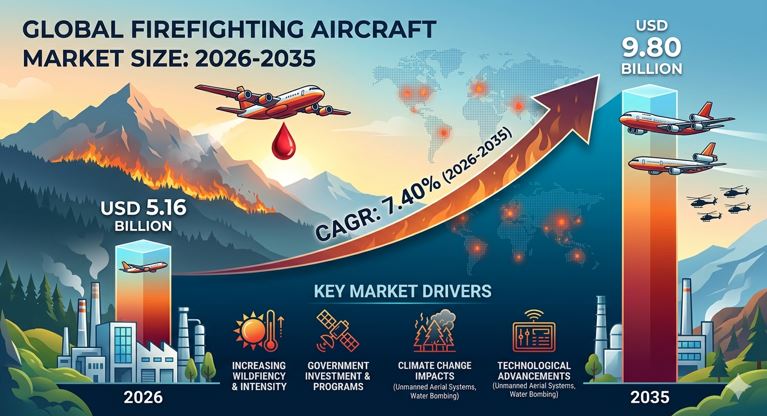
Firefighting Aircraft Market size is USD 5.16 billion in 2026 to approximately USD 9.80 billion by 2035, expanding at a CAGR of 7.40% from 2026 to 2035.
The global firefighting aircraft market has emerged as a critical segment within the aerospace and emergency response industries due to the increasing frequency and intensity of wildfires across the world. Climate change, rising global temperatures, prolonged droughts, and rapid urbanization near forested regions have significantly increased the demand for advanced aerial firefighting solutions. Governments, private operators, and defense organizations are investing heavily in firefighting aircraft to strengthen disaster response capabilities and minimize environmental and economic losses caused by wildfires.
Firefighting aircraft are specialized aerial vehicles designed to combat fires by dropping water, fire retardants, or chemical suppressants over affected areas. These aircraft include fixed-wing airplanes, helicopters, amphibious aircraft, and unmanned aerial vehicles (UAVs). They play a vital role in controlling fires in remote and inaccessible regions where ground firefighting teams face operational limitations. The market has witnessed substantial technological advancements, including precision water-dropping systems, thermal imaging technologies, and real-time communication systems that improve firefighting efficiency and operational safety.
One of the primary factors driving the growth of the global firefighting aircraft market is the increasing occurrence of large-scale wildfires in regions such as North America, Europe, Australia, and parts of Asia. Countries including the United States, Canada, Australia, Spain, and Greece have experienced severe wildfire outbreaks in recent years, leading to increased government spending on aerial firefighting fleets. Public authorities are modernizing their aircraft inventories by replacing aging fleets with technologically advanced and fuel-efficient models capable of carrying larger water payloads and operating in challenging terrains.
In addition to wildfire management, firefighting aircraft are also being used in industrial fire suppression, military operations, and emergency disaster response missions. The versatility of these aircraft has expanded their adoption among defense and civil aviation sectors. Helicopters, in particular, are gaining popularity because of their ability to hover, access confined areas, and refill water from nearby lakes or reservoirs. Fixed-wing aircraft, on the other hand, are preferred for large-scale wildfire operations due to their high speed, extended range, and large water-carrying capacities.
Technological innovation remains a key trend shaping the firefighting aircraft market. Manufacturers are integrating advanced avionics, GPS-based navigation systems, infrared sensors, and automated release mechanisms to improve operational accuracy and mission effectiveness. The adoption of unmanned aerial systems is also transforming wildfire monitoring and firefighting strategies. Drones equipped with thermal cameras and artificial intelligence are increasingly used for fire detection, surveillance, and risk assessment, enabling authorities to respond quickly before fires spread uncontrollably.
The market is also benefiting from increasing public-private partnerships and international collaborations focused on wildfire management. Governments are entering long-term contracts with private aviation companies to ensure rapid deployment of firefighting aircraft during emergency situations. Several countries are participating in cross-border firefighting agreements that allow the sharing of aerial resources during peak wildfire seasons. Such collaborations are expected to support market growth by encouraging fleet expansion and operational efficiency.
However, the firefighting aircraft market faces several challenges that may hinder growth. High procurement and maintenance costs remain major barriers, especially for developing economies with limited disaster management budgets. Specialized firefighting aircraft require extensive pilot training, regular maintenance, and advanced operational infrastructure, increasing the total cost of ownership. In addition, seasonal demand fluctuations can affect aircraft utilization rates, making it difficult for operators to maintain profitability throughout the year.
Environmental concerns related to aircraft emissions and fuel consumption are also influencing market dynamics. Manufacturers are increasingly focusing on developing sustainable and energy-efficient aircraft to align with global environmental regulations. Hybrid-electric propulsion technologies and lightweight composite materials are being explored to reduce carbon emissions and operational costs. These advancements are expected to create new growth opportunities for market participants over the coming years.
Key Firefighting Aircraft Market Trends
The global firefighting aircraft market is experiencing rapid transformation as governments, aviation companies, and emergency response agencies focus on improving wildfire suppression capabilities. Rising global temperatures, increasing forest fire incidents, and the growing need for faster emergency response systems are significantly influencing market trends. As wildfire disasters become more frequent and destructive, the firefighting aircraft industry is evolving through technological innovation, fleet modernization, sustainability initiatives, and strategic collaborations.
One of the most prominent trends in the firefighting aircraft market is the growing adoption of advanced aerial firefighting technologies. Aircraft manufacturers are integrating modern avionics, GPS-guided water release systems, thermal imaging cameras, and real-time monitoring technologies to enhance operational precision. These innovations allow pilots and firefighting teams to identify fire hotspots accurately and deliver water or retardants more effectively. Advanced communication systems also improve coordination between aerial units and ground firefighting crews, leading to faster containment of wildfire outbreaks.
Another significant trend shaping the market is the increasing demand for large air tankers (LATs) and very large air tankers (VLATs). Governments and firefighting agencies are investing in high-capacity aircraft capable of carrying substantial volumes of water and fire retardants over long distances. These aircraft are particularly useful in large-scale wildfire operations where rapid suppression is critical to preventing the spread of fires into residential or industrial areas. Modern large air tankers are being equipped with upgraded engines and fuel-efficient systems to improve operational performance while reducing maintenance costs.
The use of helicopters in firefighting operations is also witnessing strong growth. Helicopters offer unique operational advantages such as vertical takeoff and landing capabilities, maneuverability in mountainous terrains, and the ability to refill water from nearby lakes and reservoirs. This flexibility makes them highly effective for targeted firefighting missions in remote and inaccessible regions. Firefighting agencies increasingly rely on helicopters for quick-response operations, rescue missions, and urban firefighting support, contributing to their rising market demand.
The emergence of unmanned aerial vehicles (UAVs) and drone technology is another transformative trend in the firefighting aircraft industry. Drones equipped with infrared cameras, sensors, and artificial intelligence systems are being used for wildfire detection, surveillance, mapping, and damage assessment. These unmanned systems provide real-time data that helps authorities monitor fire behavior and make informed operational decisions. In some cases, drones are also being tested for small-scale fire suppression missions. The integration of AI-powered analytics with drone technology is expected to further enhance wildfire prediction and prevention strategies in the coming years.
Fleet modernization has become a major priority for governments and firefighting organizations worldwide. Many countries are replacing aging aircraft with modern, fuel-efficient, and technologically advanced firefighting fleets. Older aircraft often face maintenance challenges, reduced operational efficiency, and higher fuel consumption. As a result, public agencies are investing in next-generation amphibious aircraft and multipurpose aerial platforms capable of operating in diverse environmental conditions. Modern aircraft offer improved safety features, larger payload capacities, and lower operational costs, making them more suitable for current firefighting demands.
Sustainability and environmental concerns are also influencing market trends. Aircraft manufacturers are increasingly focusing on reducing carbon emissions and fuel consumption in response to stricter environmental regulations. Research and development activities are underway to introduce hybrid-electric propulsion systems, lightweight composite materials, and energy-efficient engines. Sustainable aviation fuel (SAF) is also gaining attention as governments and operators seek eco-friendly alternatives for aerial firefighting missions. These developments are expected to reshape the market by encouraging environmentally responsible aviation practices.
Public-private partnerships are becoming increasingly common within the firefighting aircraft market. Governments are collaborating with private aviation service providers to improve resource availability during wildfire emergencies. These partnerships help agencies access specialized aircraft, trained pilots, and maintenance support without requiring large upfront investments in fleet ownership. Long-term leasing contracts and shared operational agreements are becoming popular models for ensuring rapid deployment of aerial firefighting resources during peak wildfire seasons.
Another important market trend is the growing international cooperation in wildfire management. Countries affected by seasonal wildfires are participating in cross-border agreements to share firefighting aircraft and emergency response resources. International collaboration enables faster disaster response and helps nations manage extreme wildfire events more effectively. Such agreements are particularly valuable during periods when multiple regions experience simultaneous wildfire outbreaks and local firefighting resources become overstretched.
The market is also seeing increased investments in predictive analytics and digital wildfire management systems. Artificial intelligence, satellite monitoring, and weather forecasting technologies are being integrated into wildfire response operations to improve preparedness and risk assessment. These systems help identify fire-prone areas, monitor vegetation dryness, and forecast wildfire spread patterns. By using predictive technologies, firefighting agencies can position aircraft strategically and respond more quickly to emerging fire threats.
Regionally, North America continues to lead the firefighting aircraft market due to frequent wildfire incidents, strong government funding, and advanced aviation infrastructure. Europe is witnessing rising demand as Mediterranean countries face increasingly severe wildfire seasons. Meanwhile, the Asia-Pacific region is emerging as a key growth area driven by climate change concerns, expanding forest conservation efforts, and growing investments in disaster management infrastructure.
Key Firefighting Aircraft Market Restraints
Despite the growing demand for aerial firefighting solutions worldwide, the global firefighting aircraft market faces several restraints that could limit its growth potential. While increasing wildfire incidents and climate-related disasters continue to drive investments in firefighting infrastructure, the industry must overcome operational, financial, technological, and regulatory challenges. These restraints significantly affect aircraft procurement, deployment efficiency, maintenance operations, and long-term market expansion.
One of the most significant restraints in the firefighting aircraft market is the extremely high procurement cost associated with specialized firefighting aircraft. Modern firefighting airplanes and helicopters are equipped with advanced avionics, water-dropping systems, thermal imaging technologies, and communication equipment, making them expensive to manufacture and purchase. Large air tankers and amphibious aircraft require substantial capital investments, which can place financial pressure on governments and private operators. Many developing countries and smaller regional firefighting agencies struggle to allocate sufficient budgets for acquiring advanced aerial firefighting fleets, limiting market penetration in emerging economies.
In addition to acquisition expenses, the high operational and maintenance costs of firefighting aircraft present another major challenge. These aircraft operate in harsh environments characterized by extreme heat, smoke exposure, turbulent air conditions, and rugged terrains. Continuous operation under such demanding conditions accelerates wear and tear, increasing maintenance requirements and repair costs. Operators must also invest heavily in routine inspections, spare parts, engine servicing, and specialized maintenance infrastructure to ensure aircraft safety and operational readiness. Rising fuel prices further contribute to escalating operating expenses, particularly for large fixed-wing aircraft with high fuel consumption rates.
Another important restraint affecting the market is the seasonal nature of wildfire incidents. In many regions, firefighting aircraft are heavily utilized only during specific wildfire seasons, resulting in lower aircraft usage during the rest of the year. This creates challenges for fleet operators in maintaining profitability and operational efficiency. Since firefighting aircraft require ongoing maintenance and staffing regardless of seasonal demand fluctuations, operators often face financial burdens associated with underutilized assets. Seasonal dependency also discourages some private investors from entering the market due to concerns regarding inconsistent revenue generation.
The shortage of skilled pilots and trained firefighting personnel is another major obstacle in the firefighting aircraft industry. Aerial firefighting missions are highly complex and dangerous, requiring pilots to operate at low altitudes, navigate through dense smoke, and perform precision water or retardant drops in unpredictable weather conditions. Specialized training programs are necessary to prepare pilots for these high-risk operations. However, the limited availability of experienced firefighting pilots and technical personnel has created workforce shortages in several regions. Recruiting and retaining qualified professionals remains a significant challenge for operators and emergency response agencies.
Regulatory and certification challenges also act as restraints on market growth. Firefighting aircraft must comply with strict aviation safety regulations, environmental standards, and operational guidelines established by aviation authorities. Obtaining certifications for modified aircraft or newly developed firefighting systems can be time-consuming and costly. Delays in regulatory approvals may slow down aircraft deployment and increase development expenses for manufacturers. Additionally, varying regulatory frameworks across different countries can complicate international operations and cross-border firefighting collaborations.
The aging fleet of firefighting aircraft in several countries is another issue impacting the market. Many firefighting agencies continue to rely on older military surplus aircraft that were converted for aerial firefighting operations decades ago. These aging aircraft often experience frequent mechanical failures, reduced operational efficiency, and increased maintenance costs. While modernization efforts are underway, replacing older fleets with advanced aircraft requires substantial investments that many governments struggle to afford. The continued dependence on outdated aircraft may hinder firefighting effectiveness and limit market growth.
Environmental concerns associated with firefighting aircraft operations are also becoming increasingly significant. Traditional firefighting aircraft consume large amounts of aviation fuel, contributing to greenhouse gas emissions and environmental pollution. As governments worldwide implement stricter environmental regulations, manufacturers and operators face pressure to adopt sustainable technologies and reduce carbon footprints. However, the development and integration of environmentally friendly propulsion systems, such as hybrid-electric engines or sustainable aviation fuels, involve high research and development costs. These financial and technological barriers may slow the transition toward greener firefighting aviation solutions.
Limited infrastructure in remote and wildfire-prone regions represents another critical restraint. Effective aerial firefighting operations require access to airbases, maintenance facilities, fuel stations, and water refill points. In many rural or mountainous regions, the lack of supporting infrastructure reduces the efficiency and deployment capabilities of firefighting aircraft. Poor logistical support can delay emergency response times and increase operational difficulties during large-scale wildfire incidents. Developing adequate aviation infrastructure in remote areas often requires significant public and private investments.
Weather-related operational limitations also impact the effectiveness of firefighting aircraft. Strong winds, heavy smoke, turbulence, and low visibility conditions can restrict flight operations and reduce mission accuracy. Extreme weather events associated with climate change may further complicate aerial firefighting efforts. In some situations, unsafe flying conditions force authorities to temporarily ground aircraft, limiting their ability to contain rapidly spreading fires. Such operational uncertainties can reduce the reliability of aerial firefighting strategies during critical emergencies.
The market also faces increasing competition from alternative wildfire management technologies and ground-based firefighting methods. Advanced satellite monitoring systems, automated fire detection technologies, and AI-powered predictive analytics are improving early wildfire detection and prevention capabilities. While these technologies support firefighting operations, they may reduce reliance on expensive aerial suppression methods in certain scenarios. Governments may prioritize investments in preventive wildfire management systems rather than expanding costly aircraft fleets.
Firefighting Aircraft Market Key Opportunities
The global firefighting aircraft market is witnessing substantial growth opportunities as climate change, rising wildfire incidents, and increasing investments in emergency response infrastructure continue to reshape the industry landscape. Governments, aviation companies, defense organizations, and private operators are recognizing the critical importance of aerial firefighting systems in protecting forests, urban areas, and industrial infrastructure. As wildfire threats become more severe across different regions, the demand for technologically advanced and efficient firefighting aircraft is expected to create numerous business and investment opportunities in the coming years.
One of the most significant opportunities in the firefighting aircraft market lies in the increasing global incidence of wildfires. Rising temperatures, prolonged drought conditions, and changing weather patterns have led to more frequent and intense wildfire outbreaks in regions such as North America, Europe, Australia, South America, and parts of Asia. Governments are under growing pressure to strengthen disaster preparedness and emergency response systems, resulting in increased funding for aerial firefighting fleets. This growing need for rapid wildfire suppression is creating strong opportunities for aircraft manufacturers, service providers, and technology developers operating within the market.
Fleet modernization programs represent another major opportunity for market growth. Many countries continue to rely on aging firefighting aircraft that were originally designed for military or commercial aviation purposes and later modified for firefighting operations. These older aircraft often face operational inefficiencies, high maintenance costs, and safety concerns. As a result, governments and firefighting agencies are increasingly investing in modern, fuel-efficient, and technologically advanced aircraft with larger payload capacities and improved operational capabilities. Manufacturers that offer next-generation amphibious aircraft, helicopters, and large air tankers are expected to benefit significantly from ongoing fleet replacement initiatives worldwide.
The growing adoption of unmanned aerial vehicles (UAVs) and drone technologies presents a highly promising opportunity within the firefighting aircraft market. Drones equipped with thermal sensors, infrared cameras, artificial intelligence, and real-time communication systems are becoming valuable tools for wildfire detection, surveillance, mapping, and damage assessment. These unmanned systems improve situational awareness and help authorities monitor fire behavior more effectively. As drone technology becomes more advanced and cost-effective, the integration of UAVs into firefighting operations is expected to expand rapidly, creating new revenue streams for aerospace companies and technology providers.
Another key opportunity is the rising demand for multi-role aircraft capable of performing various emergency response functions beyond firefighting. Governments and defense agencies increasingly prefer aircraft that can support disaster relief operations, medical evacuations, search and rescue missions, humanitarian aid delivery, and surveillance activities in addition to wildfire suppression. Multi-purpose aerial platforms offer greater operational flexibility and cost efficiency, making them attractive investments for public agencies. Manufacturers developing versatile aircraft with adaptable mission capabilities are likely to gain a competitive advantage in the market.
The increasing focus on sustainable aviation technologies is also opening new opportunities for innovation and market expansion. Environmental concerns regarding aircraft emissions and fuel consumption are encouraging the development of eco-friendly firefighting aircraft solutions. Companies investing in hybrid-electric propulsion systems, lightweight composite materials, and sustainable aviation fuels (SAF) have the potential to capitalize on the growing demand for greener aviation technologies. Governments promoting carbon reduction initiatives and sustainable transportation policies may provide incentives and funding support for environmentally responsible aircraft development projects.
Emerging economies offer substantial untapped growth potential for the firefighting aircraft market. Countries in Asia-Pacific, Latin America, Africa, and the Middle East are increasingly experiencing wildfire risks due to climate change, urban expansion, and deforestation. However, many of these regions currently have limited aerial firefighting infrastructure and outdated emergency response capabilities. As awareness regarding wildfire management and disaster preparedness increases, governments in developing nations are expected to invest in aerial firefighting systems and aviation infrastructure. This creates significant opportunities for global manufacturers and service providers to expand into new regional markets.
Public-private partnerships are becoming another important area of opportunity within the firefighting aircraft industry. Many governments are collaborating with private aviation operators to improve resource availability during wildfire emergencies without making large capital investments in aircraft ownership. Long-term leasing contracts, aircraft-sharing agreements, and outsourced firefighting services are becoming more common across several countries. These partnerships allow private companies to provide specialized aircraft, trained pilots, and maintenance support while generating recurring revenue opportunities.
The expansion of predictive wildfire management systems is also expected to create opportunities for technology integration in firefighting aviation. Artificial intelligence, satellite imaging, weather forecasting tools, and data analytics platforms are increasingly being incorporated into wildfire response operations. These technologies help authorities predict wildfire risks, monitor environmental conditions, and optimize aircraft deployment strategies. Companies offering integrated digital wildfire management solutions alongside aerial firefighting capabilities are likely to experience growing market demand.
Another promising opportunity lies in international wildfire response cooperation. Several countries are establishing cross-border agreements to share firefighting aircraft and emergency response resources during severe wildfire seasons. International collaboration improves operational readiness and helps countries manage large-scale disasters more effectively. Aircraft manufacturers and service providers capable of supporting multinational firefighting operations may benefit from increasing demand for globally deployable aerial firefighting fleets.
Infrastructure development also presents growth opportunities for the market. Expanding airbases, maintenance facilities, water refill stations, and aviation support systems in wildfire-prone regions can improve aircraft deployment efficiency and operational readiness. Governments and private investors are expected to increase spending on aviation infrastructure projects to strengthen emergency response capabilities. This creates additional opportunities for aerospace engineering firms, maintenance providers, and aviation infrastructure developers.
Furthermore, technological advancements in aircraft design and firefighting systems continue to create opportunities for innovation. Improved retardant delivery systems, automated navigation technologies, enhanced cockpit safety features, and advanced communication systems are enhancing operational performance and mission success rates. Companies focusing on research and development activities can capitalize on growing demand for more efficient, reliable, and safer firefighting aircraft solutions.
Firefighting Aircraft Market Segment Insights
The global firefighting aircraft market is segmented based on aircraft type, application, capacity, end user, and operational model. Each segment plays a vital role in shaping the market landscape as governments and emergency response agencies continue investing in advanced aerial firefighting solutions to combat rising wildfire incidents. Growing climate-related disasters, technological advancements, and increasing awareness regarding rapid fire suppression capabilities are driving demand across multiple market segments.
Based on aircraft type, the firefighting aircraft market is categorized into fixed-wing aircraft, helicopters, amphibious aircraft, and unmanned aerial vehicles (UAVs). Among these, fixed-wing aircraft account for a significant share of the market due to their ability to cover large areas quickly and transport substantial quantities of water or fire retardants. These aircraft are commonly used in large-scale wildfire suppression operations where rapid deployment and extended operational range are essential. Large air tankers and very large air tankers are widely utilized in countries experiencing frequent forest fires, particularly in North America and Europe.
Helicopters represent another major segment within the firefighting aircraft market. Their versatility, maneuverability, and vertical takeoff and landing capabilities make them highly effective for firefighting operations in mountainous regions, urban areas, and remote locations. Helicopters can refill water from nearby lakes, rivers, or reservoirs using buckets or onboard tanks, enabling continuous firefighting operations. In addition to fire suppression, helicopters are extensively used for rescue missions, personnel transport, and emergency medical evacuations during wildfire emergencies.
Amphibious aircraft are gaining increasing attention due to their unique ability to operate both on land and water surfaces. These aircraft can scoop water directly from lakes, oceans, or reservoirs without requiring a return to airbases for refilling. Their operational efficiency and rapid turnaround times make them highly suitable for large wildfire operations in coastal and forested regions. Governments in wildfire-prone countries are increasingly investing in amphibious firefighting fleets to strengthen aerial response capabilities and improve operational effectiveness.
The unmanned aerial vehicle (UAV) segment is expected to witness significant growth in the coming years. Drones equipped with thermal imaging cameras, infrared sensors, and real-time communication systems are increasingly being used for wildfire surveillance, monitoring, and damage assessment. UAVs help firefighting agencies gather critical information regarding fire behavior, temperature variations, and affected areas without exposing pilots or ground crews to dangerous conditions. The integration of artificial intelligence and automated flight systems is expected to further expand the role of drones in wildfire management and emergency response operations.
Based on application, the market is segmented into wildfire suppression, industrial firefighting, urban firefighting, rescue operations, and disaster management. Wildfire suppression remains the dominant application segment due to the growing frequency and severity of forest fires globally. Governments and emergency response agencies continue to prioritize investments in aerial firefighting capabilities to minimize environmental damage, property loss, and threats to human life caused by wildfires.
Industrial firefighting is another important application area, particularly in sectors such as oil and gas, mining, chemical manufacturing, and energy production. Specialized firefighting aircraft are increasingly being deployed to manage fires in industrial facilities and hazardous environments where conventional firefighting methods may be insufficient. Urban firefighting applications are also expanding as cities located near forested regions face increasing wildfire risks. Helicopters and rapid-response aircraft are often used to support urban fire departments during large-scale emergencies.
Based on capacity, the market is divided into small, medium, and large aircraft. Large-capacity firefighting aircraft dominate the market because they can transport larger volumes of water and fire retardants over extensive areas. These aircraft are especially valuable during large wildfire outbreaks where rapid containment is necessary. Medium-sized aircraft offer operational flexibility and are commonly used in regional firefighting operations, while smaller aircraft and helicopters are preferred for targeted missions and operations in confined spaces.
In terms of end users, the firefighting aircraft market includes government agencies, military organizations, private operators, and firefighting service providers. Government agencies represent the largest end-user segment due to increasing public investments in wildfire management infrastructure and emergency preparedness programs. Defense organizations also utilize firefighting aircraft for disaster response and humanitarian operations. Meanwhile, private operators are playing a growing role in the market through leasing services, maintenance support, and contract-based firefighting operations.
The operational model segment includes owned fleets and leased fleets. Leasing models are becoming increasingly popular among governments and firefighting agencies seeking cost-effective access to specialized aircraft without significant upfront capital investments. Leasing agreements also provide flexibility during peak wildfire seasons and enable agencies to scale operations based on seasonal demand.
Firefighting Aircraft Market, Regional Analysis
Regionally, North America dominates the global firefighting aircraft market due to the high occurrence of wildfires, advanced aviation infrastructure, and substantial government investments in aerial firefighting programs. The United States represents the largest market within the region, supported by extensive wildfire management initiatives and the presence of major aircraft manufacturers and aviation service providers. Frequent forest fires in states such as California, Oregon, and Arizona continue to drive demand for advanced firefighting aircraft and emergency response systems.
Europe holds a significant share of the firefighting aircraft market as Mediterranean countries increasingly face severe wildfire outbreaks during summer seasons. Countries including Spain, Greece, Italy, Portugal, and France are investing heavily in fleet modernization programs and cross-border firefighting cooperation initiatives. The European Union has also strengthened regional disaster response coordination by supporting shared aerial firefighting resources among member states.
The Asia-Pacific region is expected to witness the fastest growth during the forecast period. Rising temperatures, rapid urbanization near forested areas, and increasing awareness regarding disaster preparedness are contributing to market expansion across countries such as Australia, China, India, Indonesia, and South Korea. Australia, in particular, has experienced devastating bushfires in recent years, prompting significant investments in aerial firefighting capabilities and emergency response infrastructure.
Latin America is also emerging as a growing market due to increasing wildfire incidents in countries such as Brazil, Chile, and Argentina. Expanding forestry activities, agricultural burning practices, and climate-related environmental challenges are encouraging governments to strengthen wildfire management programs. Meanwhile, the Middle East and Africa region is gradually witnessing market growth driven by rising investments in aviation infrastructure, disaster response modernization, and environmental protection initiatives.
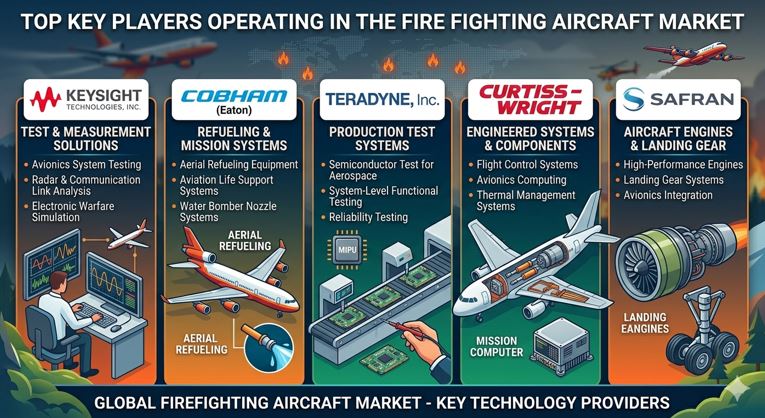
Top Key Players operating in the Firefighting Aircraft Market
- Keysight Technologies, Inc.
- Cobham Limited (Eaton)
- Teradyne, Inc.
- Curtiss-Wright Corporation
- Safran S.A
- Textron Inc.
- Astronics Corporation
- National Instruments (NI)
- Viavi Solutions Inc.
FAQ
What are firefighting aircraft used for?
Firefighting aircraft are primarily used to combat wildfires by dropping water, fire retardants, or fire suppressant chemicals over affected areas. These aircraft also support rescue missions, disaster management operations, surveillance activities, and emergency response efforts in remote or hard-to-reach regions.
Which types of aircraft are commonly used in firefighting operations?
The most commonly used firefighting aircraft include fixed-wing air tankers, helicopters, amphibious aircraft, and unmanned aerial vehicles (UAVs). Fixed-wing aircraft are suitable for large-scale wildfire suppression, while helicopters are preferred for targeted operations and rescue missions due to their maneuverability and vertical landing capabilities.
What factors are driving the growth of the firefighting aircraft market?
The market is mainly driven by the increasing frequency of wildfires, climate change, rising government investments in disaster management, and advancements in aerial firefighting technologies. Growing demand for rapid emergency response systems and modern firefighting fleets is also supporting market expansion globally.
Which region dominates the global firefighting aircraft market?
North America currently dominates the global firefighting aircraft market due to frequent wildfire incidents, strong government funding, advanced aviation infrastructure, and the presence of major firefighting aircraft manufacturers and service providers. However, the Asia-Pacific region is expected to witness the fastest growth in the coming years.
