Global Marketing Automation Software Market Overview
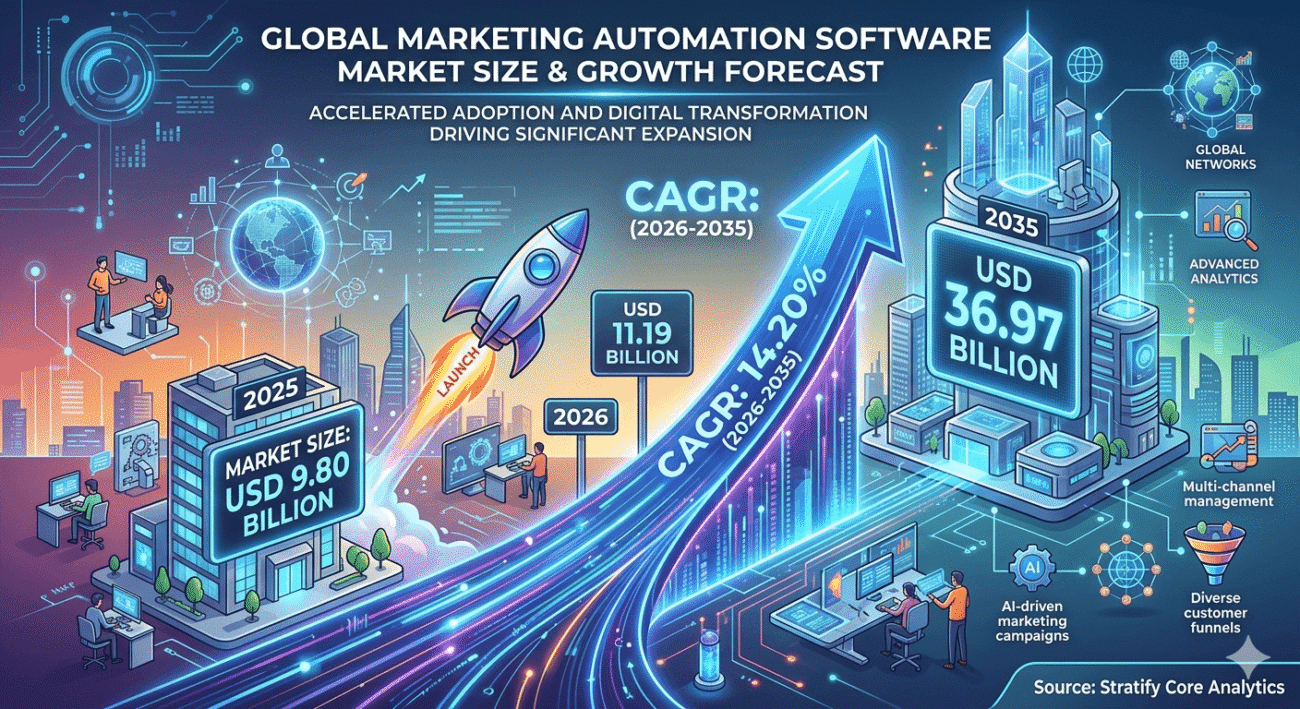
The market size for marketing automation software is estimated to reach USD 11.1 bn in 2026 and continue its growth up to around USD 36.9 bn in 2035 at a CAGR of 14.2% from 2026-2035.
The worldwide market for marketing automation software has been rapidly developing over the last decade, due to enterprises’ investments in digital transformation and in enhancing customer engagement and implementing data-driven marketing strategies. Marketing automation solutions are defined as applications or programs that automate marketing tasks such as e-mail marketing, customer segmentation, lead nurturing, social media scheduling, customer journey mapping, analytics and campaign tracking. This innovative software is widely adopted across all business sectors due to its capability to strengthen marketing accuracy, optimize operational efficiency and drive the highest value from every marketing dollar.
Demand for marketing automation platforms has seen exponential growth over recent years, due to the emergence of more channels for customer engagement and the development of digital marketing channels. Customers communicate with organizations through websites, social media, mobile applications, search engines and e-mails, etc., because manual management of diverse customer touchpoints is not effective hence large companies and SMEs need a way to reduce their manual workload by automated communication at a mass scale. The use of AI and ML capabilities is the core component of automation tools as it provides customer behavior analysis and insights across multiple channels.
Medium and large businesses have been primary consumers of marketing automation solutions due to large data repository and heavy marketing budget, but with declining cost and improved functionalities of cloud platforms SMEs have become a significant part of the marketing automation industry with their needs of low IT infrastructure investment.
The retail and digital commerce industry vertical dominates the marketing automation adoption, due to ease with which online sellers use automation to know customer behavior and response. In addition to this industries like healthcare, financial services, telecommunications, manufacturing, educational institutes and travel are also adopting marketing automation tools to identify customers, simplify communications.
Globally North America holds the largest market for marketing automation solutions due to prominent companies in the market and high penetration of CRM technology, internet access. US holds maximum market share in the marketing automation software market due to large investments by enterprises in CRM technology and online customer analytics solutions, Europe follows closely due to growing interest in the digitalization trend and personalization as a crucial strategy for businesses in this region.
The Asia-Pacific region is projected to experience the fastest market growth, due to increasing number of internet users and high adoption of mobile devices, robust e-commerce structure and increasing advertising spends on digital advertising, contributing to a significant rise in the marketing automation market demand in countries such as China, India, Japan and ASEAN countries. Enterprises in this region are readily switching to automation tools from conventional marketing channels to increase customer acquisition.
Key players in the marketing automation market include major pioneers in the industry, along with startups focusing on innovative IT solutions. Key growth strategies included intensified R&D operations, partnerships, sharing agreements, product development and launching, acquisitions/investments in AI technology in order to stay competitive in the market.
Key growth drivers of the marketing automation industry:-
- rapid rise in personalized content applications
- increasing cloud adoption
- increasing importance of content-driven digital marketing
- expanding e-commerce and online advertising industries
- emerging use of AI and forecasting tools
- significance of lead management and customer retention
- increasing number of cross channel marketing integrations.
The marketing automation market faces its operational challenges as Data privacy, complexity of integration and high operation costs. Nevertheless, the long-term prospects for the marketing automation market are bright as businesses will continue their focus toward enhancing the customer interactions in the digital world.
Key Marketing Automation Software Market Trends
The market of marketing automation software is progressing rapidly as organizations adopt innovative tools and solutions to enhance customer experience streamline campaign execution and improve marketing efficiency. One of the most prominent trends emerging in the market is the rise of artificial intelligence (AI) and machine learning capabilities of marketing automation systems.
AI-powered automation facilitates decision making through customer insights analysis and behavioral tracking suggests optimal messaging strategies and automates the delivery of customized targeted content to the right segment of customers. It also optimizes marketing campaigns real time increasing automation effectiveness.
Another key market trend is the prevalence of an omnichannel approach to marketing automation. As today’s consumers interact with brands across various digital and physical channels including social media websites, email personal mobile devices SMS and retail outlets; companies are aligned to establish unified automation platforms that synchronize messaging plans and tools across diverse channels. Omnichannel automation improves brand consistency and enhances customer experiences.
The proliferation of customer data management systems (CDPs) and customer insights platforms is also gaining prominence in the market. Organizations are consolidating data assets into centralized databases thereby enabling seamless integration these data assets with marketing automation applications providing marketers with wide-ranging rich customer knowledge. As a result marketing activities have become more personalized, targeted and data-driven.
Cloud deployment becomes dominant owing to its ease scalability cost savings and mobility advantages. Companies prefer cloud-hosted automation systems that remove maintenance investment and infrastructure costs enable rapid upgrades simplify extensions with third-party innovations and facilitate remote access. Cloud solutions are also compatible with business applications such as customer relationship management (CRM), e-commerce systems, analytics and operations platforms.
Mobile marketing automation is expanding its foothold as the use of smartphones grows across countries. Marketers are focusing on leveraging push notifications SMS advertising mobile content automation and app-based engagement strategies to capture mobile users. Mobile optimization remains imperative for audience engagement creation and conversion.
Social media marketing automation is another emerging trend as firms harness automation tools for scheduling posts tracking audience responses managing ad campaigns listening to online conversations and measuring engagement on social media channels. Such automation tools boost productivity and maintain social media consistency.
The focus on delivering highly personalized customer experiences has gained momentum as digital marketers deploy advanced system features such as targeted content based on behavioral and campaign analytics, automated tailored product recommendations personalized CRM integration in campaigns, automated digital suggestive messaging text-video personalization and hybrid AI virtual assistance to kickstart conversational marketing.
Prominent trends affecting the market are:
- Accelerating adoption of AI and ML
- Increasing emphasis on multi channel automation initiatives
- Growing implementation of customer analytics driven automation
- Adoption of marketing automation platforms in the cloud
- Mobile marketing automation initiatives
- High adoption of digital personalized messaging
- Increased use of automation for customer insight management
- Adoption of content marketing automation tools
Key Marketing Automation Software Market Key Restraints
Market restraints within the global marketing automation software industry include the following. Although marketing automation software shows substantial potential within a booming market environment, an infrastructure of restraints need to be acknowledged. The highest barrier is the high implementation and integration cost for advanced marketing automation systems.
Cost barriers are often referenced as key restraint to market growth. Especially small and medium firms lack sufficient budgetary provisions to accept licenses, support infrastructure and implementation facilities, and provide staff with requisite support and training costing time and resources. The frequency and magnitude of technical challenges in implementation hinder wider adoption of advanced marketing automation infrastructure.
A further restraint is given by complex integration issues with existing enterprise systems. Integration constraints occur where it is needed for marketing automation platforms to interface with the existing Customer Relationship Management systems, analytics platform, e-commerce application, web content management tool, or third party applications. Poor integration can cause operational disruptions, data inaccuracies, and delays in the firm’s deployment process. Firms with aging IT infrastructure might further experience difficulties with technology adaptation.
The constraints of data privacy and cyber security are beginning to impact upon growth potential. Given that marketing automation solutions require application of large data sets, including behavioral, purchase and personal data; the potential impact of data breach incidents and cyber attacks on customer confidence in the system is perceived as a restraint on growth. Growing government regulation through the introduction of legislation such as the General Data Protection regulation and regional regulation standards will increase operational complexity and cost.
The market further suffers from a shortage of highly skilled professionals capable of handling advanced marketing automation infrastructure. As advanced marketing automation solutions require detailed knowledge of analytics, campaign management, customer profiling and data interpretation, there exist high remuneration challenges to secure the required personnel and to build in-house capabilities.
Lack of in-house ability in automation is thus a key restraint on adoption. Over-use of automation can have a detrimental impact on the quality of customer engagement tactics, customer trust, and the effectiveness of campaign tactics. Overautomation can lead to a lack of authentic messaging and negative impacts on customer loyalty.
Challenges also exist in the measurement of ROI from automation solutions; the extensive analytics capabilities present make it difficult to quantify the direct benefits to increased revenue and customer retention. Uncertainty over the financial gains can inhibit investment in purchasing automation solutions. Key restraints include:
- High automation software investment costs, including software, infrastructure and staff training.
- Complex integration issues with legacy systems.
- Rising security concerns in relation to customer data privacy.
- Prohibited government legislation limiting automation tactics.
- Lack of skilled professionals offering full automation systems operation.
- Difficulty managing large data sets.
Challenges to measure the ROI of automation solutions.
- The risk that automation can undermine the operational efficiency and customer engagement.
- Reluctance to invest in automation solutions due to the fear of technology migration and software viability issues.
- Dependence on reliable technological service provision, such as fast internet connectivity, networking, and cloud computing.
Vendor lock-in issues raise concerns as they inhibit the strategic evaluation processes within businesses. Firm reliance on a particular vendor or solution due to proprietary technology, contractual exclusivity or migration complexities reduces the relative power of the firm within technological market selection.
Furthermore, as marketing automation providers constantly update and develop fresh solutions to meet rapidly evolving consumer consumption patterns, businesses face increased pressure to adapt and enhance their marketing automation frameworks continually. Keeping pace with global trends entails increased investment within organization marketing departments. The industry is further estimated to show an inverse relationship between automation software sophistication and the levels of risk aversion within the business.
Forecasting the future development of the marketing automation software industry shows that though the market currently suffers from restraints that temper growth, new innovations, rising customer awareness, and technological developments will lead to future expansion. Future market growth will be supported by lower pricing mechanisms, better integration functions, stronger security features, and user training guidance. These developments will further benefit from increased B2B use of automation platforms.
Marketing Automation Software Market Key Opportunities
Significant growth is being observed in the global marketing automation software market and has been driven by the necessity of digital engagement as well as customer retention and data-driven marketing strategies. One of the major opportunities in the market is the increasing adoption of artificial intelligence and machine learning technologies in marketing automation platforms.
All these organizations are looking for a next-generation, intelligent automation solution that can identify customer behavior, assess buying intent, and automate personalized customer experience in real time. Not only do AI-based automation tools enable organizations to optimize their campaigns and improve lead scoring, but they also ensure automation of mundane marketing tasks leading to a strong growth potential for automation vendors.
The rising demand for omnichannel marketing automation solutions also represents another major opportunity for market growth. Customers today engage with brands on multiple digital platforms such as e-mail, websites, mobile apps, social media, and e-commerce portals. With such multi-channel presence, organizations need to build integrated, omnichannel marketing automation solutions to manage customer conversations consistently. Companies providing a seamless cross-channel communications mechanism along with centralized analytics and unified customer data management solutions will be able to garner huge benefits in the evolving market landscape.
The rapid digital transformation of small- and medium-sized enterprises (SMEs) further offers considerable opportunities to catalyze industry growth. Adoption of marketing automation in large enterprises has primarily been restricted by high capital investments and operational complexities. However, recent evolution of several cloud-based subscription deployment models and development of scalable SaaS platforms have lowered capital investments leading to accessibility of automation solutions to a growing number of SMEs to improve customer communication, expedite campaigns and achieve greater marketing efficiency without lack of an extensive IT infrastructure.
Increasing online commerce and retail industries accelerate opportunities in the market. Online commerce requires engagement with customers through best practice recommendations, cart recovery campaigns, and loyalty programs with the help of automation software to achieve higher conversions and customer loyalty. Multidimensional sales insights and automated customer lifetime management are allowing online merchants to facilitate such activities through automation software. With an increasing number of online shopping activities around the globe, the segment is expected to witness significant growth in the future.
CRM-integrated marketing automation solutions extend another significant avenue in the market. On one hand, organizations are targeting to unite marketing, sales, and customer service iterations to realize cohesive ecosystems combining inter-departmental effort. On the other hand, such integrated modules can facilitate better lead management, customer segmentation, campaign automation, and improved sales management. The industry will observe good demand for such integrated modules from such clients across industries.
The IT industry is promoting the rising use of mobile automation strategies to reach benefits in the category. With consumers spending increasing amounts of time on their smartphones and other mobile-enabled applications, the need for automation platforms to adopt mobile centric marketing automation strategies is rising.
Vendors offering push notifications, SMS automation, mobile marketing personalization, and location-based marketing capabilities are gaining huge prominence in the industry. Retail, travel, entertainment, and financial services are the key sectors that have accounted for the surge in demand for mobile marketing automation.
The healthcare industry is emerging as another strong avenue for marketing automation vendors. Healthcare institutions are adopting automation platforms to manage patient communication, appointment reminders, health campaigns, and secure patient engagement. Data privacy compliance, along with ensured security of sensitive data communication, is helping such platform offerings to gain high acceptance from hospitals, health institutions, and pharmaceutical companies.
Emerging Asia-Pacific economies, Latin America, and the Middle East are also conquering a share of new opportunities for the industry. As internet penetration, penetration of smart devices, and digital ecosystems grow rapidly in these economies, such organizations will move fast to implement automation technologies. Such emerging markets powered by cost conscious pricing strategies, localized solutions, and multi-lingual offerings will observe huge market profits.
Marketing Automation Software Market Key Drivers
The growing need for customized customer interaction is the foremost factor for the growth of the marketing automation software market. The needs of modern consumers have become more personalized, requiring relevant content, contextualized recommendations and coherent digital experiences through all modes and channels of communication. As a result, enterprises are implementing marketing automation systems to gather customer information, interpret behavioral trends and communicate in a customized manner at large volumes. The customer-centric marketing approach is thus continuously supporting the expansion of the worldwide market.
The exponential expansion of digital marketing activities is the second key factor propelling the market. Companies are fairly reallocating their advertising investments to digital media, including email marketing, social networking, search engine marketing, online advertising, etc., rather than conventional channels. The marketing campaigns managed manually are time consuming and complex, especially in the case of large databases. Marketing automation systems are effective in functioning the campaigns along with event automation, scheduling, reporting/analysis and customer segmentation.
The proliferation of customer information through increased digital usage is a third major aspect fuelling the marketing automation market. Organizations derive and use huge amount of data gathered from online websites, social media platforms, mobile apps, e-commerce stores etc., and convert it into meaningful insights to remain competitive and increase sales. The advanced analytics features of the software offer better targeting, improved campaign execution and conversion rates.
The increasing adoption of cloud computing technologies is also a prominent market booster. The cloud-based marketing automation systems are flexible, remotely accessible, less expensive from an infrastructure perspective and provide easier software upgrades. Hence, the preference for cloud based delivery models has been growing among organizations in diverse industry sectors.
Growth in the significance of lead nurturing and lead generation activities is yet another driver for the market. Organizations are seeking more effective ways to pull customers up along the purchase journey. The automation is specifically effective in automating processes such as lead scoring, targeting email communications, boosting customer engagement and measuring conversions. This results in higher sales and marketing efficiency.
The increasing application of artificial intelligence and predictive analytics techniques in marketing automation is also fostering market development. These technologies can analyze customer behavioral data patterns, predict purchase needs and recommend campaign approaches accordingly. This helps organizations to target customers more precisely and achieve better performance.
Growing utilization of social media platforms by businesses for consumer relation building and brand building is further helping market growth. The social media marketing automation systems facilitate management of social media campaigns, subsequent content dissemination, social media tracking and audience analysis. With the advent of more and more social media outlets, the demand for marketing automation technology is further likely to proliferate.
The rising importance of focus on customer retention and relationships as powerful demand drivers also signifies the market expansion. In view of the fact that customer acquisition is more expensive than customer retention, organizations are emphasizing service and loyalty. The marketing automation platforms help organizations to perform retention activities by automating campaign execution, tracking customer focus groups, capturing customer feedback and offering re-targeting value propositions.
Increasing demand for targeted and measurable marketing performance is also supporting the market growth. There is a growing emphasis on defining marketing KPIs and establishing reporting standards so as to drive strategic planning. The software solutions provide a dashboard and data visualization tools to optimize and evaluate campaigns in measurable terms.
- Increasing demand for personalized customer experiences
- Rapid growth of digital marketing activities
- Rising volume of customer data generation
- Growing adoption of cloud-based SaaS solutions
- Higher focus on lead generation and nurturing
- Integration of AI and predictive analytics technologies
- Expansion of social media marketing campaigns
- Greater emphasis on customer retention strategies
- Increasing need for measurable marketing ROI
Marketing Automation Software Market Segment Insights
Market segmentation for marketing automation software industry takes place on the basis of deployment mode, organization size, application, industry vertical and region. These segments add to the growth of the overall market and, at the same time depend upon the changing business needs of various industry verticals. The market is divided into these categories:
Deployment mode (cloud based and on premise): Cloud based deployment controls the industry as it provides efficiency, affordability and flexibility. Cloud based industry provides for remote access, automatic updation of the software, subscription based pricing etc. As compared to on premise, the former is slowly gaining importance due to the affordability feature, meeting reduced capital investment for installing automation tools. Small & medium sized enterprises select cloud for automation tools to meet their needs at an affordable price.
Business organization size (Large enterprise and Small & medium sized enterprises): Large organizations control the market for automation software as they have a huge customer base, complex marketing requirements and a high budget to meet their requirements. These organizations invest heavily in automation tools that are capable of amalgamating with their databases, CRM, analytics, and ERP. SMEs are poised to become a rising business category due to increased awareness about the benefits of automation tools and the cost effectiveness of SaaS model.
Application areas in the industry (campaign management, lead nurturing, email marketing, customer engagement, inbound marketing, social media marketing and analytics & reporting): Email marketing controls the marketing application area due to its high dependency for communication and awareness activities. Lead nurturing and campaign management tools are experiencing a rising growth being utilized by organizations to control the conversion rate and fine-tune the customer journey.
The social media marketing aspect of the automation industry is experiencing further growth due to increasing business spending on digital branding and social media as well as influencer marketing. These automation tools help organizations automate their social media posts, analyze interaction details and manage their digital engagements. Analytics & reporting details of automation tools have an increasing demand due to the need for quantifying the results and making marketing results quantifiable.
Verticals in Industry (Retail & e-commerce, BFSI, education, healthcare, manufacturing, media & entertainment, travel & tourism and IT & telecommunication): Retail & e commerce industry comprises of high market share owing to its dependency on online advertisements and individual customer interactions, loyalty programs and personal engagements. These industries utilize automation tools for contact targeting and recommendation engines, and managing abandoned carts effectively.
Further BFSI industry has a rising demand for marketing automation software for customer interaction, financial product advancement and lead management. It also uses automation tools for smooth handling of customer onboarding and regulatory compliance. The healthcare industry is using automation tools for patient engagement activities, managing appointment schedules and spreading awareness among the masses.
IT & Telecommunication industry has high demand for advanced marketing automation tools owing to high competition and need for digital advertisements for customer acquisition. Educational institutes utilize automation tools for enhanced customer communication and increasing enrollments.
Region wise industry segmentation reveals North America to control the major shares of marketing automation software industry due to its high number of automation providers, developed digital structure, infrastructure and higher usage of AI based tools. Europe is a close competitor on the backend of increasing digital transformation programs. Asia pacific is heading for highest growth during the forecast period in line with increasing penetration of internet usage, SMS users and digitization of more industry verticals in the developing economies including India & China.
- Cloud-based deployment dominates due to scalability and affordability
- Large enterprises lead adoption with advanced marketing ecosystems
- SMEs show strong growth through SaaS-based accessibility
- Email marketing remains a core application segment
- Social media automation experiences rapid expansion
- Retail and e-commerce sectors contribute major revenue share
- BFSI and healthcare industries increase automation investments
- North America holds the largest market share
- Asia-Pacific emerges as the fastest-growing regional market
Marketing Automation Software Market Regional Analysis
The global market for marketing automation software is expanding quickly, driven by high demand for AI-powered interactions, multi-channel campaigns, lead generation and targeted marketing efforts. In addition to the retail, BFSI, healthcare, manufacturing, IT and telecommunications industries, many firms are implementing marketing automation platforms in order to increase customer retention and marketing ROI while streamlining their workflows.
With growth predicted to continue over the next decade at a CAGR in double digits, the global market will expand more as a result of cloud adoption, analytics integration, extensive digitalization efforts and other contributing factors.
North America accounts for a substantial share of the marketing automation software market because many large technology solution suppliers are based there and there are numerous highly capable digital infrastructure systems and business enterprises that are investing a significant amount of capital. Key market growth areas in the U.S. include early adoption of cloud-powered marketing systems, AI-powered marketing analytics and CRM integration solutions.
Companies that extensively use cloud-based marketing solutions for various campaigns including e-mail, social media and customer journey orchestration, will be most dominant in this segment over the next few years. This segment retained its position as the leading market in the recent past, mainly attributed to a mature digital environment, continued investment in data-driven marketing channels and a sophisticated digital landscape.
In Europe, the marketing automation software market is considerable due to rampant digital marketing penetration in a number of large and small and medium businesses. The market is increasingly dominated by companies in Germany, the UK and France due to demand for greater control over campaigns and more precise customer targeting.
Companies in the EU are primarily focused on ensuring adherence to a strict policy on data security including GDPR for compliance-driven marketing solutions. Cloud-based marketing automation platforms, AI-centric personalizations and predictive marketing analytics are major drivers in the EU market, in addition to growing expenditure on digital commerce and customer-oriented relationships.
Asia Pacific, which is showing a faster growth rate than the other segments, will see a substantial increase in market share over the forecast period thanks to rapid digitalization, greater Internet use and a rapid rise in the volume of e-commerce transactions. Demand for data-driven marketing automation is growing significantly in the Chinese, Indian, Japanese, and South Korean markets due to the widespread acceptance of a digital-first marketing strategy.
Demand is also projected to surge from increasing social media and digital advertising penetration and AI-powered customer engagement platforms. Increased use of automated systems for multilingual campaigns, enhanced lead management and a stronger customer analytics program are leading companies to utilize these automation tools. The expansion of small and medium-sized firms along with growing start-up registrations will likely cause the demand for cloud-based marketing tools to increase in the years to come.
Top Key Players operating in the Marketing automation software market
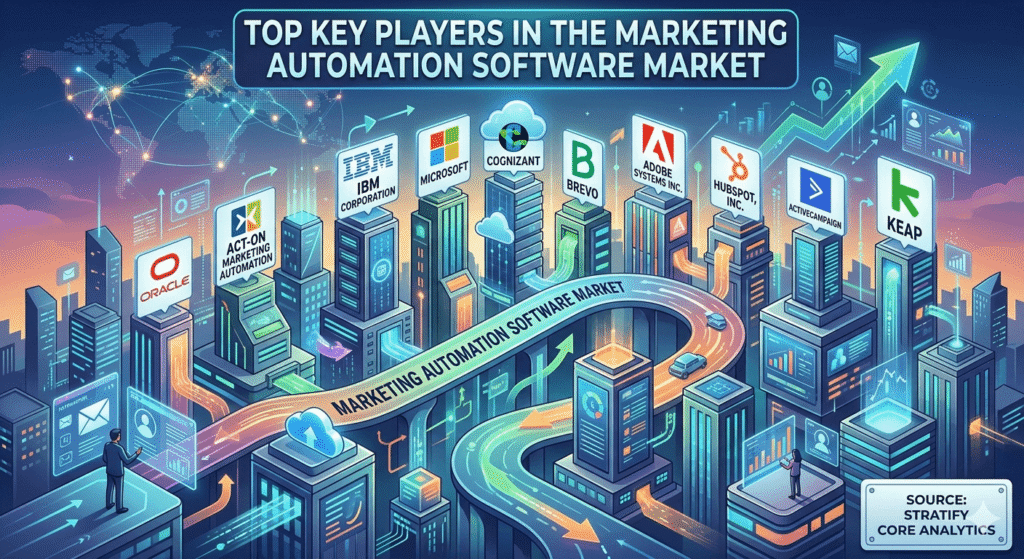
- Oracle
- Act-On Marketing Automation
- IBM Corporation
- Microsoft
- Cognizant
- Brevo
- Adobe Systems Inc.
- HubSpot, Inc.
- ActiveCampaign
- Keap
FAQ
What is marketing automation software?
Marketing automation software is a digital platform that automates repetitive marketing tasks such as email campaigns, lead nurturing, customer segmentation, social media management, analytics tracking, and personalized communication workflows.
Which region dominates the marketing automation software market?
North America currently dominates the marketing automation software market due to the strong presence of major technology providers, advanced cloud infrastructure, and high enterprise adoption of digital marketing technologies.
What factors are driving market growth?
Key growth drivers include increasing adoption of AI-powered marketing tools, rising demand for personalized customer engagement, growth of e-commerce, expanding cloud deployment, and increasing use of omnichannel marketing strategies.
Who are the leading companies in the marketing automation software market?
Major companies operating in the market include Salesforce, Adobe, HubSpot, Oracle, Microsoft, SAP, IBM, Klaviyo, Braze, ActiveCampaign, and Mailchimp.
