
Global Copper Market Overview
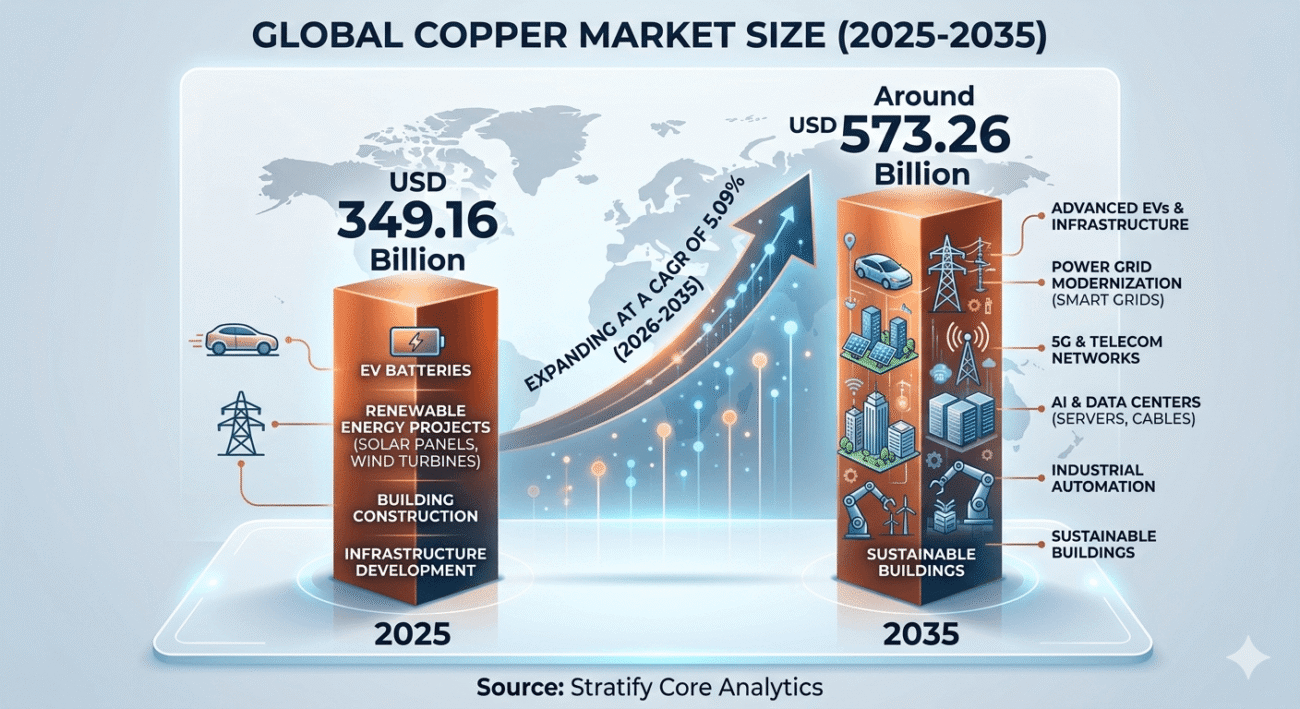
The Global Copper Market size was calculated at USD 349.16 Billion in 2025 and is expected to reach around USD 573.26 Billion by 2035, expanding at a CAGR of 5.09% from 2026 to 2035.
The global copper market plays a vital role in driving global industrial development, infrastructural expansion, and technological innovation. Copper is among the most widely employed base metals because of its superior characteristics: its conductivity, corrosion resistance, durability, and recyclability. Applications include electrical wiring, construction and building materials, transportation vehicles, telecommunication infrastructure, and sustainable energy generation technologies. Industries have continued to develop, and economies have increased investment in urbanization and electrification-related initiatives, which have supported the global demand for copper over the past decade.
Copper can be categorized as a strategic industrial metal as it is extensively used for manufacturing as well as in energy-related activities. Growing demand for clean energy solutions, electric vehicles, smart grids, and efficient energy infrastructure is a major catalyst behind the rising demand for copper consumption. The development of electric vehicles is leading to higher demand for copper on account of their abundant electronic components, electric storage systems, and charging systems. Similarly, renewable energy solutions like solar panels and wind turbines require copper-based wiring and electricity transmission networks, which are contributing to rising demand over the long term.
Copper is still one of the leading raw materials, being consumed in large quantities by the construction industry. From pipes and roofing to electrical cables and plumbing systems in housing, office buildings, and industrial structures. The strong and fast-paced urbanization taking place in many emerging markets like China, India, Brazil, and Southeast Asia has generated growth in housing and infrastructure development, thus in demand for copper. In developed countries, the market is driven by the modernization of old electrical installations, as well as investments in eco-friendly buildings.
Asia-Pacific holds the major share in the global copper market both in production and consumption. The vast industrial base and construction sector of China make it the biggest copper consumer in the world. Also, the high demand from electronics manufacturing requires importing vast quantities of copper concentrates and refined copper. India is considered an important growth market due to increased focus on infrastructure, renewable energy generation, and high industrialization trends. Copper usage is also growing in other countries in the Asia-Pacific region as a result of increasing manufacturing activities and investments in power transmission infrastructure.
The Latin America region is also one of the most critical regions globally for the production of copper. Countries such as Chile and Peru are some of the top producers, and together their share of the global supply is huge. The reason Chile dominates copper production in the world so much has to do with their large mineral deposits and established mining industry. The Latin America region possesses a wide variety of natural resources and enjoys foreign investments in its mining sectors. Despite all this, there are political uncertainties, strikes, legislation pertaining to the environment, and changes in the price of goods that all influence the mining activities in the region and consequently the global supply of copper.
On the other hand, North America and Europe are major consumers of copper, as the two main sectors in which it is most demanded include automobiles and industrial equipment, in addition to being an important material in electronic components, as well as renewable energy production. Governments of both continents in Europe and North America strongly support the trend towards clean energy and electric vehicles, and thus the demand for copper will undoubtedly increase in the coming years. Moreover, recycling in Europe and North America makes up a large share of the secondary copper market.
Global factors such as raw materials availability, mining investments, geopolitical factors, trade policies, and macroeconomics influence the global market for copper. Copper market prices are sensitive to movements in global business activities due to it being perceived as a benchmark indicator of industrial production and growth, as an upturn in business activity in the economy leads to an increase in demand as mining output is stepped up, along with increasing activities in manufacturing and construction. Downturns in economic activity, along with the disruption in supply chains, can cause market dynamics to be unfavorable.
Technology adoption in mining and refining operation, automation of processes and application of digital monitoring system, the introduction of environmentally conscious extraction techniques has significantly improved the efficiency and productivity of the operations and made its development more sustainable as mining firms are reducing emissions to the environment along with their carbon footprint, the effective management of mining waste along with the reducing water usage in the refining of copper has become a key area of focus in light of pressure from governments and environmental activist.
Recycling is a vital element in the copper market because copper can be recycled endlessly, without any compromise in its physical and chemical characteristics. By using recycled copper, we are saving energy, reducing the amount of greenhouse gas emitted, and limiting our reliance on primary mining. As the efforts towards sustainability intensify across all nations, demand for recycled copper will boom for diverse industries.
While the market forecast looks promising, there are a few setbacks the copper market has to deal with. Falling ore grades, increasing operating expenses, the increasing number of environmental factors, and geopolitics in key mining nations might limit the supply. Moreover, energy price fluctuation, along with the transportation cost, impacts the production cost. Notwithstanding these factors, long-term prospects for the market remain upbeat with rising investment in renewable energy, electrical vehicles, information technology, and urban development.
The global market is projected to achieve constant growth over the coming years due to accelerating industrialization, the accelerating transition to renewables, and escalating electrification across different sectors. The role of copper will continue to grow as it’s an imperative material in supporting global growth and promoting sustainability.
Key Copper Market Trends
The copper market has been strong and is poised for significant demand in 2025-2026 due to continued industrialization growth, a boom in renewable energy projects, a rapid acceleration of electric vehicles (EVs), and an increase in spending for artificial intelligence (AI) infrastructure. Copper, aptly nicknamed Dr. Copper for being an indicator of economic growth, is among the most strategic industrial metals on a global basis. Analysts are forecasting demand to climb significantly in the coming decade, driven by the forces of electrification and the upgrade of modern infrastructure.
One of the dominant market themes in the copper space is the acceleration of the green energy revolution. Investment in solar farms, wind projects, storage devices, and the modernization of electrical grids are driving immense demand for copper when compared to existing fossil-fuel energy sources. Studies indicate that it takes anywhere between four and six times as much copper per megawatt to power the green energy grid as the existing one.
Another key factor in copper demand growth is the growing popularity of electric vehicles (EVs). Electric cars and trucks require significantly higher amounts of copper than traditional internal combustion vehicles because of their electric motors, charging equipment, battery packs, and wiring. It has been reported that EVs contain about three to four times more copper than conventionally-powered cars. Government emissions regulations, along with government subsidies for EV production and purchase, will fuel greater demand for copper in the automotive industry out to 2035.
Artificial intelligence (AI) and increasing data center usage represent additional key drivers of copper demand. AI technologies depend on massive data centers, which are equipped with substantial power supply systems, cooling facilities, and electrical transmission lines. Experts caution that the increasing scale of hyperscale AI campuses may place further strain on the already tight supply of copper. It is anticipated that by 2035, the world’s existing copper mines may only be capable of meeting about 70% of the predicted global demand for the commodity without significant increases to new mining operations.
Copper prices reached an all-time high last month as rising demand coincided with continued supply disruptions. Futures prices also reached record levels in 2026 as mining firms grappled with lower ore grades, production delays, a lack of workers, and geopolitical instability. Production outages have occurred at mines in regions such as Indonesia and Chile, which are among the world’s largest copper producers, further squeezing global supplies. The increasing price of energy and scarcity of sulfuric acid, a crucial component in the refining of copper ore, have pushed costs up.
An imbalance of supply is one of the key issues the copper sector faces. Opening new mines involves enormous investment and environmental permits, red tape, and public backlash-and mining firms will also need to boost refinery capacity. The copper market may enter a lengthy supply deficit later this decade if investment into new mines and refineries does not keep pace with growth in demand, market estimates suggest. Hundreds of thousands of tons per year more production capacity will be needed by 2035.
With more than half the total global demand, China remains the largest market for copper globally. Government-initiated infrastructure projects, strong manufacturing output, green energy projects, and EV production are major drivers behind global copper price trends in the country. Other important growing copper-consuming centers are emerging in India and Southeast Asian countries, driven by rapid urbanization, industrialization, and government initiatives, and are expected to be a significant driver for copper demand in the years to come.
Sustainability is a major emerging aspect of the copper market. Governments and producers are spending more money on technology and initiatives in order to be able to recover and utilize recycled copper. Using recycled copper is less energy-intensive and meets global requirements for reduced carbon emissions, while also contributing to a more robust supply chain, reducing dependency on primary resources. It is anticipated, however, that the rise in usage of recycled copper will not be sufficient to overcome the widening gap between copper demand and supply expected over the next ten years.
Geopolitical trends are also impacting copper trade flows and price volatility. Trade restrictions, tensions between countries, transportation bottlenecks, and the importance of critical mineral security issues have led to a restructuring of global supply chains. Countries like the U.S. And the E.U. Are beginning to implement mineral security approaches within their borders, alongside international collaborations with copper-producing nations, to gain access to long-term supplies of the metal.
Copper markets remain overwhelmingly bullish despite short-term market swings. In the longer term, the build-out of renewable energy, the uptake of EVs, and the continued build-out of AI infrastructure, among other factors related to the global move toward electrification, will sustain strong copper demand for many years to come. However, underlying supply constraints along with continuing geopolitical risk can lead to ongoing price volatility.
Copper Market Key Restraints
The market for copper is growing at an accelerated pace as a result of rising demand for copper due to industrial advancement and urbanization, and also growing applications across various industries like construction, automotive, electronics, and the renewable energy sector. Despite being a large market with high growth opportunities for the market, various restraints can be identified that may affect the growth of the copper market during the forecast period: fluctuations of raw material prices, environmental problems relating to mining, supply chain problems, degradation of ore grades, governmental regulations, and strictness. All of the above factors can affect the manufacturers, suppliers, and also the investors associated with the market for copper.
Prices for copper are one of the main constraints affecting the market, as their value depends on factors like global economic situations, global geopolitics, trade agreements between countries, changing factors influencing supply and demand, and changing trends of industrial production. The fluctuation in the prices of copper can create difficulties in long-term planning for both manufacturers and end-users. In case there is any slump or depression in the global economic scenario, industrial production tends to decline in drastic ways, which eventually leads to a sharp decline in prices for copper, and rising energy prices and inflation can add to these complexities.
Pressure also comes from the environmental problems surrounding the mining and processing of copper. Copper extraction involves widespread mining processes and can lead to a range of problems: large areas of forest are destroyed in order to mine for copper, extensive land degradation, damage to water sources and large amounts of greenhouse gases are emitted. All mining processes must adhere to environmental regulations, and the environment impacted should be considered in the process. Due to high investment in new technologies and processes, a wider range of methods is being used to create more environmentally friendly processes and a larger amount of energy to extract the mineral. Ultimately, these costs and additional factors increase production, and this is directly translated to the market and acts as a restriction for its expansion.
A further complication for the market is that the grade quality of the copper ore deposits is falling. It has become harder to discover high-grade copper deposits, so instead, mining companies have to delve into lower-grade deposits. These are expensive to process and require large amounts of water and energy to do so, along with new and improved methods. Low-grade copper deposits therefore lead to low production efficiency and have already become a limit for market supply, and problems for demand are set to arise from its anticipated increase in the automotive (electric cars) and energy industries (renewable energy).
Disruptions in the supply chain hinder market growth as well. Geopolitical disturbances, trade restrictions, congestion at transit points, shortage of workers, and natural disasters present significant risks to supply chain, of the world and this has been clearly visible during the post COVID-19 phase, in which the global supply chain was weakened because the outbreak caused mine closures, slowed the delivery of products, and led to a decrease in manufactured output. The delay in the supply chain is not only a bottleneck for getting raw and finished products, but also adds extra costs to the producer because of production delay. The over-reliance of a small few copper producing countries creates risk, which enhances the possibility of supply chain disruption as it is a concentrated risk.
The energy-intensive nature of copper mining and processing further obstructs market growth. In the production of copper, high power and fuel consumption occur. Because of that, if the prices of fuel and electricity escalate, then it raises the production costs for the miners and refiners. In countries with an unstable power supply, it is possible that production might not be smooth. Also, in response to the global push to reduce carbon emissions, the mining companies are investing in efficient technologies and incorporating renewable energy sources into their operations, but the integration of those technologies may be expensive.
Alternative substitution of material will have an effect to the market of copper. The alternative materials could take copper’s place for their relatively low costs and weight, such as fiber optics, aluminum, and others. Aluminum, for example, is a widely used conductor material in power distribution, automobiles, and other usages in replacement for copper and at a lower cost. Large-scale use of alternative materials may result in the loss of copper in certain areas and also limited market growth.
Labor issues and social conflicts in mining areas are also another issue concerning the copper market. Strikes of workers, salary disputes, and anti-mining action may result in low productivity and limited supply. Land disputes, environmental issues, and allocation of resources among the people at the mining sites of copper-producing countries are typical issue which may delay the building of the mines, cause greater difficulties with the legislation, and bring investors anxiety.
Lastly, new mine development faces the obstacles of stringent permits and regulations. Gaining permits and environmental approvals to conduct research, mining, processing, and consumption of copper can be very costly and lengthy. New production capacity investment and expansion can be delayed by new mining regulations. However, political uncertainty and unstable regulations regarding mining in some areas made for a less favorable operating environment, which would directly affect investor attitudes and the market expansion.
The global market demand for copper is still strong from different industrial applications; however, there are limitations to the market expansion. Problems which restricts market expansion include fluctuation of the price, environmental regulation, decreasing of the ore grades, supply chain disruption, rising costs of energy, replacement of other materials, unrest from the industry, and government regulation control. To overcome the constraints on the market expansion, the investment would be put in sustainability in mining technologies, new development in technology, recycling of copper, a better distributed supply chain, and diversifying the supply of copper resources. Success in overcoming constraints will keep the business profitable, a market leader, and provide sustained growth in the future.
Copper Market Key Opportunities
Rising industrialization, rapid urbanization, and increasing investment in green and renewable technologies are all contributing to boosting the global copper market to a large extent. Copper is considered one of the most important metals industrially, as it has wonderful characteristics including good electrical conductivity, thermal conductivity, and great resistance to corrosion. Building, vehicle, electric, communication, electricity generating industries are still dependent on copper and its derivatives. Government and individual organizations paying more and more attention to sustainable and environmental development will definitely drive the increase in consumption.
The rise of renewable energy sectors is an obvious opportunity in the copper market. Various kinds of renewable energy systems, such as solar panels, wind power generators, hydroelectric generation, and energy storage, will consume quite a lot of copper in wires, motors, transformers, and transmitting stations, especially when compared with traditional generating technologies. More electrical networks involved lead to more consumption of copper and its alloys. Various countries, especially in Europe, North America, and the Asia Pacific, invest so much in green energy technologies to decrease environmental pollution.
The rise of the electric vehicle (EV) industry is also offering growth prospects for the copper market. Electric vehicles use almost four times the amount of copper used in traditional internal combustion engine vehicles. Copper has a key role in a number of EV components, such as batteries, electric motors, power distribution systems, and electric car chargers. Robust growth of the manufacturing of EVs, driven by the adoption of government policies as well as increasing environmental consciousness on the part of consumers, will boost demand for copper in the long run. Moreover, global efforts to establish widespread EV charging stations are creating demand for electric vehicle charging cables and other electrical components.
The development of infrastructure and smart cities in emerging economies is also creating market growth opportunities. Many developing economies are undertaking large-scale projects in transportation, smart cities, construction of residential facilities, and industrial undertakings, all of which depend on a significant usage of copper. Pipes, electrical systems, roofing materials, and machinery remain the indispensable components in the development of the modern infrastructure. Among emerging Asian economies, China and India have higher industrial growth, making the Asia Pacific one of the leading global consumers of copper.
Developments in telecommunications and digital technology are offering another significant avenue of opportunity. The growth of 5G networks, data centers, and fast internet access is raising the demand for copper wires and connectors. Though fiber optics is replacing wires for long-haul communication, they are still being used extensively for power supply and short-range communications systems. High adoption of smartphones, cloud technologies, and IoT devices will support growth in the demand for copper wires, connectors, and cabling solutions in the telecommunications and electronics industry.
New avenues for copper have also opened up due to the growing trend for recycling and sustainable copper production. Copper is the only metal that is recyclable indefinitely without loss of its quality or performance. The increased focus on the circular economy and environmental sustainability will make industries invest more in copper recycling technology, as recycled copper not only reduces energy consumption and excavation needs but also caters to growing market demand. It is likely to improve the second copper market in the years to come due to efforts from governments and environmental organizations to boost recycling rates.
Innovation through new technologies in mining and extraction is one factor that is improving the expansion opportunities of the copper market. The mining industry has increasingly adopted automation, artificial intelligence, and efficient processing technologies. This helps improve productivity and lower the production costs in the mining industry, thereby producing copper while preserving safety and environmental standards. Explorations of virgin areas also promise to lead to future copper supply and ensure a continued expansion of the copper market.
The construction industry is one significant demand for copper products, which will ensure the continuation of market opportunity at a stable level. Copper is extensively utilized in wiring, plumbing, heating, and also in construction activities. An increase in investment in construction, in the form of residential houses, commercial buildings, and public works, is anticipated to increase the copper demand all over the world. Energy-efficient buildings and homes, and the growing popularity of ‘smart’ homes, will raise demand for efficient and better electrical devices, thereby contributing to increased consumption of copper.
Another significant aspect fueling the growth of the copper market is the increased focus on energy transmission and upgrading the existing grid. Governments across the world are updating the aging power grids and ensuring the electricity availability to the rural population. The components of transformers, substations, transmission lines, and power distribution apparatus depend on copper. The rise of renewable energy integration with the grid and smart grid technology is anticipated to drive higher demand for copper.
Even though the copper market is witnessing significant challenges like raw material price fluctuation and supply chain disruptions, its future seems to be exceptionally strong. Demand for renewable energy, electric vehicles, construction, and digital transformation is expected to drive healthy profitability for manufacturers, suppliers, and investors. Those organizations that emphasize responsible mining and usage of renewable resources and Recycling facilities would gain an upper hand in the market.
Copper Market Key Drivers
Demand for copper globally is on a strong upswing, driven by accelerating industrialization and rapid urbanization alongside increasing demand from clean energy technology. The conductive and corrosion-resistant nature, coupled with its strength, makes it one of the indispensable industrial metals as it is extensively used in the construction, automobile, electronics, power, and telecommunication sectors. The rising economic growth and robust government spending on infrastructure and clean energy projects are estimated to fuel demand for copper.
The burgeoning demand from the construction sector is a key market driver for copper. Copper is used widely in building constructions, from plumbing systems to the electrical wiring and roofing, along with heating appliances. The fast-paced urbanization and development of the infrastructural sector, especially in the Asia Pacific, the Middle East, and Latin American regions, with significant government spending on residential, commercial, and industrial projects, are expected to spur the usage of copper-based products. Even in the developed economies, modernization of old and aging infrastructure is proving to be a booster for the demand.
Another factor that contributes a lot to the copper market is the increased demand for electric vehicles (EVs). Copper is essential in manufacturing electric vehicles as it possesses excellent electrical conductive properties. Compared to the conventional vehicles powered with the engine of internal combustion, electric vehicles need a lot more copper in their batteries, electric motor, charging infrastructure, wiring system, etc. Driven by emission regulations by the governments globally and also promoting eco-friendly transport and a growing trend toward electric vehicles, this is leading to high demand for copper.
Renewable energy is a third sector with significant growth, which is fueling the demand for copper. These types of renewable energy plants are like solar panels, wind turbines, and other energy storage systems, and require a good amount of copper to efficiently generate and transfer the electrical power. The energy storage systems and wind power systems require an extensive amount of copper wiring and electrical parts for enhanced efficiency of the system. The decreasing carbon footprints worldwide and increasing investments in renewable energy are providing immense growth opportunities in the copper market for manufacturers.
Rising technology and digitization are the driving forces behind market expansion. A surge in the use of consumer electronics, smartphones, laptops, data centers, and telecommunications has increased the requirement for copper parts. These have become an essential component of printed circuit boards, semiconductors, and communications cables due to their excellent conductivity. With the increasing use of 5G technology and high-speed broadband communication, the consumption of copper in the telecommunications sector will rapidly escalate.
The power generation and transmission industry is also playing a significant role in the market growth. These segments are consuming vast quantities of copper for use in transformers, generators, transmission cables, substations, etc. Owing to its excellent electrical and thermal efficiency. The demand for power is rising continuously across the globe, prompting the utility companies and governments to invest in improving power distribution networks and grids. The installation of renewable power sources also demands a large volume of copper infrastructure.
Moreover, increasing demand in industrial machinery and manufacturing activities also contributes to the rising consumption of copper. This metal is widely employed in machinery components, motors, and heat exchangers across sectors such as aerospace, defense, heavy engineering, and industrial equipment. Expanding manufacturing in the developing economies is creating new markets for copper producers. Furthermore, increased automation and digitization in industries are also giving a boost to its consumption.
The prices and supply-demand outlook for copper are currently being driven by the constraints in supply and the reduction of grades in major copper mining areas around the world. Existing mines are finding themselves in a situation where it is becoming costly to extract copper as ore grades are falling, along with various other issues and costs, such as environmental concerns. Demand, however, is increasing rapidly in the global context, leading to further investment in both mining facilities and recycling. Recycling of copper is seen as a vital component in industry’s efforts to reduce environmental impact and maintain the longevity of the copper supply.
In addition, the influence of governments and sustainability efforts is further affecting the market. Various governments are putting policies into place with respect to efficient energy use, electric cars, and renewable energy, all of which are indirect drivers of copper demand. Increasing use of “green technologies” and sustainable building materials will further increase the demand for copper over time.
On the whole, the copper market is anticipated to have considerable growth in the forthcoming years on account of the increased infrastructure building, rise in the investments made in renewable energy, rapid electrification, and the boom in various industrial sectors. The increase in emphasis on the sustainability aspect and the adoption of green energy alternatives are expected to sustain the importance of copper in various economic development plans worldwide. Thus, with constant evolution in the fields of technology, innovations, and the business world, the market is anticipated to have robust growth and opportunities throughout the globe.
Copper Market Segment Insights
Driven by factors such as the increasing industrialization, construction of urban infrastructure, and rapid development of renewable energy projects, the global copper market has seen substantial growth. Copper is the fourth most widely used industrial metal in the world. Copper possesses superior electrical conductivity, thermal efficiency, corrosion resistance, and durability, making it indispensable in numerous industries. The copper market is broadly divided based on type of product, type of application, end-use industry, and region. Each of these segments plays an important role in the global copper industry and is subject to changing trends in manufacturing, construction, transportation, and the energy industry.
The copper market has been divided into copper wire rods, copper plates and sheets, copper tubes, and copper strips. The copper wire rods have been dominating the global copper market as they are used extensively for electrical wiring, telecommunication lines, and transmission of power. Furthermore, the ever-growing demand for electricity, coupled with the growing use of smart grid systems, has propelled the demand for copper wire products. The use of copper tubes in the plumbing industry, as well as in HVAC systems and refrigeration, has contributed to the market’s growth. Copper plates and sheets are used for construction and other heavy industries, and also find significant application in manufacturing automotive components and machinery.
Based on application, the market is segmented into Electrical and electronics, Construction, transportation, industrial machinery, and consumer goods. The Electrical and electronics segment holds a dominant position in the market due to copper’s outstanding electrical conductivity and its effectiveness in transmitting electric power. It finds widespread use in transformers, motors, generators, printed circuit boards, and consumer electronic goods. Driven by growing demand for electric vehicles, renewable energy systems, and sophisticated electronic devices, the consumption of copper is set to increase in this segment over the coming years.
The construction industry is another significant application segment of the copper market. Copper is used extensively for roofing, plumbing, wiring, and heating systems for both residential, commercial, and industrial buildings. Growing urbanization and the renovation of old buildings, along with the construction of new ones in developing economies, are proving to be major factors spurring the demand for copper. The increased spending on infrastructure by many governments globally, including developing economies, toward smart cities, public transport, and sustainable infrastructure are the key factor driving the demand for products of the construction sector.
In the transportation segment, the application of copper is substantial in automobile manufacturing, the railway system, the aviation industry, and naval applications. The requirement for copper is substantially higher in electric vehicles (EVs) compared to conventional vehicles because of EV battery, charging infrastructure, and electric motor systems. Since governments across the globe focus on cleaner transportation and decarbonization of the economy, copper in electric mobility is expected to grow significantly during the forecast period.
The industrial machinery sector is also a key revenue-generating segment for the market. Copper is an integral component used in industrial machinery, equipment of various manufacturing applications, turbines, and industrial motors, owing to its robust nature and superior electrical conductivity. Increased use of automation and energy-saving technologies in industrial processes has resulted in a higher demand for advanced copper components. Furthermore, rapid development in the renewable energy segment, especially in solar and wind power installation, will drive further demand for copper for wiring and transmission purposes.
On an end-use industry basis, the market has been segmented into the following categories: energy, automotive, construction, electronics, telecommunications, and others. Energy application accounts for the largest share of the market owing to growing investment in power generation, transmission, and the renewable energy sector. The applications of copper have been widely found in the construction of solar panels, wind turbines, electric substations, battery storage devices, etc. Sustained demand is estimated across the globe, especially in view of the renewable energy development throughout the globe.
On a geographical basis, the Asia-Pacific region holds the largest share in the global market on account of burgeoning industrial expansion and increased infrastructure projects and manufacturing production in various nations like China, India, Japan, and South Korea etc. China is leading in both production and consumption on account of the huge application of copper in the construction industry and the expansion of its electronics industry. Other major regions include North America and Europe on account of mounting investment in the renewable energy sector and electric vehicles.
Latin America and MEA are predicted to show growth in terms of both production and consumption of copper as a number of regions like Chile and Peru rank among the top producers of copper in the world, and a rise in mining activity, industrialization, and infrastructure developments is expected to fuel the growth in the market over the coming years.
Overall, the market is expected to grow due to technological advancements, high demand for electricity, increasing pace of urbanization, and movement towards eco-friendly solutions all across the world. The market players are continuously striving to enhance production capacities, develop effective recycling technology, and focus on new applications to expand and maintain their position in the market. Growth opportunities for the market will remain abundant due to the increasing significance of electrification, green electricity, and electric transportation.
Copper Market, Regional Analysis
The worldwide market for copper is experiencing robust growth, driven by growing demand for renewable energy, electric vehicles, construction, power transmission, and industrial manufacturing. Copper is still one of the most essential metals in industry thanks to its high conductivity, resistance to corrosion, and recyclability. Regional demand variations are mostly dependent on the degree of industrialization of a particular country, the investments in infrastructure, mining activities, and the progress made in the field of green energy. In the Asia-Pacific region, the biggest share of the global copper market can be noted, whereas in the regions of North America and Europe, the fastest growth rates are recorded, driven by trends such as electrification and sustainability. Moreover, there are emerging economies in the regions of Latin America, the Middle East, and Africa, the growth rates of which are powered by mining investments and infrastructure investments.
Asia-Pacific has dominated the global copper market share and is anticipated to maintain its share over the forecast period. Countries like China, India, Japan, and South Korea represent dominant copper-consuming countries due to urbanisation and industrialization. Increasing manufacturing activities in this region have also resulted in higher consumption of copper. China dominates the global copper market and is the largest consuming country globally, consuming nearly half of the global demand for refined copper. Driven by substantial investments in electric vehicles, renewable energy infrastructure, power grids, and consumer electronics, the country is expected to continue consuming more copper over the forecast period. Additionally, growing domestic investment in infrastructure projects like smart cities, railway projects, and construction housing, as well as investments in solar power projects, would lead to higher consumption of copper in India, which is considered to be another high-growth market. Industry experts estimate that the Asia-Pacific region accounted for over 70% of the global market share.
North America holds significance in the global copper market due to its growing investments in renewable energy infrastructure and electric vehicle production. Within the North America region, the U.S. leads in contributing to the copper market due to its growing investments in the modernization of power grids, rise in green energy projects, expansion in electric vehicle charging infrastructure, and subsequent increase in copper demand for wiring, transformers, batteries, and electronic components for industrial and residential usage. With rising concern in maintaining the domestic mineral supply chain and mining operations, North America holds a vital position in terms of market growth over the coming years. Canada also contributes significantly to the market in the form of copper mining.
European copper demand is booming, driven by high climate objectives and the fast adoption of renewable technologies. Countries like Germany, France, Italy, and the UK are spending enormous amounts on electric mobility, offshore wind farms, solar energy systems, and energy-saving buildings. The EU’s objectives of carbon neutrality and electrification significantly drive up copper demand in power transmission and the automotive sector, as EV motors, battery systems, charging stations, and renewable energy sources utilize large amounts of copper. Also, growing interest in recycling and the circular economy promotes the use of recycled copper in the region, though Europe largely depends on the import of virgin copper raw materials. Technological progress and sustainable production practices encourage market development in Europe.
The Latin American market holds significant importance to the world copper industry as the region harbors the world’s largest reserves and operations for mining of the metal. Among the largest copper producers of the world are Chile and Peru, whose copper concentrate and refined copper products serve as the main exports to various countries globally. The mine production of copper in Chile accounts for a major share of the world’s mine production. Growing foreign investments in the region’s mining projects, modernization of extraction technology, and increasing prices of the metal influence the growth positively. Also, governments in the region are implementing favorable policies and attracting foreign investors for developing the mining sector. However, unstable political scenarios, environmental issues, and strict regulatory frameworks may restrict market expansion in some countries.
The Middle East and Africa market shows significant potential for copper as industrialization, infrastructure development, and mining investment grow in these regions. Copper-rich African nations such as Zambia and the Democratic Republic of Congo (DRC) are increasingly gaining relevance as copper suppliers to world markets, while increasing investments from foreign mining enterprises in these countries foster the growth of production capacity and export markets. Growing demand from the Middle East for metals is driven by increasing construction work, renewable energy initiatives, and smart city building efforts, in all sectors utilizing both electrical and infrastructure-grade copper wiring. Growing investment to diversify Gulf nations’ economies away from dependence on oil is helping to drive this growth.
Within the dynamics of the regions in this market, electrification will continue to be an increasingly significant factor alongside investment in renewable energy projects, urban infrastructure development, and technological advances. The Asia-Pacific region will continue to be a key consumer market, while North America and Europe will also maintain steady demand growth from energy transition factors. Latin America is expected to remain important as a copper-producing region, and MEA is expected to be a potential growth market on the back of growing investments and activity. Copper market growth will continue across regions as a consequence of rising world demand for clean energy technologies and the electrified transport sector.
Top Key Players Operating in the Copper Market
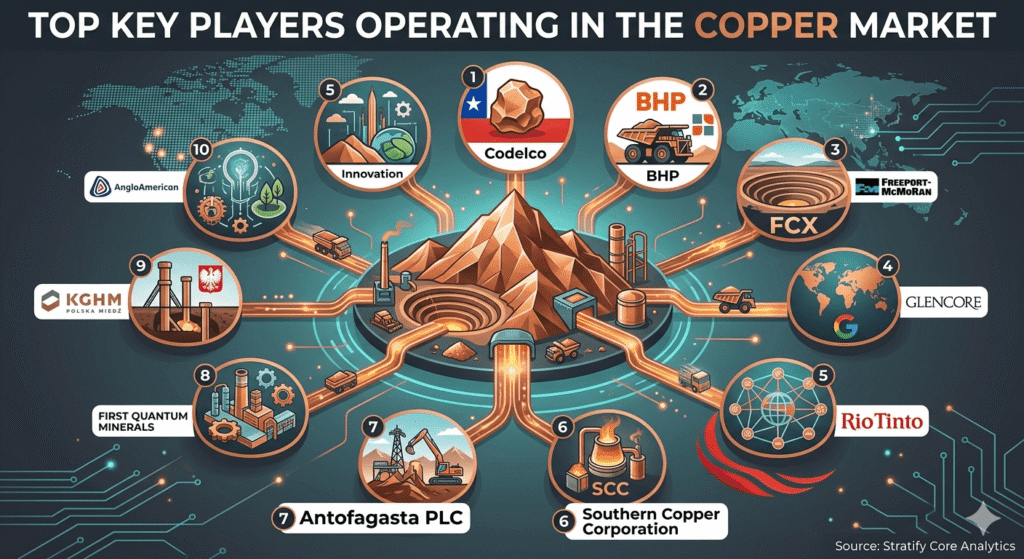
- Codelco
- BHP
- Freeport-McMoRan
- Glencore
- Rio Tinto
- Southern Copper Corporation
- Antofagasta PLC
- First Quantum Minerals
- KGHM Polska Miedź
- Anglo American
Copper Market FAQ
What factors are driving the growth of the copper market?
The copper market is growing due to rising demand from the construction, automotive, electronics, and renewable energy sectors. Increasing adoption of electric vehicles and expansion of power infrastructure are also major growth drivers.
Which region dominates the global copper market?
Asia-Pacific dominates the global copper market, led by strong industrialization and manufacturing activities in countries such as China and India. The region also benefits from growing investments in infrastructure and renewable energy projects.
How is the renewable energy sector impacting copper demand?
Renewable energy systems such as solar panels, wind turbines, and energy storage solutions require significant amounts of copper for wiring and electrical components. This is substantially increasing global copper consumption.
What are the key challenges faced by the copper market?
The copper market faces challenges such as fluctuating raw material prices, environmental concerns related to mining activities, and supply chain disruptions. Regulatory policies and geopolitical tensions can also affect production and trade.
