
Global 3D Printers Market Overview
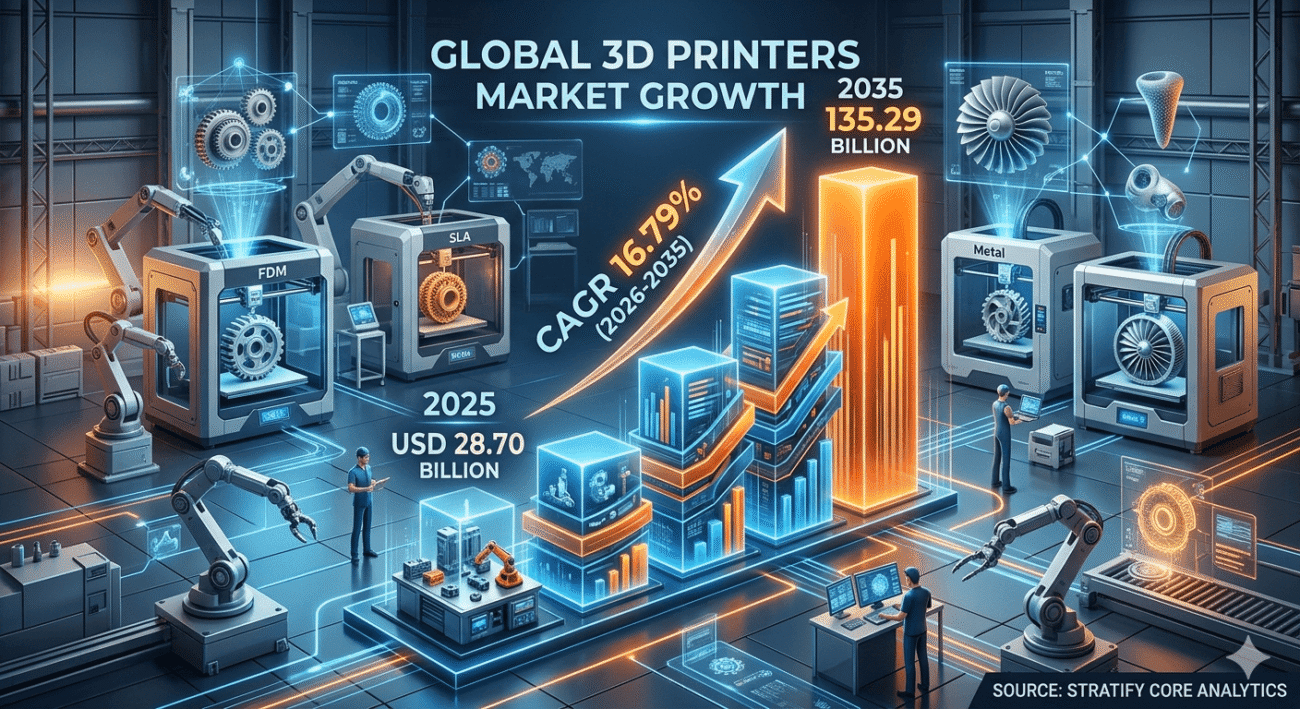
The Global 3D Printers Market size accounted for USD 28.70 Billion in 2025, and is expected to reach around USD 135.29 Billion by 2035, growing at a CAGR of 16.79% from 2026 to 2035.
The growth of 3D printing globally during the past 10 years was phenomenal, driven by the progressive development of additive manufacturing technology and increased usage across various sectors of the economy, along with increasing demand for manufacturing customized objects. 3D printing is also called additive manufacturing, which is an innovative technology that forms complicated 3D-objects layer by layer according to a digital model. This is a game-changer in the traditional manufacturing processes and is transforming numerous industries, including healthcare, aerospace and defense, automobile, construction, and consumer electronics, as well as the education sector.
Another factor driving growth in this market is the growing use of rapid prototyping solutions. The number of manufacturers from different industries that are using 3D printers to speed up the development of products, cut down on materials used, and reduce costs, is growing at a rapid pace. With traditional manufacturing processes, there can be a substantial cost involved for the use of tooling, and manufacturing processes can take up much time compared to the quick design iterations and flexibility offered by 3D printers, especially beneficial for the specific industries that deal with custom-designed or low-volume production.
The healthcare industry has gained more importance as there has been an exponential rise in the application of 3D printing technology. From hospitals to manufacturers of medical devices, they extensively use 3D printers to create surgical instruments, implants, prosthetics, even bio-printed organs and tissues. Through personalization using 3D printing in the healthcare sector, not only has the life of patients become better, but also reduced the manufacturing complexity of medical parts. High growth in patient-specific implants and devices also plays an imperative part.
3D printing has also gained significant adoption in the aerospace and automotive sectors. Manufacturers in the aerospace industry use additive manufacturing for light-weighting of airframe components with complex geometrical structures, thereby improving fuel efficiency. In the automotive industry, additive manufacturing has been utilized to facilitate the production of rapid prototypes, tooling, and spare parts, as well as the end parts of products. The decreasing production cycle time and improving supply chains are driving the importance of 3D printing in modern industrial complexes.
With regards to the competitive landscape of the 3D printers market on a global level, technological innovation is important to take into account. Manufacturers are constantly introducing advanced printers capable of processing an extensive variety of materials like metals, polymers, ceramics, and composites. In addition to that, metal 3D printers, AI-powered designing software, and multi-axis printers are currently shaping the market, thus expanding the scope of applications for additive manufacturing. With market trends showing more demand for space-saving, industrial-grade solutions, a strong interest is displayed by small enterprises, researchers, and educational institutions.
In terms of geography, North America is considered the largest market share for the global 3D printing market, driven by favorable technology infrastructure, increasing R&D expenditure, and the growing rate of industrial use. It’s mainly because the U.S. continues to be a major player in AM innovations, especially in segments like aerospace, healthcare, and defense industries. Europe is also a dominant share due to the government initiatives that drive industry 4.0 and sustainable manufacturing technologies.
The Asia Pacific is anticipated to grow with the highest growth rate over the forecast period. As countries like China, Japan, South Korea, and India in the Asia Pacific are increasingly using modern manufacturing technologies, it aims at increasing industrial output and global competitive strength of manufacturing in that region. China, being the enormous production center of low-cost desktop 3D printing machines, is contributing a larger portion of shipment volumes globally, and increasing usage by SMEs is also anticipated to accelerate this market.
There are opportunities for expansion, although there will be a number of difficulties to face. The start-up cost of the equipment, the scarcity of materials, the complexity of technology, and the lack of standardization in some industries can deter the market’s growth. The question of intellectual property and quality control of the product can also be considered.
The above-mentioned factors, although restrictive at present, can possibly be eliminated through future developments in software integration, materials science, and automation. It is predicted that in the future, with the widespread use of new digital practices by organizations and their shift towards green production, 3D printing technology will emerge as a pivotal part in their future production plans. Growing concern over localized production, mass customisation, and on-demand production will offer countless opportunities for stakeholders around the globe.
The 3D printers market is forecast to grow well in the long-term due to increasing applications in industrial fields, rapid technological advancements, and significant investment in the additive manufacturing infrastructure. With industries recognizing and tapping into the capabilities of such a flexible, affordable, and ecologically responsible manufacturing technique, 3D printing technology will undoubtedly be integral to shaping the future of worldwide manufacturing.
Key 3D Printers Market Trends
Rapid Growth in 3D Printers Market: Technology is evolving at an unprecedented rate within the global 3D printers market due to increasing demand across key end-user industries, including aerospace, automotive, healthcare, construction, and consumer goods. The scope for additive manufacturing has expanded far beyond that of the niche prototyping applications.
Growing uptake of Industrial Grade AM machines. While 3D printers are seeing a growing adoption rate from industrial-grade additive manufacturing, companies are gradually transitioning beyond prototyping for actual product manufacturing. Some of the key industries, which are witnessing rapid growth of high-performance ultra-lightweight parts production and sophisticated printers in the Aviation, Aerospace & defense, and Automotive sectors, are expanding due to benefits like a cleaner supply chain as it moves away from high-volume production towards localized printing, reducing the wastage material and improving flexibility in design.
The increasing use of artificial intelligence is the other significant market trend. AI software improves the automation of printers, predictive maintenance, quality control, print optimization, and printer automation. Newly developed AI-enabled 3D printers can detect printing defects in real time and self-correct errors. Researchers and developers are working to improve machine efficiencies through the utilization of an intelligent manufacturing ecosystem, which combines learning, robotics, and additive manufacturing. The AI in 3D printing market is projected to rise considerably in the years to come.
Sustainability and eco-friendly production also contribute to the transformation of the 3D printer market. The subtractive manufacturing processes use more material as compared to additive manufacturing, where less material is wasted. There is a clear trend among manufacturers to embrace the usage of recyclable and biodegradable plastic polymers and also the production methods that are eco-friendly. On-demand manufacturing significantly helps in limiting the inventory costs and the costs of transportation that are involved, and it fits into global environmental plans very well. So sustainability has become a significant factor and differentiator for companies in the market and will continue to be the growth driver in the years ahead.
A second important development involves the evolution of multi-material and metal 3D printing. Current 3D printers are capable of producing products out of various metals, ceramics, composites, and novel polymers, allowing the manufacturing of very sturdy yet intricate components. Metal AM, in particular, has been experiencing an increased growth in high-value, high-precision, and low-weight industrial segments. Manufacturers of aerospace products use metal 3D printing for complex engine components and airframe structures that are not feasible with traditional manufacturing methods. The speed-up of laser systems and new powder handling technology is accelerating the transition to industrial use.
One area showing the quickest rate of growth in the 3D printing market is healthcare applications. Customized implants and prosthetic devices, medical and dental products, and models to assist in planning for surgery are being used in hospitals, laboratories, and by medical equipment suppliers, with bioprinting technologies also emerging and finding use in areas of regenerative medicine and tissue engineering. Personalised health solutions through additive manufacturing are having a positive effect on patient recovery and also decreasing cost and delivery time.
The other booming trend of large-scale construction 3D printing, which is grabbing the world’s interest. The construction industries are exploring additive manufacturing in order to build low-cost housing, components of structures, and structures that are modular in nature. The efficiency and speed of large-scale 3D printers are increasing, enabling quick construction with labor-saving benefits, low material waste, and thereby gaining major investment from governments and private companies, with the need to tackle housing and modernization issues.
Apart from this, a growing number of relatively inexpensive industrial-grade and desktop 3D printers provides access to the market to independent makers, academic institutions, and small firms. Increasing affordability of the hardware, ease-of-use of software, and wide availability of materials for desktop applications contribute to market entry for the non-industrial users. Small-scale manufacturers and entrepreneurs are now extensively utilizing compact 3D printers for personalized products and prototypes production and low-volume manufacturing. An increasing number of firms are opting for AM desktop systems because of their enhanced flexibility and economy.
Also, another visible market trend seen is the geographical market expansion. North America and Europe hold the largest market shares owing to rapid technology adoption and robust infrastructure, whereas the APAC market is growing exponentially with rapid industrialization, increasing investments, and the initiatives by the government to acquire newer generation of manufacturing technologies, such as promoting the use of AM ecosystem by governments of China, India, Japan, and South Korea.
The 3D printers market is embarking on a new stage, where it has expanded its industrial applications and gained the attention of players across industries for enhanced flexibility, cost optimization, customized products, and the integration of new-generation technologies such as AI. Moreover, AI adoption, new materials, and digital manufacturing integration will have a profound impact on the overall 3D printer market growth prospects.
3D Printers Market Key Restraints
The global 3D printers market has observed significantly rising growth during the last decade on the grounds of mounting need for rapid prototyping, bespoke fabrication, technological breakthroughs in key sectors such as aerospace, automotive, health care, consumer electronics, among others. As more firms make significant capital investments in additive manufacturing, the global 3D printing market is poised to achieve a strong compound annual growth rate through 2033. Even though the market looks bright on its surface and may serve the world a number of benefits it suffers through a plethora of crucial factors which could create barriers towards massive market growth and wide-scale adoption across various sectors, including expensive hardware and printing supplies, technical shortcomings, complex regulations, dearth of skilled workforce, and problems with the supply chain.
High start-up costs for industrial 3D printers are one of the biggest limiting factors for the 3D printers market. The most advanced 3D printers, suitable for sectors such as aerospace, healthcare, and automotive manufacturing, are highly costly and, due to high purchase costs of equipment, cannot be afforded by most SMEs. Apart from the 3D printer purchase cost, the businesses have to expend a substantial amount of money for software, maintenance, post-processing devices, and training courses. High setup costs represent a considerable impediment, especially for the developing world manufacturers, where most manufacturing organizations have very restricted budgets. High initial capital spending is the most discouraging factor for companies seeking to move from conventional manufacturing methods to additive technologies.
A second significant limitation is the high expense of the materials required for 3D printing technologies. The high-tech polymers, metal powders, ceramics, and composites required for industrial usage are significantly more expensive than the traditional materials associated with manufacturing processes. The fluctuations in prices of these materials add an element of uncertainty to operations and costs associated with these technologies, with a finite number of suppliers for many of the performance materials, thus leading to concentration risks in the supply chain and a lack of room to maneuver on price. This leaves businesses struggling to establish an efficient cost base, especially with large-scale manufacturing operations.
Low speed of production and scalability is another major barrier to increasing the market for 3D printers. While the 3D printing technology is highly suited for prototyping and low-volume production of items, it can hardly compete with established processes such as injection molding in the case of mass production of goods. For additive manufacturing processes, large volumes or items with large details can result in prolonged production times. The low manufacturing speed limits the manufacturing efficiency and adoption of the technology for large volumes at industrial production levels. As a result, the traditional production methods still stand for large-scale manufacturing.
Technical limitations of additive manufacturing processes also provide a challenge for market growth. A number of current 3D printing systems are suffering from poor dimensional accuracy, poor surface finish, and variability in material strength. Post-processing techniques such as polishing, machining, and heat treatment may be needed for the component to reach industrial specifications. Material possibilities are still restricted in comparison to conventional manufacturing processes. The limitation of technical difficulties makes 3D printing technology less desirable for high-duty applications and inhibits industrial uptake for mission-critical tasks.
Another significant market restriction is the scarcity of talented and knowledgeable people. Handling the complex, high-level 3-D printing machines necessitates the utilization of know-how in areas like CAD, materials science, additive manufacturing engineering, and machine calibration, none of which are easily available in all areas of the world. This inability to properly utilize a state-of-the-art 3-D printing machine slows down the utilization of these technologies in different regions, leading to decreased efficiency levels when integration in existing production flows is needed. Additional workforces have to be trained at enormous costs for this purpose.
Regulation and Intellectual Property will also be an issue in the 3D printers market. Many sectors such as health, aviation, and defence, need strict quality, safety and certification requirements and for components made on a 3D printer, these can also be time-consuming and expensive, this may cause a delay on market entry for certain industries. Intellectual property is a key issue due to the simple transferring of digital design files; the issue of piracy, counterfeiting, and replication will arise, and these legal issues will put off Manufacturers and technology suppliers.
Regulation and Intellectual Property will also be an issue in the 3D printers market. Many sectors, such as health, aviation, and defence, need strict quality, safety, and certification requirements, and for components made on a 3D printer, these can also be time-consuming and expensive; this may cause a delay on market entry for certain industries. Intellectual property is a key issue due to the simple transferring of digital design files; the issue of piracy, counterfeiting, and replication will arise, and these legal issues will put off Manufacturers and technology suppliers.
Energy consumption and environmental issues also influence 3D printing technology adoption. A number of additive manufacturing techniques demand substantial electricity and result in waste of material during printing and post-processing. It has been noted that some of the plastic materials for printing can also cause environmental pollution if recycled effectively. With government bodies and industry focusing on environment-related objectives, manufacturing industries have the need to adapt their products by using environmentally friendly materials and energy-saving methods; otherwise, their products will be refused in environmentally sensitive regions.
Finally, the global 3D printing market exhibits great potential for growth as technology advances and usage within the industrial sectors rises; nevertheless, there are a few constraints that are yet to be mitigated, which prevent the market from becoming fully developed. High equipment prices, costly raw materials, small scalability, technical hurdles, scarce labor, regulations and compliance requirements, supply chain risks, and sustainability issues are a few constraints impacting the market. In order to unlock the full potential for the 3D printing market in the long run, companies will have to tackle the identified constraints by way of technological advancement, cost reduction methods, workforce training, and strengthening regulatory requirements.
3D Printers Market Key Opportunities
The global 3D printer market is showing impressive growth on account of growing requirements of rapid prototyping, custom manufacturing, and technological developments in numerous sectors. As this sector grows and evolves with new innovations each day, opportunities have opened for organizations in designing new and innovative ways to increase production efficiency, reduce waste of materials, and achieve designs with much higher complexity with more precision. Adoption of 3D printing techniques in sectors like healthcare, automotive, aerospace, education, construction, electronics, etc., is providing considerable opportunities for market growth at the global level.
An area in which there is great potential for the 3D printers market is the medical sector. Doctors, surgeons, dentists, and other medical professionals are more frequently using the technology to manufacture custom prosthetics, dental crowns, surgical instruments, and are even looking into bio-printing. Being able to create more patient-specific medical implants accurately and within a faster time and at a lower cost can result in better treatment for the patient. More potential research in the future may allow tissue printing and organs to become more commonly used in the years to come. The amount that the healthcare sector will continue to spend on developing technologies suggests that demand will continue to grow in this segment.
A great deal of opportunity also exists for market players in the aerospace and defense industries. Aerospace companies are implementing 3D printing in the production of lightweight complex part designs that would not be possible with traditional manufacturing processes. With a reduction in material usage and shorter manufacturing lead times, additive manufacturing leads to increased efficiency and reduced costs in the manufacturing processes. Defense agencies are investigating 3D printing for the application of on-demand manufacturing of spare parts and crucial components required on missions, specifically in isolated locations. This is a major driver of market innovation and will contribute to the accelerated market growth.
Moreover, the automotive industry’s new challenges also give rise to some new possibilities. In this field, 3D printing technology is already employed: manufacturers currently use their 3D printer to create their car prototype, and spare parts for vehicles. With these technologies, they can produce prototypes as well as parts, and prototype testing is realized rapidly, which helps significantly reduce R&D duration.
The increasing popularity of electronic vehicles will encourage the automobile industry to utilize lighter spare parts from 3D printing for the fuel economy performance of its products. The advancement of the additive manufacturing process will keep growing as it provides access to innovative, flexible, and sustainable manufacturing processes.
The education sector, a steadily growing segment, is emerging as a potential market for the 3D printers industry. The usage of 3D printers for making practical applications and the learning of new technological ideas in STEM (Science, Technology, Engineering, and Mathematics) education is being adopted at the school level. Investment in 3D desktop printers, an affordable way to nurture the creative instincts, engineering, and designing talent at various schools, colleges, and technical institutes, the digital learning and the hands-on learning approaches, coupled with the rise of the technical education sector, would create a sustainable business prospect in the coming years.
Increased demand for personalized consumer products is another growth opportunity for the 3D printing market. Now, personalized products, for example, jewelry, footwear, fashion accessories, home furnishings, and electronics items, etc. Are high demand. The customized products can be designed in 3D printers with no costly tooling and in limited quantities, thereby reducing inventory requirements for small entrepreneurs and startup companies to develop distinctive and custom-made products without incurring high production costs. However, as personalization is becoming an integral part of consumers’ expectations, compact and flexible printers will experience a high growth rate.
Industrial manufacturing also has expanding opportunities with the development of integrated additive manufacturing systems. Manufacturers are implementing industrial 3D printers into the manufacturing of tooling, prototypes, and final parts. The advantages of streamlining the manufacturing process and lessening the amount of waste material and supply chain disruption have driven the adoption of 3D printing by manufacturers. The availability of novel manufacturing materials for printing metals, ceramics, composites, and biodegradable plastics has broadened the scope of applications in manufacturing, which will allow for broader adoption.
The construction industry is another area with a huge growth opportunity for the 3D printers market. Construction companies are beginning to investigate large-format 3D printing technologies for the purpose of designing cost-effective and sustainable building structures. 3D printing technology in the construction industry may lead to savings in the labor force, construction waste, and building time. Many governments and private sectors have already initiated investments in smart cities and affordable housing projects, which create huge demand for technology for building new structures, and hence, large-format 3D printers for building applications are anticipated to grow immensely in the global market.
Growth opportunities also lie with emerging economies in the Asia Pacific, Latin America, and the Middle East, driven by industrialization, increasing technology adoption, and government support programs. China, India, and South Korea are investing heavily in technologies in order to improve their production capacity at home, and eventually to compete in the world market. Governments of the regions are promoting the adoption of AM technologies for Industry 4.0 and digital manufacturing.
The overall growth of the 3D printers market is anticipated due to increased adoption of the advantages of additive manufacturing in all industries. Technology evolution, significant investments in research and development, and increasing demand for custom and sustainable manufacturing solutions, all these factors are going to generate abundant opportunities for the players over the predicted period. Players focusing on innovation and research in new materials and forming strategic partnerships will find itself a head of the industry.
3D Printers Market Key Drivers
The growing adoption of sophisticated manufacturing technologies in a variety of industries is fueling a substantial expansion in the 3D printers market worldwide. Higher consumer preference for customized goods and efficient prototyping, as well as inexpensive manufacturing procedures, are driving the growth of this market. Sectors such as healthcare, aerospace, automobile, construction, and consumer electronics have incorporated 3D printing techniques in their production procedures.
Rapid prototyping is one of the primary factors contributing to the rise of the 3D printer market. Companies are emphasizing shortening product development cycles and improving their innovative capacity. Through 3D printing, they can produce precise prototypes in a minimum time, enabling engineers and designers to test the ideas and make amendments before mass production. Hence, this technology not only shortens the production time but also minimizes the use of raw material, making it highly efficient for industries.
Another significant factor driving the market is the healthcare industry. The application of 3D printing is burgeoning across medical fields that include prosthetics, dental implants, surgical tools, tissue engineering, and many more. Custom medical devices printed with the help of 3D printers have better patient results and enhanced accuracy. In addition to this, hospitals and research facilities are investing in bioprinting technology, which is further spurring the demand for 3D printing.
The growth is being accelerated with the technological advancement of additive manufacturing, by continuously evolving developments in printing material, software, and the capabilities of 3D printers, the printing processes become more precise and efficient. Companies are introducing 3D printers that deliver faster and more accurate complex models, and the addition of multi-material and metal 3D printing has widened up the application possibilities in different sectors.
Other rapidly expanding markets include the automotive industry and the aircraft and aerospace industry. The higher utilization of 3D printing technology within these industries has boosted the growth of 3D printing. 3D printing technology provides strong, light components, vehicles, and aircraft that consume less fuel, and the performance of the equipment is enhanced. For the particular sector above, 3D printing technology benefits in designing complicated parts and designing a light part when manufacturing, and an ‘on-demand’ production.
Another factor driving up demand for 3D printers is the increased trend toward mass customization. As consumers are beginning to demand products that match their needs, customized shoes, jewelry, apparel, and homeware have become highly prevalent within the mass customization industry. Businesses can accommodate individual needs and manufacture products that are tailored to consumer desires at little additional manufacturing cost, primarily within the retail and consumer goods industries.
Academic institutions and research organizations are adopting 3D printing technologies in their academic studies and experimentation. Universities and technical schools are including additive manufacturing courses within their engineering and design curriculum to give students hands-on experience with new manufacturing technologies. Besides academic use, government programs to promote technological innovations and digital manufacturing also stimulate investment in the 3D printing environment.
In addition to other trends like the smart manufacturing process and Industry 4.0, the 3D printers market has now got new opportunities in the shape of smart manufacturing processes and automation. Firms are utilizing the integration of cloud computing, artificial intelligence, and automation with the manufacturing process of additive manufacturing. 3D printing is ideal for decentralized production and the demand for on-demand manufacturing.
Environmental benefits of 3D printing, along with market sustainability concerns, are helping to increase the size of this market. Traditional manufacturing produces considerable amounts of waste material, while additive manufacturing uses only that which is needed. Waste reductions can assist companies in maintaining their environmentally sustainable objectives while also complying with environmental regulations. Further, local manufacturing allowed through the use of 3D printers requires less travel and thereby leads to fewer carbon emissions.
Cheaper desktop 3D printers becoming readily available is broadening their customer base of small businesses, startups, and the general consumer. Cheaper hardware combined with simplified software has never made 3D printing so accessible to people of all abilities. This technology is being adopted by hobbyists, designers, and entrepreneurs for product design, creative ideas, and to produce small production runs.
Increased investment from governments and organizations is another factor contributing to market development. Numerous countries are also encouraging additive manufacturing via subsidies, grants, and joint projects that are focused on building manufacturing strength and driving technology progress in 3D printing.
However, even with the challenges of high initial investment costs and limits on materials, the market outlook remains very optimistic. The continuously pursued research and development will further bridge the technology gap and the high price of advanced 3D printing machines. The increasing demand for industrial processes such as efficiency, customization, and innovation, makes it apparent that the global 3D printers market will grow considerably in the coming days.
3D Printers Market Segment Insights
The worldwide 3D printer market has witnessed rapid growth in the past decade, due to its rapidly progressing technology, and expanding range of industrial uses and demand for fast prototyping and customized manufacturing. Growing adoption in sectors like healthcare, automotive, aerospace, construction, education, and consumer goods has accelerated the market. It is the fundamental part of modern manufacturing industries with their move to digital and economic production methods.
The 3D printers market is divided into segments based on technology, component, type of printer, application, end-user industry, and region. Each of these segments holds immense potential to influence the market and its growth opportunities, while the increasing adoption of artificial intelligence, cloud computing, and automation in additive manufacturing processes will continue to fuel the growth of the market worldwide.
By Technology
In this case, technology markets: Stereolithography (SLA), Fused Deposition Modeling (FDM), Selective Laser Sintering (SLS), Digital Light Processing (DLP), etc. Of all these technology markets, FDM is the predominant technology in low-cost, user-friendly to educators, hobbies, and small businesses, widely adopted in prototyping and parts (as thermoplastics).
The stereolithography (SLA) technology is also picking up momentum because of the smooth-surface finishes of its produced models, which are characterized by relatively fine and accurate objects, such as surgical models, dental molds and alignments, and prosthetics. And SLA technology in the form of selective laser sintering( SLS) technology is also highly adopted within the automobile sector as well as in industries such as aerospace, in order to come up with stronger, lighter, and tougher parts.
By Component
The component segment consists of hardware, software, and services. Hardware dominates a significant portion of the additive manufacturing market. The hardware segment’s rapid growth is primarily driven by the increasing adoption and sales of desktop and industrial 3D printers in regions worldwide. Printers, scanners, and printing materials are among the widely utilized hardware components. Furthermore, improvements in printer speed, productivity, and material compatibility are driving hardware market demand.
The software market is growing at a high pace, as various organizations are embracing solutions for design optimization and workflow management. Various sophisticated software allow users to construct intricate 3D models, predict the performance of products, and simplify operations. In addition to this, the services segment, which encompasses consulting, maintenance, and training services, is expected to grow consistently, as organizations will need technical expertise to implement additive manufacturing in the process.
By Printer Type
Industrial vs Desktop 3D Printing The market can be divided into industrial 3D printing technology and desktop 3D printing technology. The Industrial 3D printing market size is extensive, given its widespread application in the aerospace, automotive, health care, and defense Industries. Moreover, the technology is precisely engineered for large-scale production and advanced applications and offers the advantage of utilizing an advanced range of metals, composites, and even materials. Desktop 3D printing technology plays an important role and is used by educational institutes, small companies, designers, and people, as it is comparatively inexpensive.
Tiny desktop printers available in affordable ranges will foster more innovation and creativity by startups, and also the research and development activities in the industry by various individuals and companies will enhance the capability of such desktop printers.
By Application
By Application the market for 3D printers is divided into prototyping, tooling and manufacturing of functional parts. Prototyping is the dominant segment as the need to shorten the product development time and decrease the manufacturing cost makes almost all industries rely on the 3D printing technology to build the prototypes quickly, so that the design can be modified before large-scale manufacturing.
The manufacturing of functional parts is a very attractive segment as customers are now looking for custom-designed lightweight parts. Additive manufacturing is becoming a very useful technique for the aerospace and health care industries to create parts with better performance characteristics and complex structures. Tooling is also gaining traction as the mold, jigs, and fixtures are being manufactured using 3D printing for quick turnaround.
By End-User Industry
The healthcare sector is one of the fastest-growing end-user segments in the 3D printers market. Hospitals, research institutions, and medical device manufacturers are using 3D printing for developing implants, prosthetics, surgical tools, and anatomical models. Personalized healthcare solutions and advancements in bioprinting technologies are expected to drive further growth in this segment.
The aerospace and automotive industries are also major contributors to market expansion. These industries utilize 3D printing for producing lightweight components, reducing material waste, and improving fuel efficiency. Moreover, the education sector is increasingly adopting 3D printers to enhance practical learning experiences and promote innovation among students. Consumer goods manufacturers are leveraging additive manufacturing to offer customized products and improve design flexibility.
Regional Insights
North America is estimated to hold the largest share in the global 3D printers market owing to a large number of top technology firms, a robust research environment, and the high growth of adoption of advanced manufacturing technology. The presence of prominent key players and the growth of aerospace, automotive, and healthcare application industries in the US are significantly contributing to the growth of the North American region.
With increasing investment in industrial automation and the government pushing for digital manufacturing, Europe is projected to hold a considerable market share. While the Asia-Pacific region is expected to record the fastest growth in the projected period, this growth is expected to be driven by fast industrialization and the growth in the manufacturing sector in countries such as China, Japan, and India, as well as awareness regarding additive manufacturing in the region.
All in all, the world 3D printer market is expected to be in a growth stage as industries continue to adopt innovative manufacturing technology. Continued demand in customization, speeding production, and eco-friendly manufacturing will shape the market.
3D Printers Market, Regional Analysis
3D printing is a market of global expansion. Industries including medical, aerospace, automotive, education, and consumer products have adopted additive manufacturing. Market demands of 3D printing are divergent in different regions according to levels of industrialization, government support, technological development, and industrial capability. Presently, North America owns the largest market share, while Asia-Pacific is predicted to be the fastest-growing market in different regions. Europe owns a significant market share, relying on a high industrial application level and investment in technologies.
The dominant share is being held by North America in the global market for 3D printers, driven by a strong, established manufacturing sector and the early adoption of the additive manufacturing processes. The US is the largest contributor to the market within this region due to investments made in aviation, defense, health care, and automotive sectors. A significant amount of R&D investments are continuously made by major key players for improving the printing speed, material printability, and production speed. As per the market reports, North America holds more than 32% market share of the 3D printing industry in the year 2025. The extensive utilization of industrial printers for rapid prototyping and for bespoke manufacturing processes enhances the growth of the market in the entire region.
North America has seen a steady rise in the application of 3D printing solutions to custom implants, dental applications, prosthetics, and surgical instruments in the healthcare industry, among others. Other industries, such as aerospace companies, have taken the lead in utilizing additive manufacturing for efficient component manufacturing and reduced production costs. Favorable market conditions for further growth are being facilitated by a strong technological ecosystem composed of equipment, software, and material suppliers. The governments in the region, through industry initiatives on advanced manufacturing and Industry 4.0 implementation, are providing substantial support for growth.
3D printers are also an integral part of the European region, with Europe being an ideal market where manufacturing sectors have a solid base to support 3D printer technology and a growing demand in new techniques of precise and efficient manufacturing. Leading markets of Europe for 3D printers include, apart from others, Germany, the United Kingdom, France, and Italy, although all the aforementioned markets represent early adopters of industrial additive manufacturing solutions. Considering it’s an established market in manufacturing with an emphasis on the automotive and engineering industry, Germany leads in it as well.
Manufacturers in this region are all taking the challenge and exploring a new approach to additive manufacturing in an effort to cut production costs, minimize material scrap, and establish a more sustainable manufacturing process. Collaboration projects between educational institutions, technology providers, and manufacturers have experienced a rapid increase in funding and engagement all over Europe.
3D printing applications are finding themselves increasingly used in the large-scale production process across the European automotive and aerospace industries. Governments within Europe have also been promoting digitally driven manufacturing processes and the smart factory concept. This has, in part, been motivated by an increasing trend in Europe towards the development of energy-efficient manufacturing and eco-friendly manufacturing processes, and will continue to drive the growth of AM applications in Europe. Beyond this, the ongoing rise of applications in dental printing, biomedical engineering, and personalized consumer products is all set to contribute to the overall growth of the European market in the long term.
Over the forecast period, the Asia Pacific is expected to account for the fastest growth in the global 3D printers market. Countries with economic growth rates such as China, South Korea, Japan, and India are heavily investing in developing their 3D printers’ capacities by implementing the adoption of technologies related to industrial automation and digital manufacturing. China, with government stimulus, an increase in industrial output, and growth in Chinese manufacturers of 3D printers, captured a significant share of the market of 3D printers in the Asia Pacific region. The country has also become one of the largest producers of 3D printers in the world, with both desktop and industrial models that are relatively cheap to afford.
Japan and South Korea also continue to contribute to the market development in the region through innovations in robotics, electronics, and precision engineering. The increasing awareness of advanced manufacturing technologies and growing venture activities have been fuelling the market growth in India. Educational and research organizations in the Asia Pacific have been using 3D printing for product development and engineering, and there is a booming development in the healthcare sector; the demand for customized medical devices has been creating new opportunities.
The increasing prevalence of digital technology and industrial sector growth in Latin America is a growth factor for the use of 3D printers. Primarily influenced by Brazil and Mexico, demand has grown in various industries like the automotive industry, for their quick prototyping applications, and in the health sector, for their patient-specific implants and cost-effective prototyping and manufacturing capabilities. Albeit small in size compared to North America and Europe, the market will surely grow with a recovering economy and digitalization of trends throughout the region.
Steady growth of the 3D printers market is also occurring in the Middle East and Africa region. The countries like the United Arab Emirates and Saudi Arabia governments are encouraging smart manufacturing initiatives and construction technology, an increasing number of applications of 3D printers are being seen in architecture, infrastructure development, and the health sector across the region. Educational institutions are also including additive manufacturing technology in engineering and technology programs to inspire innovation and talent creation.
The regional market landscape in the global 3D printers market will be primarily driven by growth in the level of technological development, adoption of technologies in various industries, and the provision of incentives by governments and increased investment in R & D. Though the largest market revenue share will be captured by North America, the APAC region is estimated to grow at the highest growth rate in the next few years. Europe will continue to be the hot spot for innovations, while Latin America and the Middle East economies will open new vistas for the market players. An increase in the demand for custom-manufactured products, green manufacturing processes, and advanced prototype solutions will boost the demand across all regions of the global 3D printers market.
Top Key Players Operating in the 3D Printers Market
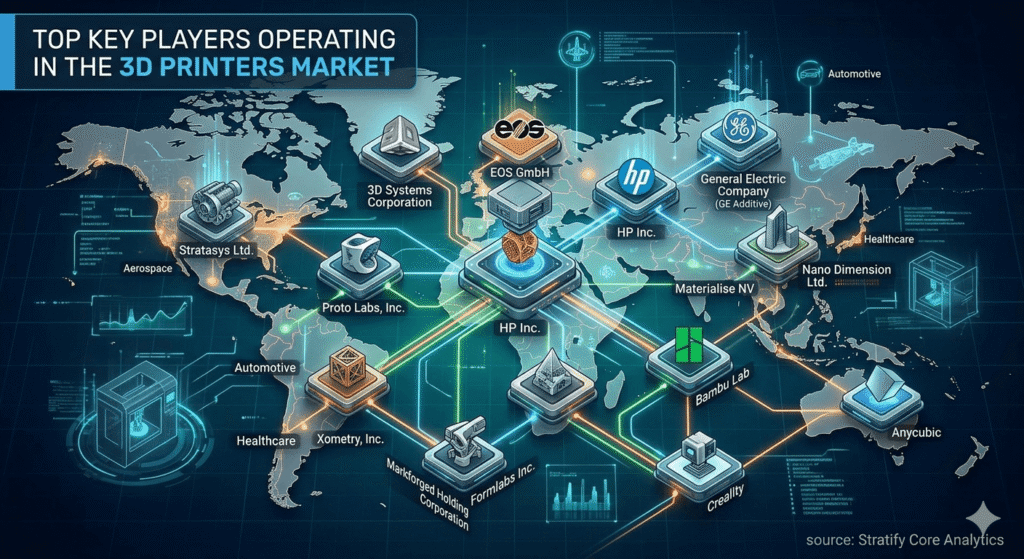
- Stratasys Ltd.
- 3D Systems Corporation
- EOS GmbH
- HP Inc.
- General Electric Company (GE Additive)
- Materialise NV
- Proto Labs, Inc.
- Xometry, Inc.
- Markforged Holding Corporation
- Formlabs Inc.
- Nano Dimension Ltd.
- Velo3D, Inc.
- Bambu Lab
- Creality
- Anycubic
Frequently Asked Questions
1. What is driving the growth of the 3D printers market?
The growth of the 3D printers market is driven by increasing adoption across industries such as healthcare, automotive, aerospace, and manufacturing. Rising demand for rapid prototyping, customized production, and cost-effective manufacturing solutions is also contributing significantly to market expansion.
2. Which industries are the major users of 3D printers?
Major industries using 3D printers include healthcare, automotive, aerospace & defense, education, construction, and consumer goods. These sectors utilize 3D printing technology for prototyping, product development, tooling, and customized manufacturing applications.
3. What are the different types of 3D printing technologies available?
Common 3D printing technologies include Fused Deposition Modeling (FDM), Stereolithography (SLA), Selective Laser Sintering (SLS), Direct Metal Laser Sintering (DMLS), and PolyJet printing. Each technology offers unique advantages depending on material compatibility, precision, and production requirements.
4. What are the future trends in the 3D printers market?
Future trends in the 3D printers market include advancements in metal 3D printing, increased use of artificial intelligence in printing processes, sustainable printing materials, and wider adoption of industrial-scale additive manufacturing. The market is also expected to benefit from growing investments in smart manufacturing and Industry 4.0 technologies.
